

CV writing for students represents one of the most challenging yet crucial steps in launching a professional career. Unlike experienced professionals with extensive work histories, students must strategically present their education, part-time roles, volunteering, and transferable skills in a format that captures employer attention. The good news? With the right approach, students can create compelling CVs that open doors to internships, graduate schemes, and entry-level positions across the UK job market. This comprehensive guide explores exactly how to transform academic achievements and limited experience into a document that demonstrates genuine value to potential employers.
Understanding the Student CV Challenge
Students face unique obstacles when approaching CV writing for students. Most lack the traditional employment history that fills experienced candidates’ documents, yet employers still expect a professional, well-structured presentation.
The key lies in reframing your perspective. Employers recruiting students and recent graduates understand you won’t have decades of corporate experience. They’re looking for potential, transferable skills, academic achievement, and evidence of drive and reliability.
Employers reviewing student CVs typically assess academic performance, transferable skills, part-time work experience, volunteering, society involvement and evidence of motivation. They understand students have limited professional experience and are often more interested in potential, attitude and capability than extensive employment histories.
Understanding these priorities transforms how you approach every section of your CV. Rather than apologising for limited experience, you’ll confidently showcase the experiences you do have in ways that resonate with recruiters.
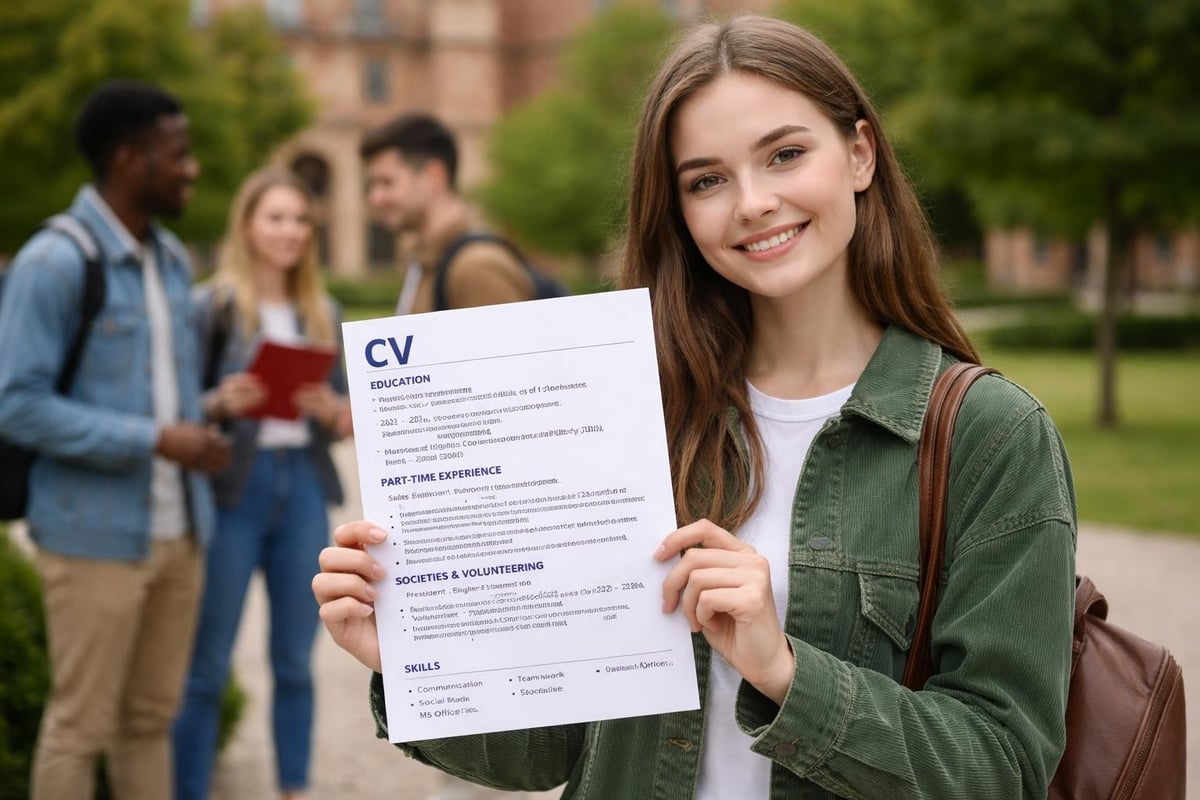
Essential Sections Every Student CV Must Include
CV writing for students requires a specific structure that emphasises your strongest assets whilst maintaining professional standards. Each section serves a strategic purpose.
Personal Details and Contact Information
Begin with your full name, phone number, email address, and location (city and county suffice). Ensure your email address sounds professional. If you’re still using “partylover99@email.com” from secondary school, create a new address using your name.
Never include your full address, date of birth, photograph, or marital status. These details are unnecessary and consume valuable space better used for relevant information.
Personal Statement
Your personal statement appears directly below your contact details and provides 3-4 sentences summarising who you are, what you’re studying, and your career objectives. This section is your elevator pitch.
For comprehensive guidance on crafting this crucial opening, explore how to write a CV personal statement that captures attention immediately.
Education Section
Follow with A-levels, including subjects and grades. GCSEs can be summarised as “9 GCSEs including English (Grade 8) and Mathematics (Grade 7)” unless you achieved exceptional results worth highlighting individually.
Work Experience
Even limited work experience matters. Part-time retail, hospitality, tutoring, or administrative roles all demonstrate valuable skills.
Each work experience entry should include the job title, employer, dates of employment and a concise summary of responsibilities and achievements. Focus on measurable outcomes and transferable skills that demonstrate value to future employers.
Focus on transferable skills. Working in retail demonstrates customer service, cash handling, problem-solving, and teamwork. Tutoring shows communication, patience, planning, and subject expertise.
Use action verbs and quantify achievements where possible: “Served an average of 50+ customers per shift whilst maintaining 95% positive feedback scores” sounds considerably more impressive than “Worked in customer service.”
Skills and Achievements That Strengthen Student CVs
Beyond formal employment, CV writing for students involves showcasing a broader range of experiences that demonstrate capability and character.
Volunteering and Society Involvement
University societies, volunteering roles, and community involvement provide excellent material. Perhaps you served as treasurer for the Economics Society, managed social media for a charity, or organised events for the Student Union.
These experiences demonstrate leadership, organisation, communication, and initiative. Present them with the same professionalism as paid employment:
Students’ Union Charities Committee
As Volunteer Coordinator for a Students’ Union charity initiative, you might coordinate fundraising events, manage volunteers and work with local businesses to secure sponsorship and support. These activities demonstrate leadership, organisation and communication skills that employers value.
Technical and Soft Skills
Create a dedicated skills section highlighting both technical competencies and interpersonal abilities relevant to your target roles.
Technical skills might include:
Technical skills may include software proficiency, data analysis tools, foreign languages and industry-specific platforms relevant to your chosen career path. Focus on skills you can genuinely demonstrate and discuss confidently in interviews.
Effective formatting improves readability and professionalism. Use a clear font, maintain consistent spacing and headings, include sufficient white space and ensure the document remains easy to scan quickly. Good formatting supports the content rather than distracting from it.

Tailoring Your CV for Different Applications
Generic CVs rarely succeed. CV writing for students becomes significantly more effective when you customise each application to match specific role requirements.
Analysing Job Descriptions
Before submitting any application, carefully analyse the job description and person specification. Highlight key requirements, preferred skills, and valued experiences. Then review your CV asking: “Does this clearly demonstrate I meet these criteria?”
If the role emphasises teamwork and communication, ensure your CV showcases group projects, society involvement, or customer-facing roles. If technical skills dominate the requirements, prioritise relevant coursework, software proficiency, and any related projects.
ATS Optimisation Matters
Approximately 75% of CVs never reach human eyes, filtered out by Applicant Tracking Systems (ATS) before recruiters review them. These systems scan for keywords, relevant terms, and proper formatting.
To improve ATS performance, use clear section headings, incorporate relevant keywords naturally throughout the document, avoid complex formatting such as tables and text boxes, use standard fonts and save the file in the format requested by the employer.
Creating Role-Specific Versions
Maintain a master CV containing all your experiences, then create tailored versions for different application types. Your CV for marketing roles should emphasise creativity, social media experience, and communication skills. The same CV adapted for data analysis positions would highlight quantitative modules, Excel proficiency, and analytical projects.
This doesn’t mean fabricating experiences, but rather strategically ordering and emphasising the most relevant elements for each opportunity.
Common Mistakes Students Make (And How to Avoid Them)
CV writing for students involves navigating several common pitfalls that can undermine otherwise strong applications.
Length and Formatting Errors
Student CVs should never exceed two pages, and one page often suffices for undergraduates. Recruiters spend approximately 7 seconds on initial CV scans. Dense paragraphs, tiny fonts, or excessive length guarantee rejection.
Underselling Achievements
Many students list responsibilities without highlighting achievements. “Responsible for social media” tells recruiters nothing about your impact. “Grew Instagram following by 200% over six months through targeted content strategy and engagement campaigns” demonstrates measurable success.
Transform every responsibility into an achievement by asking: “What did I accomplish? What improved because of my involvement? What quantifiable results did I achieve?”
Including Irrelevant Information
Your CV isn’t an autobiography. Hobbies like “socialising with friends” or “watching Netflix” add no value. Either exclude hobbies entirely or list only those demonstrating relevant skills (marathon running shows dedication, chess indicates strategic thinking, blogging demonstrates writing ability).
Similarly, avoid clichéd phrases like “hard-working team player with excellent communication skills.” These mean nothing without evidence. Instead, demonstrate these qualities through specific examples in your experience descriptions.
Professional Support for Student CV Development
Whilst this guide provides comprehensive direction for CV writing for students, many find personalised professional support invaluable. Professional CV writers help students transform raw experiences into polished, compelling narratives that consistently secure interviews.
Working with experienced professionals offers several advantages. They understand current recruitment trends, know exactly what employers seek in graduate candidates, and can objectively assess your experiences to identify the most compelling elements. They also ensure your CV navigates ATS systems successfully whilst maintaining human appeal.
When selecting CV writing support, look for practitioners with proven expertise in student and graduate recruitment. Review testimonials from previous clients, verify their understanding of your target industry, and ensure they offer consultative, bespoke service rather than template-based approaches.

Student CV Writing for Military Families and Service Leavers
Students from military families and younger service leavers often possess transferable skills that are highly attractive to employers, including adaptability, resilience, teamwork and leadership. These experiences should be positioned carefully within a student CV to demonstrate maturity and capability beyond academic achievement alone.
For service leavers entering higher education or civilian employment, translating military experience into language that recruiters immediately understand can significantly strengthen applications.
Student CV Support for Police Career Pathways
Students pursuing policing careers or criminal justice-related roles often need to demonstrate communication skills, integrity, decision-making ability and community engagement. A well-written student CV can help present these qualities clearly whilst highlighting relevant education, volunteering and work experience.
This is particularly valuable for students applying for policing pathways, public sector opportunities or graduate programmes linked to law enforcement and community services.
Integrating Cover Letters and Application Documents
CV writing for students extends beyond the CV itself. Most applications require supporting documents that work together to present a cohesive professional image.
The Essential Cover Letter
Never submit a CV without a tailored cover letter unless explicitly told not to. Cover letters provide crucial context that CVs cannot, explaining your motivation, demonstrating research into the organisation, and connecting your experiences directly to role requirements.
A strong student cover letter should begin by introducing the role being applied for and explaining your interest. The main body should connect your experience and skills to the employer’s requirements, whilst the closing section should reinforce enthusiasm and invite further discussion through an interview.
Personalise every cover letter. Generic letters are immediately obvious and suggest lack of genuine interest. Research the company, reference specific projects or values, and explain precisely why you want this particular role at this specific organisation.
LinkedIn Profiles for Students
Increasingly, recruiters review LinkedIn profiles alongside traditional applications. Ensure your profile complements your CV with a professional photograph, compelling headline, and detailed experience descriptions.
Your LinkedIn profile can include additional context unavailable in your two-page CV, such as detailed project descriptions, recommendations from lecturers or employers, and relevant coursework examples. For comprehensive guidance, explore resources from professional CV writers who specialise in student applications.
Practical Tips From Recruitment Professionals
Drawing from decades of recruitment experience, these practical insights help students create CVs that genuinely open doors.
Quantify Everything Possible
Numbers catch attention and provide concrete evidence of impact. Rather than “Helped increase sales,” write “Contributed to 15% sales increase over the summer period through proactive customer engagement and product knowledge.”
Even without access to specific figures, estimate reasonably: “Tutored approximately 20 students over two academic years” or “Managed events attended by 50-100 participants.”
Proofread Obsessively
Spelling mistakes, grammatical errors, and typos instantly disqualify candidates. After writing your CV, leave it for 24 hours, then proofread with fresh eyes. Read it backwards sentence by sentence to catch errors your brain auto-corrects when reading normally.
Continuous Development and Updates
CV writing for students isn’t a one-time task. Your CV should evolve continuously throughout your academic career and beyond.
Regular Review Cycles
Review and update your CV every three months, even when not actively job searching. Add new modules, update your expected degree classification, include recent volunteering experiences, and refine descriptions based on your developing understanding of your strengths.
This regular maintenance means your CV stays current and you’re always prepared when unexpected opportunities arise. It’s considerably easier to make small, regular updates than to overhaul a two-year-old document when a perfect opportunity suddenly appears.
Building Your Experience Portfolio
Strategically seek experiences that strengthen your CV. If you notice most graduate schemes in your target sector value international experience, investigate study abroad opportunities or summer programmes overseas. If leadership appears consistently in job descriptions, pursue committee positions in university societies.
This proactive approach to experience-building differentiates successful candidates from those who passively wait for opportunities.
Seeking Feedback and Iteration
The most effective CV writing for students involves continuous feedback and refinement. Utilise your university’s careers service, attend CV workshops, and request honest feedback from anyone reviewing your applications.
When you receive interview invitations, your CV has succeeded. When applications consistently receive rejections, something needs to change. Analyse patterns, seek professional input, and be willing to make substantial revisions.
Frequently Asked Questions
How long should a student’s CV be?
Student CVs should typically be one to two pages maximum. First and second-year undergraduates often fit everything relevant onto one page, whilst final-year students and recent graduates may require two pages to adequately present their experiences. Never exceed two pages, regardless of your background. Quality and relevance matter far more than quantity.
Should I include a photograph on my UK student CV?
No. UK recruitment standards discourage photographs on CVs to prevent unconscious bias and ensure fair assessment based on qualifications and experience rather than appearance. Including a photograph actually reduces your chances of success with many employers and wastes valuable space better used for relevant content.
What if I have no work experience at all?
Focus on academic projects, university society involvement, volunteering, and transferable skills developed through your studies. Significant coursework, dissertations, group projects, and presentations all demonstrate valuable capabilities. Many students underestimate how much relevant experience they’ve gained through academic and extracurricular activities.
How do I explain gaps in my CV?
Brief gaps are normal and rarely require explanation, especially for students whose timelines naturally include academic holidays and transitions between study levels. If you have extended gaps (more than six months), briefly explain them positively: “Career break to travel Southeast Asia, developing cultural awareness and independence” or “Cared for family member whilst completing online professional development courses.”
Should I create different CVs for different types of roles?
Absolutely. CV writing for students becomes significantly more effective when you tailor content for specific applications. Create versions emphasising different skills, experiences, and achievements depending on whether you’re applying for creative roles, technical positions, customer-facing opportunities, or analytical careers. This doesn’t mean fabricating information, but rather strategically highlighting the most relevant elements for each application type.
## Ready to Strengthen Your Student CV?
Creating an effective student CV is about more than listing qualifications. It requires presenting your education, achievements, skills and experiences in a way that demonstrates genuine value to employers.
I work with students and graduates across the UK through detailed one-to-one consultation, helping them create bespoke CVs that improve interview opportunities and strengthen career prospects.
Learn more about my Professional CV Writing Service, read my client testimonials and discover how a professionally written CV can help you stand out in a competitive graduate job market.