

Your CV is more than a document listing your work history. It’s a marketing tool that positions you as the ideal candidate for your target role. One of the most critical elements that determines whether your CV lands you an interview is the skills section. Understanding which skills for your CV to prioritise, how to present them effectively, and how to align them with employer expectations can transform your job search. In 2026’s competitive job market, where Applicant Tracking Systems (ATS) filter thousands of applications daily, strategic skills selection has never been more important. This comprehensive guide will help you identify, categorise, and present the skills for your CV that genuinely open doors.
Understanding the Skills Landscape
The employment landscape has shifted dramatically over the past few years. Employers now seek candidates who demonstrate both technical proficiency and human-centred abilities that AI cannot replicate. When considering skills for your CV, you must recognise this dual requirement.
Employers increasingly look for a combination of technical expertise and strong interpersonal capability. Hard skills demonstrate professional competence, whilst soft skills show how effectively you work with colleagues, stakeholders and customers in a changing business environment.
The Three Pillars of CV Skills
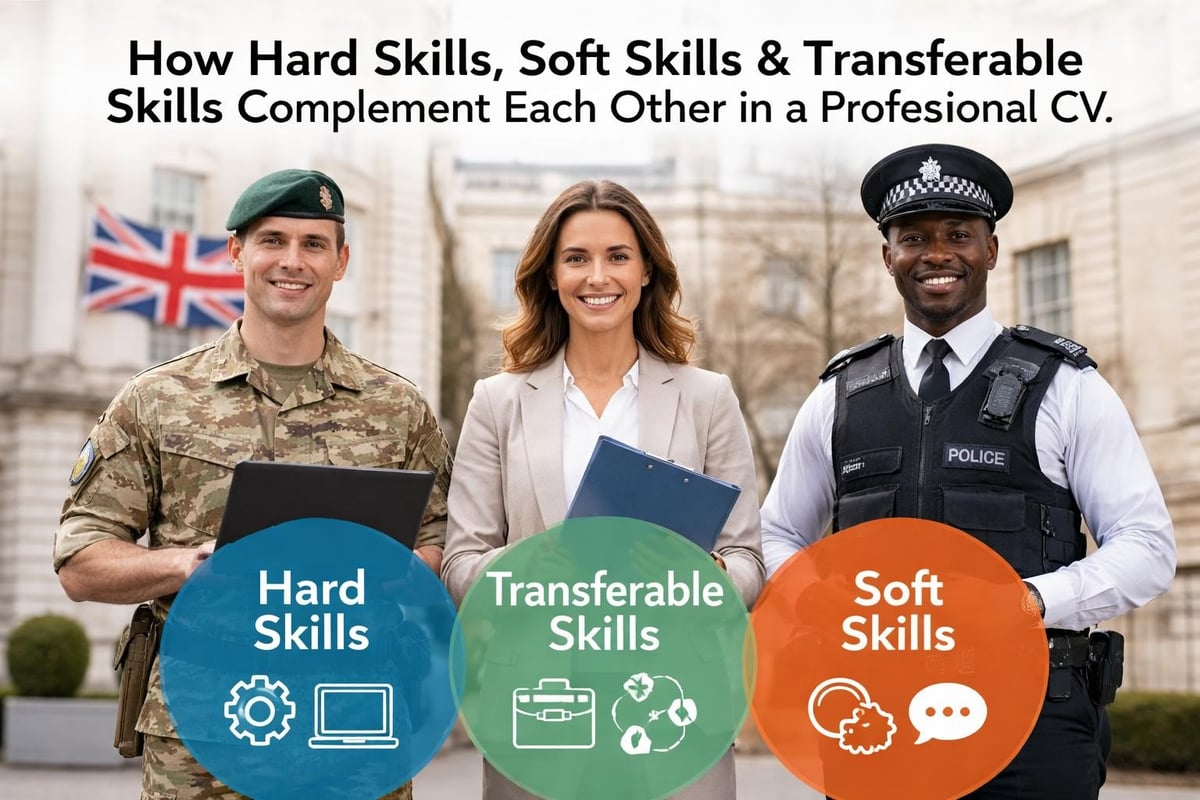
Effective CV skills typically fall into three categories. Hard skills demonstrate technical capability and specialist knowledge, soft skills highlight how you interact with others and operate within organisations, whilst transferable skills show how your experience can be applied across different industries, functions and career paths.
This framework helps you build a comprehensive skills profile that appeals to diverse employers. Each category serves a distinct purpose in demonstrating your value proposition.
Hard Skills That Employers Actively Seek
Hard skills remain the foundation of most technical and professional roles. These are the abilities you’ve acquired through formal education, training programmes, certifications, or hands-on experience. When listing hard skills for your CV, specificity matters enormously.
Hard skills should be supported by evidence wherever possible. Professional qualifications, certifications, project outcomes, software proficiency and measurable achievements provide credibility and help employers assess your level of expertise. The stronger the evidence, the more persuasive the skill becomes.
Industry-Specific Technical Competencies
Different sectors require distinct technical proficiencies. Manufacturing roles might emphasise lean management and quality assurance, whilst creative positions highlight software like Adobe Creative Suite or Final Cut Pro.
The key to selecting the right hard skills for your CV lies in thorough job description analysis. Extract the specific technical requirements mentioned in target roles and ensure your CV mirrors this language. This approach not only helps with ATS compatibility but also signals immediate relevance to hiring managers.
When working with clients at John Logan Consulting and Mentoring, I often find they undervalue their technical abilities or fail to articulate them in terms employers understand. A consultative approach to CV writing uncovers these hidden competencies and presents them with appropriate context.
Soft Skills: The Human Advantage
Whilst technical abilities get you through the door, soft skills often determine long-term career success. These interpersonal and cognitive capabilities have become increasingly valuable as automation handles routine tasks.
Employers continue to place significant value on adaptability, communication, problem-solving, leadership, emotional intelligence, time management, collaboration and critical thinking. These skills help organisations navigate change, improve performance and build effective teams.
The challenge with soft skills lies in substantiation. Anyone can claim to be a “strong communicator” or “natural leader.” The difference between a mediocre CV and an exceptional one is evidence. Rather than simply listing these skills for your CV, you must weave them into achievement statements with measurable outcomes.
For example, instead of stating “excellent teamwork skills,” demonstrate it: “Led cross-functional team of eight specialists to deliver £2.3M infrastructure project three weeks ahead of schedule, improving interdepartmental collaboration protocols adopted company-wide.”
Strategic Placement: Where Skills Belong on Your CV
The positioning of skills for your CV significantly impacts readability and ATS performance. Modern CVs typically incorporate skills in multiple strategic locations rather than relegating them to a single section.
Optimal Skills Integration Points
Professional summary: Weave your top three to five skills into your opening paragraph, establishing immediate relevance. This section should capture your unique value proposition whilst naturally incorporating keywords from target job descriptions.
Skills section: Create a dedicated area listing 8-15 relevant competencies, organised logically by category or relevance. This section serves both human readers and ATS algorithms, making it essential for initial screening success.
Experience descriptions: Embed skills within achievement statements throughout your employment history. This contextualises your abilities and proves application in real-world scenarios.
Qualifications and training: Link certifications directly to relevant technical skills, reinforcing credibility and providing verification pathways.
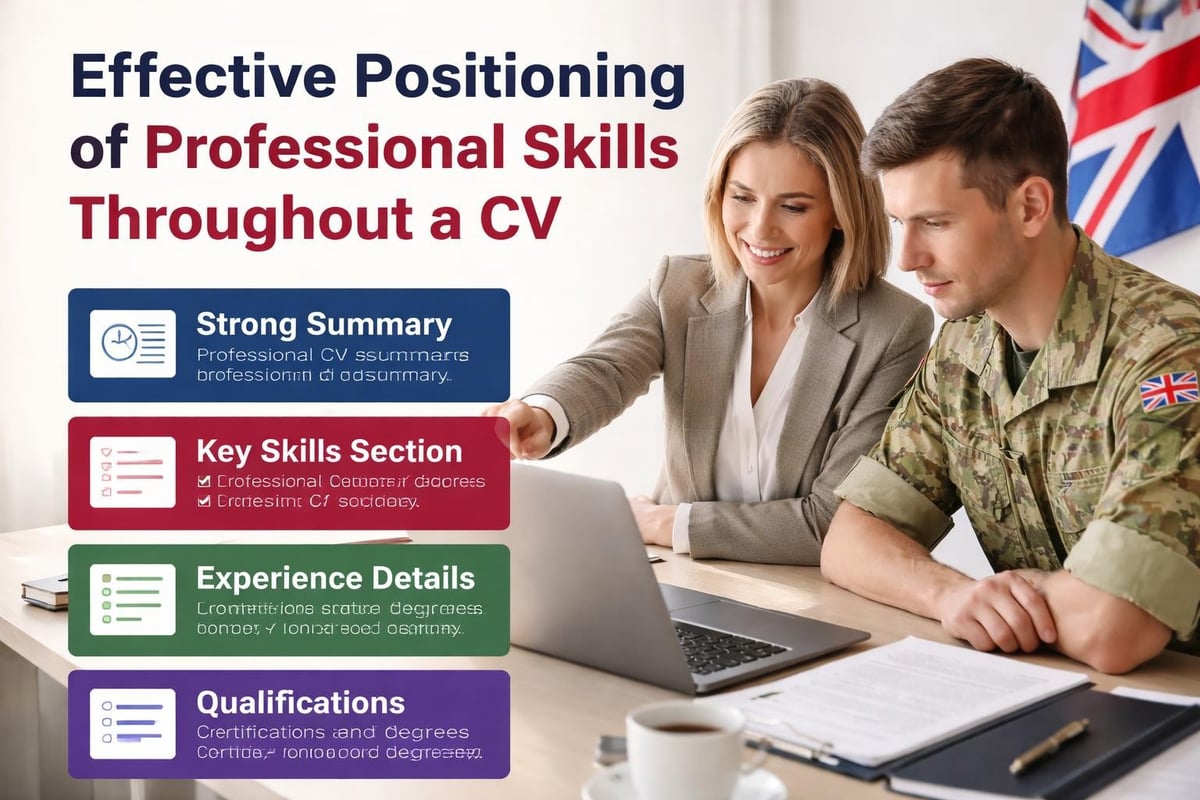 Skills should appear throughout your CV rather than being confined to a single section. Your professional profile should highlight your strongest capabilities, your career history should demonstrate how those skills have been applied, and a dedicated skills section should provide recruiters with a quick overview of your key strengths
Tailoring Skills for Your CV to Each Application
Generic CVs rarely succeed in competitive job markets. Each application deserves a tailored approach that aligns your skills for your CV with specific employer requirements.
The Customisation Process
Begin by thoroughly analysing the job description, identifying both explicit and implicit skills requirements. Look beyond the obvious bullet points to understand the organisation’s challenges, culture, and strategic priorities.
Create a master skills inventory containing every relevant capability you possess, categorised by type and proficiency level. This comprehensive database becomes your source material for customisation.
For each application, select the 10-15 most relevant skills that match the role requirements. Prioritise those mentioned multiple times in the job description or emphasised as essential rather than desirable.
Adjust your skills section to reflect this targeted selection, ensuring your professional summary also highlights these priorities. This alignment significantly increases your chances of passing ATS filters and capturing recruiter attention.
I often explain to clients that bespoke cover letters work in tandem with tailored CVs to create a cohesive application package. The cover letter provides context for how your skills address specific organisational needs, whilst the CV substantiates these claims with evidence.
Emerging Skills for 2026 and Beyond
The professional landscape continues evolving rapidly, with new technologies and working methodologies creating demand for contemporary competencies. Forward-thinking candidates include emerging skills for your CV that demonstrate adaptability and future readiness.
Emerging skills continue to grow in importance across many industries. Areas such as artificial intelligence literacy, data analytics, cybersecurity awareness, sustainability, remote team leadership, change management and diversity initiatives demonstrate adaptability and future-focused thinking. Including relevant emerging skills can help differentiate your CV from competing applicants.
These capabilities signal that you’re not merely keeping pace with industry changes but actively preparing for future developments. Even if these skills aren’t explicitly requested in job descriptions, their presence can differentiate you from candidates with identical traditional qualifications.
Research your target industry’s trajectory. What challenges will organisations face in the next 18-24 months? Which skills will address those challenges? Proactively developing and highlighting these competencies positions you as a strategic hire rather than a tactical fill.
Common Mistakes When Listing Skills for Your CV
Despite skills being fundamental to CV effectiveness, many candidates undermine their own applications through preventable errors. Understanding these pitfalls helps you avoid them.
The Overused Buzzword Trap
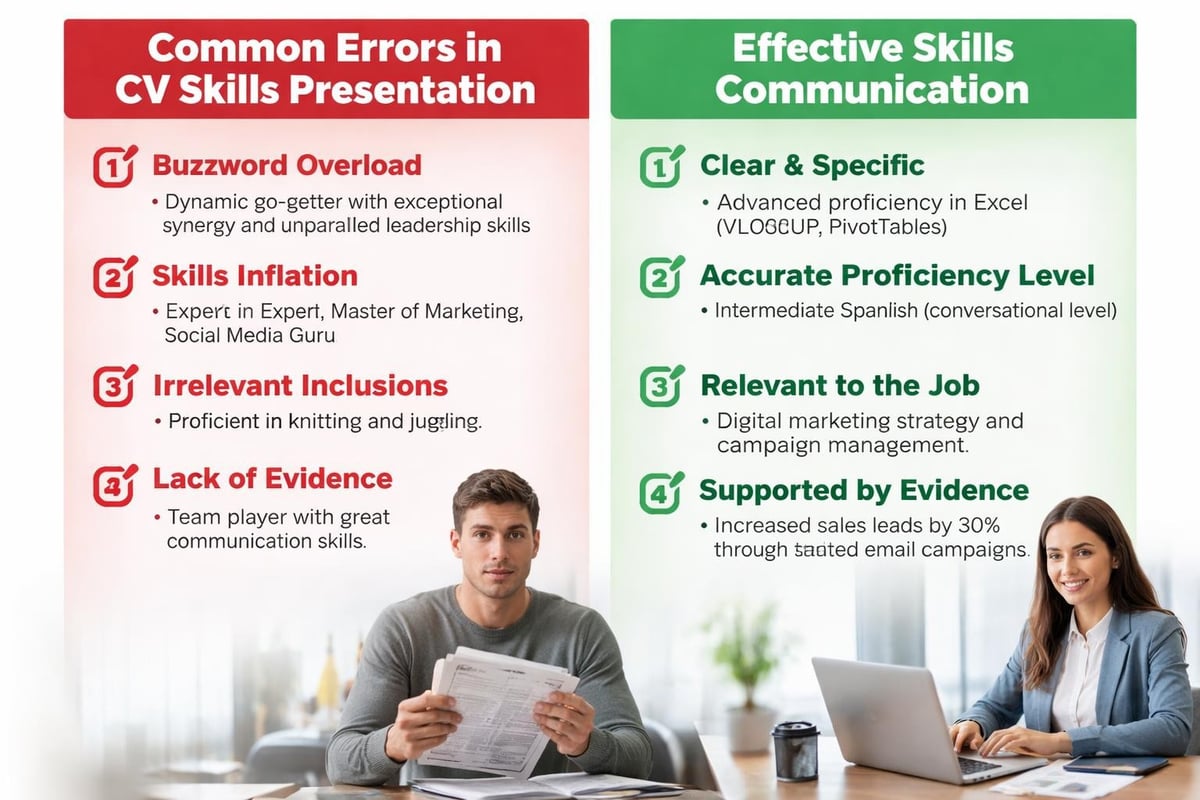
Terms like “passionate,” “innovative,” “results-driven,” and “detail-oriented” have become meaningless through overuse. These vague descriptors occupy valuable space without conveying genuine information about your capabilities.
Replace generic claims with specific skills and evidence. Instead of “innovative problem-solver,” specify “developed automated reporting system reducing monthly close time by 40%, adopted across five UK regional offices.”
Skills Inflation and Misrepresentation
Exaggerating proficiency levels creates significant problems during interviews and employment. Claiming expert-level knowledge of software you’ve used twice will become apparent quickly, damaging credibility and potentially ending your candidacy.
Be honest about proficiency levels. Many CVs benefit from indicators like “proficient,” “working knowledge,” or “certified” to accurately represent capability depth. This transparency builds trust and sets realistic expectations.
Irrelevant Skills Clutter
Including every skill you’ve ever acquired dilutes your CV’s impact. Your ability to use Microsoft Word is assumed in 2026 for professional roles. Similarly, listing hobbies as skills (“enjoys reading”) wastes precious space.
Focus on skills directly relevant to your target roles. If you’re applying for senior finance positions, your Bronze Duke of Edinburgh Award from school adds no value. Be ruthless in editing for relevance.
ATS Optimisation for Skills Sections
Applicant Tracking Systems process the majority of CV submissions at medium and large organisations. Understanding how these systems evaluate skills for your CV is essential for reaching human reviewers.
ATS software scans for keywords matching job descriptions, ranking applications by relevance. Your skills section plays a disproportionate role in this initial filtering because systems identify and weight this content heavily.
ATS optimisation requires using terminology that reflects the job description, including both acronyms and full terms where appropriate, avoiding complex graphics or formatting and ensuring key skills appear naturally throughout the document. The objective is to maximise compatibility without compromising readability.
Industry-Specific Skills Frameworks
Different sectors have distinct expectations for how you present skills for your CV. Understanding these conventions demonstrates industry knowledge and professional polish.
Different industries place emphasis on different capabilities. Technology employers often prioritise technical expertise and project delivery, finance organisations focus on analytical ability and regulatory knowledge, whilst healthcare employers value clinical competence, compliance and patient-centred care. Understanding these differences helps ensure your CV remains relevant to the roles you are targeting.
For military veterans transitioning to civilian roles, translating service experience into civilian-relevant skills for your CV requires particular attention. Leadership, logistics, project management, and security clearances translate effectively when articulated in business language.
Quantifying and Evidencing Your Skills
The most powerful CVs don’t simply list skills for your CV-they prove them through specific, quantified achievements. This evidence-based approach transforms generic claims into compelling credentials.
The Achievement Formula
Structure accomplishment statements using this framework: Action verb + specific task + measurable outcome + broader impact.
Weak example: “Responsible for social media management”
Strong example: “Developed and executed integrated social media strategy across five platforms, growing engaged following by 340% in eight months and generating £180K in attributed revenue, establishing framework now used by three additional business units”
This approach simultaneously demonstrates multiple skills (strategic planning, digital marketing, data analysis, scalable process development) whilst providing concrete evidence of capability and impact.
Numbers capture attention and establish credibility. Whenever possible, quantify your achievements with percentages, currency amounts, time savings, or volume metrics. Even approximate figures (“managed team of approximately 12”) provide more context than vague claims.
Developing Skills Strategically for Career Progression
Your CV should reflect not just your current capabilities but also your professional development trajectory. Employers value candidates who invest in continuous learning and skills enhancement.
Professional development should focus on closing gaps between your current capabilities and future career goals. This may involve gaining certifications, undertaking specialist training, volunteering for stretch assignments, completing practical projects or developing expertise in emerging technologies and methodologies.
When you include recently acquired skills for your CV, note the acquisition date or qualification year. This demonstrates ongoing professional development and shows you’re actively preparing for advancement rather than remaining static.
Many professionals find it valuable to review job descriptions for roles one or two levels above their current position. These aspirational postings reveal which skills to develop now for future career progression.
International Variations in Skills Presentation
Whilst this guide focuses on UK conventions, understanding international differences becomes relevant for candidates targeting global organisations or considering overseas opportunities. CV expectations vary significantly across regions.
UK and European CVs typically include more personal detail and comprehensive skills sections than American résumés, which tend toward brevity. Middle Eastern employers often expect extensive detail, whilst Australian conventions closely mirror UK standards.
If you’re targeting roles with multinational corporations, research their headquarters location and primary operational regions. Adapt your skills presentation to align with those conventions whilst maintaining UK spelling and formatting standards.
Language skills deserve particular attention. For UK-based roles, specify your English proficiency level using recognised frameworks (CEFR levels). Additional languages should note proficiency (conversational, business fluent, native) and any certifications like DELE for Spanish or DELF for French.
Ready to Strengthen the Skills Section of Your CV?
Knowing which skills to include on your CV is only part of the challenge. The real value comes from presenting those skills in a way that demonstrates credibility, relevance and measurable impact.
I work with professionals across the UK to create bespoke CVs through detailed one-to-one consultation, ensuring key skills, achievements and experience are positioned effectively for both recruiters and ATS systems.
Learn more about my Professional CV Writing Service, read my client testimonials and discover how a professionally written CV can help you secure more interviews and better career opportunities.
Questions and Answers
What’s the ideal number of skills to include on a CV?
Between 10 and 15 skills work well for most professional CVs, though this varies by seniority and industry. Entry-level candidates might list 8-12 skills, whilst senior professionals could include 15-20 if all remain genuinely relevant. Quality and relevance matter far more than quantity. Each skill should directly support your candidacy for target roles. If you’re struggling to justify why a skill belongs on your CV, it probably doesn’t.
Should I include skills I’m currently developing but haven’t mastered?
Honesty remains paramount on CVs. If you’ve begun developing a skill through courses, self-study, or initial projects, you can include it with appropriate qualifiers like “currently developing,” “foundational knowledge,” or “in progress.” Never claim proficiency you don’t possess, as this will become apparent during interviews or employment. Focus on skills where you can confidently discuss applications and demonstrate understanding during conversations.
How do I handle outdated technical skills on my CV?
Remove genuinely obsolete technologies unless they demonstrate relevant underlying competencies. For example, if you worked with legacy database systems, the specific platform may be outdated, but your database management expertise remains current. Focus on transferable knowledge rather than deprecated tools. If older skills remain industry-relevant (COBOL in certain financial systems, for instance), keep them, but ensure contemporary skills feature prominently to avoid appearing outdated yourself.
What’s the difference between skills and competencies on a CV?
These terms are often used interchangeably, though some HR frameworks distinguish between them. Skills typically refer to specific, learnable abilities (Excel proficiency, project management), whilst competencies encompass broader behavioural capabilities demonstrated across situations (strategic thinking, stakeholder engagement). For CV purposes, “skills” serves as the umbrella term. Structure your section logically using subcategories like “Technical Skills,” “Leadership Competencies,” or “Core Capabilities” rather than worrying about semantic distinctions.
How can I make my CV skills section stand out visually without compromising ATS compatibility?
Use simple formatting that both humans and algorithms can process effectively. Bold category headings, use bullet points or vertical bars (|) to separate items, and employ clear hierarchical structure. Avoid tables, graphics, or columns in the skills section itself, though these can work elsewhere on your CV. White space improves readability-don’t cram skills too densely. Consider a subtle skills rating system using text (Proficient, Advanced, Expert) rather than visual elements like stars or bars that ATS cannot parse. For professional assistance with optimal CV formatting, you can reach out to John@johnlogan.co.uk for expert guidance.
Matching Skills to Job Descriptions Effectively
The most successful job applications demonstrate clear alignment between candidate capabilities and employer requirements. This matching process goes beyond simply including the same words-it requires strategic presentation of skills for your CV that addresses specific organisational needs.
Begin by creating a comparison table as you analyse each job description:
Before applying for any role, compare your skills against the requirements listed within the job description. This process helps identify your strongest matches, highlights any development areas and ensures the most relevant examples receive prominence throughout your application.
This systematic approach ensures you address every requirement whilst identifying potential gaps. For essential skills where you lack direct experience, consider adjacent capabilities that demonstrate transferable aptitude.
When you’ve identified gaps in critical areas, address them honestly. If a role requires advanced Excel skills and yours are intermediate, acknowledge this whilst emphasising your rapid learning ability and willingness to pursue relevant training. This transparency, combined with demonstrated commitment to development, often resonates better than omission or exaggeration.
Balancing Breadth and Depth in Skills Presentation
Career professionals often struggle with whether to emphasise specialisation or versatility when selecting skills for your CV. The optimal approach depends on your target roles and career stage.
Specialist positioning is often most effective for senior technical professionals, niche industry experts and individuals progressing within a clearly defined career path. In these situations, demonstrating depth of expertise can be more valuable than presenting a broad range of capabilities.
Most effective CVs blend both approaches, establishing core expertise whilst demonstrating complementary breadth. Your professional summary might position you as a “chartered accountant specialising in M&A due diligence with broader commercial finance and strategic planning capabilities.”
This framework acknowledges your deep expertise whilst signalling versatility and broader business understanding. The skills section then reflects this balance, with emphasis on specialist competencies supported by relevant transferable skills.
Leveraging Skills for Career Transition
Changing careers or industries presents unique challenges in skills presentation. Your existing capabilities must be reframed to demonstrate relevance to your target sector.
Transferable skills become your strongest asset during transitions. Leadership, communication, project management, analytical thinking, and problem-solving apply across virtually all professional contexts. These universal competencies form the bridge between your current experience and future aspirations.
Successful career transitions rely on identifying transferable skills, reframing existing experience in relevant terminology, highlighting adjacent knowledge and demonstrating a willingness to learn. Employers are often more interested in adaptability and potential than direct sector experience alone.
A teacher transitioning to corporate training might emphasise curriculum development (instructional design), classroom management (facilitation and stakeholder engagement), assessment creation (competency frameworks), and educational technology (learning management systems). The underlying skills remain constant; only the terminology changes.
Research terminology conventions in your target industry. The same capability might be called “vendor management” in procurement, “supplier relationship management” in operations, or “partner engagement” in business development. Using the right language signals insider knowledge and cultural fit.
Selecting and presenting the right skills for your CV requires strategic thinking, honest self-assessment, and careful alignment with employer requirements. The difference between a CV that generates interviews and one that gets overlooked often comes down to how effectively you communicate your capabilities through relevant, evidence-based skills presentation. If you’re looking for expert support in crafting a CV that truly showcases your abilities, John Logan Consulting and Mentoring provides bespoke, consultative CV writing services with decades of recruitment expertise, ensuring your skills are positioned to open doors to your next career opportunity.