
Transitioning from military service to civilian employment represents one of the most significant career shifts anyone can experience. The structured environment, specialised terminology, and unique achievements gained during service require careful translation into language that civilian employers understand and value. Resume writing for veterans isn’t simply about listing previous roles; it’s about strategically positioning your experience, leadership capabilities, and technical expertise in a format that resonates with hiring managers who may have limited knowledge of military structures. Whether you served in the British Army, Royal Navy, Royal Air Force, or Royal Marines, the skills you’ve developed are highly transferable, but presenting them effectively requires a thoughtful, targeted approach.
Understanding the Civilian Employer Perspective
Most civilian hiring managers haven’t served in the armed forces, which means military rank structures, operational codes, and service-specific terminology can create confusion rather than clarity. When approaching resume writing for veterans, the primary challenge involves bridging this knowledge gap whilst maintaining the credibility and significance of your achievements.
Civilian recruiters typically spend between six and eight seconds on an initial CV scan. During this brief window, they’re looking for recognisable job titles, quantifiable achievements, and relevant skills that match their job description. Military terminology such as “platoon sergeant,” “logistics coordinator (REME),” or “Warfare Officer” may not immediately translate into civilian equivalents in the reader’s mind.
Translating Military Experience Effectively
Consider these translation strategies:
- Replace military-specific job titles with civilian equivalents (e.g., “Operations Manager” instead of “Squadron Leader”)
- Convert technical military terminology into industry-standard language
- Describe equipment and systems by their civilian applications rather than military designations
- Frame missions and operations as projects with measurable outcomes
- Highlight certifications that have civilian recognition value
Key principle: Think about what you accomplished and the skills you used, not just your military role designation.
Structuring Your CV for Maximum Impact
Resume writing for veterans requires careful consideration of format and structure. Unlike military service records that follow standardised formats, civilian CVs must be tailored to each application whilst maintaining professional consistency.
Choosing the Right CV Format
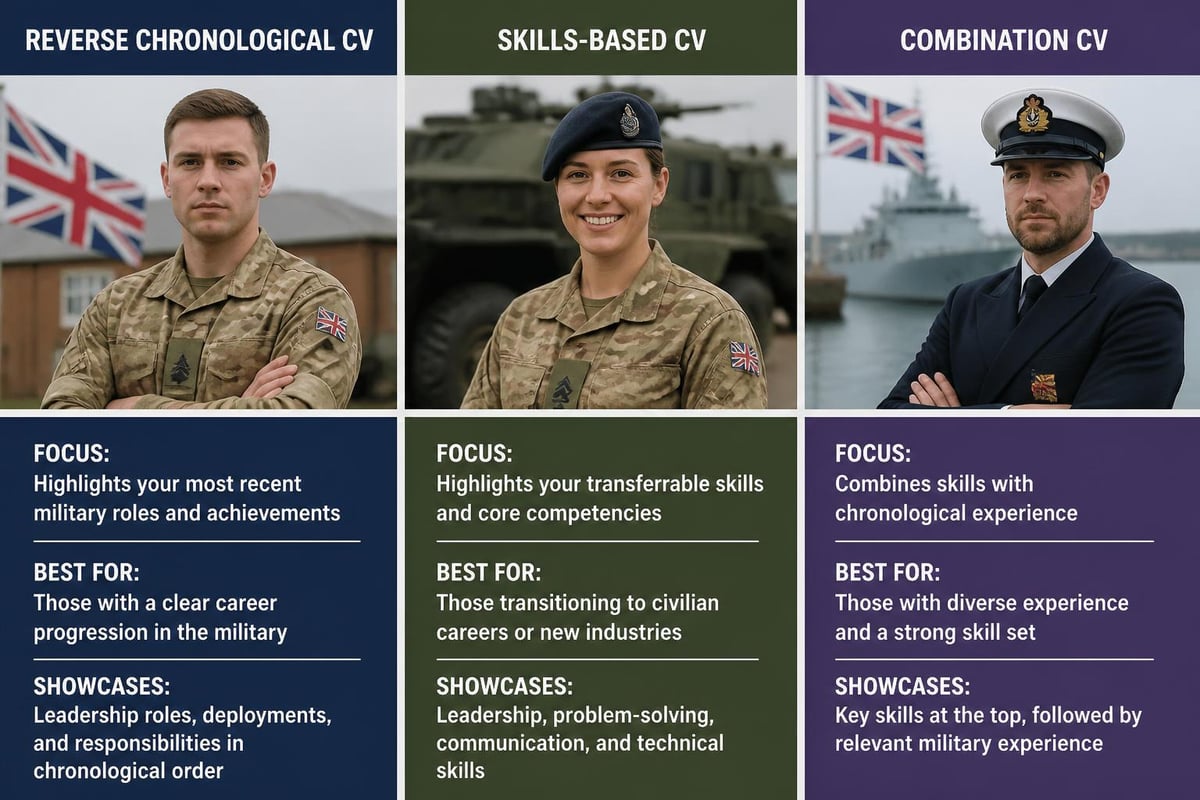
For most veterans, a reverse chronological format works best, particularly when you’ve had consistent service and can demonstrate clear progression. This format places your most recent experience first, allowing you to lead with your military achievements whilst immediately showing career development.
The Professional Summary: Your Opening Statement
The professional summary sits at the top of your CV and serves as your elevator pitch. For resume writing for veterans, this 3-4 sentence paragraph must immediately establish your value proposition to civilian employers.
Effective professional summaries include:
- Your current professional identity (not military rank)
- Years of experience and key areas of expertise
- Notable achievements or specialisations
- The type of role you’re targeting
Example: “Operations Manager with 12 years’ experience leading teams of up to 50 personnel in high-pressure environments. Proven track record in logistics coordination, process optimisation, and strategic planning across multiple international locations. Specialised in supply chain management, risk assessment, and implementing efficiency improvements that reduced operational costs by 23%. Seeking to leverage leadership and analytical expertise in a civilian operations management role.”
Quantifying Military Achievements
Numbers provide context and credibility. When pursuing resume writing for veterans, quantifying your achievements transforms general statements into compelling evidence of your capabilities.
Metrics That Matter to Civilian Employers
- Budget responsibility: “Managed equipment procurement budget of £2.3 million annually”
- Team leadership: “Led cross-functional team of 35 specialists across three departments”
- Efficiency improvements: “Streamlined maintenance procedures, reducing downtime by 34%”
- Training delivery: “Developed and delivered 47 training courses to 280+ personnel”
- Project completion: “Coordinated logistics for operation involving 200+ personnel across four locations”
- Cost savings: “Implemented inventory management system saving £85,000 annually”
- Safety records: “Maintained zero safety incidents across 18-month deployment period”
When quantifying achievements, always consider what civilian employers value: cost savings, efficiency improvements, team performance, project delivery, and safety records.
Translating Military Skills to Civilian Requirements
The competencies developed during military service are highly valuable in civilian employment, but resume writing for veterans requires explicit connection between military experience and civilian job requirements.
Core Transferable Skills
Military service develops capabilities that civilian employers actively seek but may not recognise unless clearly stated:
Leadership and Management
- Personnel development and mentoring
- Performance management and appraisals
- Resource allocation and prioritisation
- Crisis management and decision-making under pressure
- Change management and implementation
Technical and Operational
- Project planning and execution
- Quality assurance and compliance
- Risk assessment and mitigation
- Process improvement and optimisation
- Technical troubleshooting and problem-solving
Communication and Collaboration
- Stakeholder management across organisational levels
- Clear briefing and reporting
- Cross-functional team coordination
- Conflict resolution and negotiation
- Training development and delivery
Matching Skills to Job Descriptions
Create a master CV containing all your experience, then customise each application by emphasising the most relevant aspects. This targeted approach significantly improves your success rate compared to sending identical CVs to every employer.
Common Resume Writing Mistakes Veterans Make
Understanding pitfalls helps you avoid them. Resume writing for veterans comes with specific challenges that can undermine otherwise strong applications.
Overusing Military Jargon
Problem: “Served as SNCO responsible for G4 operations coordinating with J3 staff during OP HERRICK deployment.”
Solution: “Operated as Senior Logistics Manager coordinating supply chain operations with strategic planning teams during international deployment managing resources for 400+ personnel.”
Underselling Achievements
Many veterans downplay their accomplishments due to military culture that emphasises team success over individual recognition. Civilian employers expect you to highlight personal contributions and achievements. It’s not boastful; it’s professional communication.
Creating Overly Lengthy CVs
Military service generates extensive experience, but civilian CVs should typically remain within two pages. Focus on the most recent 10-15 years and experiences most relevant to your target role. Earlier or less relevant experience can be summarised briefly or omitted entirely.
Listing Duties Instead of Achievements
Weak approach: “Responsible for maintaining vehicle fleet and supervising maintenance team.”
Strong approach: “Led 12-person maintenance team managing 45-vehicle fleet, achieving 97% operational readiness rate whilst reducing maintenance costs by £34,000 through preventative maintenance programme implementation.”
Addressing Employment Gaps and Career Transitions
Resume writing for veterans often involves explaining service periods, deployments, and the transition process itself. Modern employers generally view military service positively, but clarity about your timeline helps avoid confusion.
Presenting Military Service on Your CV
List your military experience just as you would any employment, with clear dates, position titles (translated to civilian equivalents), and the organisation:
Operations Manager (Squadron Leader equivalent)
Royal Air Force, Various UK and International Locations
March 2014 – February 2026
For deployments, integrate them into your overall military experience rather than listing them separately unless they involved significantly different responsibilities that are relevant to your target role.
Managing the Transition Period
If you’re currently in your notice period or recently left service, address this clearly:
- Include your expected or actual service leaving date
- Mention any transition training or civilian qualifications you’ve gained
- Highlight any interim work, volunteering, or professional development
Note on your CV: “Currently completing military service transition (leaving date: July 2026). Immediately available for civilian employment from August 2026.”
Enhancing Your CV with Civilian Qualifications
Military training provides valuable qualifications, but civilian employers may not recognise their significance. Resume writing for veterans should include both military credentials and any civilian equivalents or additional qualifications gained.
Certifications and Qualifications to Highlight
Many military qualifications have civilian recognition:
Additionally, consider pursuing civilian qualifications during your transition period to strengthen your CV. Many resettlement programmes offer funding for professional certifications that enhance employability.
Optimising for Applicant Tracking Systems
Modern recruitment relies heavily on Applicant Tracking Systems (ATS) that scan CVs before human review. Resume writing for veterans must account for these systems whilst remaining readable for human hiring managers.
ATS-Friendly Formatting Principles
- Use standard section headings (Professional Experience, Education, Skills)
- Avoid tables, text boxes, headers, and footers for critical information
- Stick to common fonts (Arial, Calibri, Times New Roman)
- Save as .docx format unless specifically requested otherwise
- Include relevant keywords from the job description naturally throughout your CV
Keyword Integration Strategy
Identify keywords from job descriptions and incorporate them authentically into your CV. For a logistics management role, relevant keywords might include:
- Supply chain coordination
- Inventory management
- Vendor relations
- Process optimisation
- Budget management
- Team leadership
- Compliance and safety
- Data analysis
- Strategic planning
Working with a professional CV writer can ensure your CV is properly optimised for ATS systems whilst maintaining the authentic voice and compelling narrative that resonates with human readers.
Industry-Specific Considerations
Resume writing for veterans varies depending on your target industry. Different sectors value different aspects of military experience.
Security and Defence Contracting
Former service members are highly valued in defence contracting, security consultancy, and related fields. Emphasise:
- Security clearance levels (if still valid)
- Operational planning and risk assessment
- Understanding of defence procurement and contracting
- International experience and cultural awareness
- Specific technical systems expertise
Logistics and Supply Chain
Military logistics experience translates exceptionally well to civilian supply chain roles. Highlight:
- Complex supply chain coordination across multiple locations
- Inventory management systems and procedures
- Vendor and contractor relationship management
- Transportation and distribution planning
- Quality control and compliance
Project Management
Military operations are essentially complex projects with multiple stakeholders, tight deadlines, and significant resources. Emphasise:
- Multi-phase project planning and execution
- Stakeholder management at various organisational levels
- Resource allocation and budget management
- Risk identification and mitigation
- Team coordination across departments or organisations
Technology and Engineering
Technical military roles provide excellent foundations for civilian IT and engineering careers. Showcase:
- Specific technical systems and software proficiency
- Problem-solving and troubleshooting capabilities
- Technical documentation and reporting
- Continuous improvement and innovation
- Training delivery and knowledge transfer
The Cover Letter Component
Whilst your CV provides the detailed evidence of your capabilities, a well-crafted cover letter contextualises your military-to-civilian transition and demonstrates your understanding of the civilian role. Effective cover letters complement your CV by explaining your motivation, addressing potential employer concerns, and making the explicit connection between your military background and their specific requirements.
Your cover letter should:
- Open with genuine enthusiasm for the specific role and organisation
- Briefly acknowledge your military background as an asset, not an obstacle
- Connect 2-3 key achievements from your military service to the job requirements
- Demonstrate research into the company and understanding of their challenges
- Express confidence in your ability to transition successfully
- Close with a clear call to action
Professional Development and Networking
Resume writing for veterans extends beyond the document itself. Your CV should support a broader job search strategy that includes networking, professional development, and personal branding.
LinkedIn Profile Alignment
Your LinkedIn profile should complement your CV, using similar language and highlighting the same key achievements whilst potentially providing more detail and context. Ensure your LinkedIn headline uses civilian terminology that appears in relevant job searches.
Continuous Skill Development
During your transition period, invest in skills that strengthen your civilian employability:
- Industry-specific certifications relevant to your target sector
- Software proficiency (Microsoft Office, industry-standard applications)
- Professional memberships in civilian organisations
- Volunteering that demonstrates commitment to your chosen field
- Networking events and industry conferences
Leveraging Veteran Networks
Numerous organisations support veteran employment transitions. Connect with veteran-focused professional groups, attend career fairs specifically for service leavers, and engage with mentorship programmes that pair veterans with civilian professionals in your target industry.
Frequently Asked Questions
How long should my CV be as a veteran transitioning to civilian employment?
Your CV should typically be two pages maximum, regardless of your years of service. Focus on the most recent and relevant experience, quantifiable achievements, and skills that directly relate to your target civilian roles. Earlier or less relevant military experience can be summarised briefly. Quality and relevance matter far more than comprehensive chronological detail.
Should I include my military rank on my civilian CV?
Generally, no. Instead, translate your rank into a civilian equivalent job title that conveys your level of responsibility. For example, “Operations Manager” or “Team Leader” communicates more clearly to civilian employers than “Staff Sergeant” or “Lieutenant.” You can mention your rank in parentheses if it provides useful context: “Operations Manager (Flight Lieutenant equivalent).”
What if I don’t have civilian work experience beyond my military service?
Military service is work experience. Focus on translating your military roles into civilian terminology, emphasising transferable skills, quantifiable achievements, and responsibilities that align with civilian job requirements. Additionally, include any part-time work, volunteering, or professional development activities undertaken during or after service. Many successful civilian careers are launched directly from military service without intermediate civilian employment.
Send me your CV for a free review to John@johnlogan.co.uk. I’ll look through it myself and give you honest, constructive feedback as a professional CV writer.
Resume writing for veterans requires strategic translation of military experience into civilian terminology whilst maintaining the credibility and significance of your service achievements. By focusing on quantifiable results, transferable skills, and employer-relevant capabilities, you can create a compelling CV that positions you competitively for civilian roles. John Logan Consulting and Mentoring specialises in helping veterans make this transition successfully, providing bespoke, consultative CV writing that translates military experience into powerful civilian career documents. Contact John@johnlogan.co.uk to discuss how professional CV writing can accelerate your transition and open doors to the civilian career you deserve.