
Send me your CV for a free review to John@johnlogan.co.uk. I'll look through it myself and give you honest, constructive feedback as a professional CV writer.
Transitioning from military service to civilian employment represents one of the most significant career changes a professional can make. The skills, experience, and achievements gained during military service are highly valuable, yet translating them into language that civilian employers understand requires specialist expertise. A military to civilian resume writing service provides the professional guidance needed to bridge this gap, transforming military terminology into compelling civilian career narratives that open doors to new opportunities. For veterans leaving the British Armed Forces in 2026, understanding how to present military experience effectively is essential for career success.
Understanding the Military to Civilian Transition Challenge
The greatest obstacle veterans face isn't a lack of qualifications or experience. It's communication. Military roles use specific terminology, rank structures, and operational language that civilian hiring managers simply don't understand.
When a CV states "Led platoon operations in complex environments," a civilian recruiter may struggle to grasp the leadership scope, team size, or transferable skills involved. This communication barrier costs talented veterans opportunities they're genuinely qualified for.
Common translation challenges include:
- Military acronyms and service-specific jargon
- Rank-based job titles that don't translate to civilian equivalents
- Achievement descriptions focused on operational success rather than business outcomes
- Security classifications that limit what can be disclosed
- Technical specialisations without clear civilian parallels
A military to civilian resume writing service specialises in deconstructing these barriers. Professional writers understand both military structures and civilian employer expectations, creating CVs that honour service whilst speaking the language of business.
Why Generic CV Templates Fail Veterans
Many veterans initially attempt DIY CV writing using standard templates. These approaches consistently underperform because they don't address the unique translation requirements military experience demands.
Generic templates can't capture the nuance of military service. A Royal Marines Colour Sergeant managing logistics operations possesses project management, supply chain expertise, and team leadership skills worth six figures in civilian roles, but standard CV formats don't facilitate this translation effectively.
According to Military.com’s transition strategies, identifying transferable skills and presenting them appropriately is fundamental to successful civilian career transitions.
What a Military to Civilian Resume Writing Service Provides
Professional military CV writing services offer structured, consultative processes that extract, translate, and position military experience for maximum civilian impact. This isn't about rewriting history; it's about presenting the same achievements in language that resonates with your target audience.
| Service Component | What It Includes | Why It Matters |
|---|---|---|
| Skills Translation | Converting military terminology to civilian equivalents | Ensures hiring managers understand your capabilities |
| Achievement Quantification | Adding metrics and business-relevant outcomes | Demonstrates measurable impact in language employers value |
| ATS Optimisation | Keyword integration for applicant tracking systems | Gets your CV past digital screening filters |
| Formatting Expertise | Professional layout meeting civilian expectations | Creates positive first impressions with recruiters |
| Consultative Process | Personal interviews to extract relevant experience | Captures details you might not realise are valuable |
The most effective military to civilian resume writing service doesn't use questionnaires or automated systems. Instead, detailed consultations uncover the full scope of your experience, identifying transferable skills you may not recognise as marketable.
The Translation Framework
Professional CV writers use systematic frameworks to translate military experience. This involves identifying three key elements within each role:
- Leadership and management responsibilities – How many people reported to you? What decisions did you make? What resources did you control?
- Technical and specialist skills – What systems, equipment, or methodologies did you master? How do these relate to civilian technologies?
- Measurable outcomes and achievements – What improved because of your work? Can this be quantified in percentages, timeframes, or cost savings?
A RAF logistics officer who "managed squadron supply operations" actually "oversaw £2.5M inventory systems, supervised 15-person team, and reduced equipment downtime by 34% through process improvements." The second version speaks directly to civilian operations managers.
Essential Elements of Military CVs for Civilian Roles
Effective military to civilian CVs share common structural elements that maximise readability and impact for civilian recruiters who may have limited understanding of Armed Forces experience.
Professional Summary That Bridges Both Worlds
Your CV's opening paragraph must immediately establish credibility in civilian terms whilst acknowledging military background. This section answers the employer's fundamental question: "Why should we interview this candidate?"
Strong military-to-civilian professional summary:
"Results-driven operations manager with 12 years' British Army experience leading teams of up to 40 personnel in high-pressure environments. Proven expertise in logistics coordination, process optimisation, and personnel development. Seeking to leverage strategic planning and operational excellence skills in civilian manufacturing or supply chain management roles."
This summary translates rank and service into civilian job titles (operations manager), quantifies experience (12 years, 40 personnel), and identifies target sectors (manufacturing, supply chain).
Skills Section Strategy
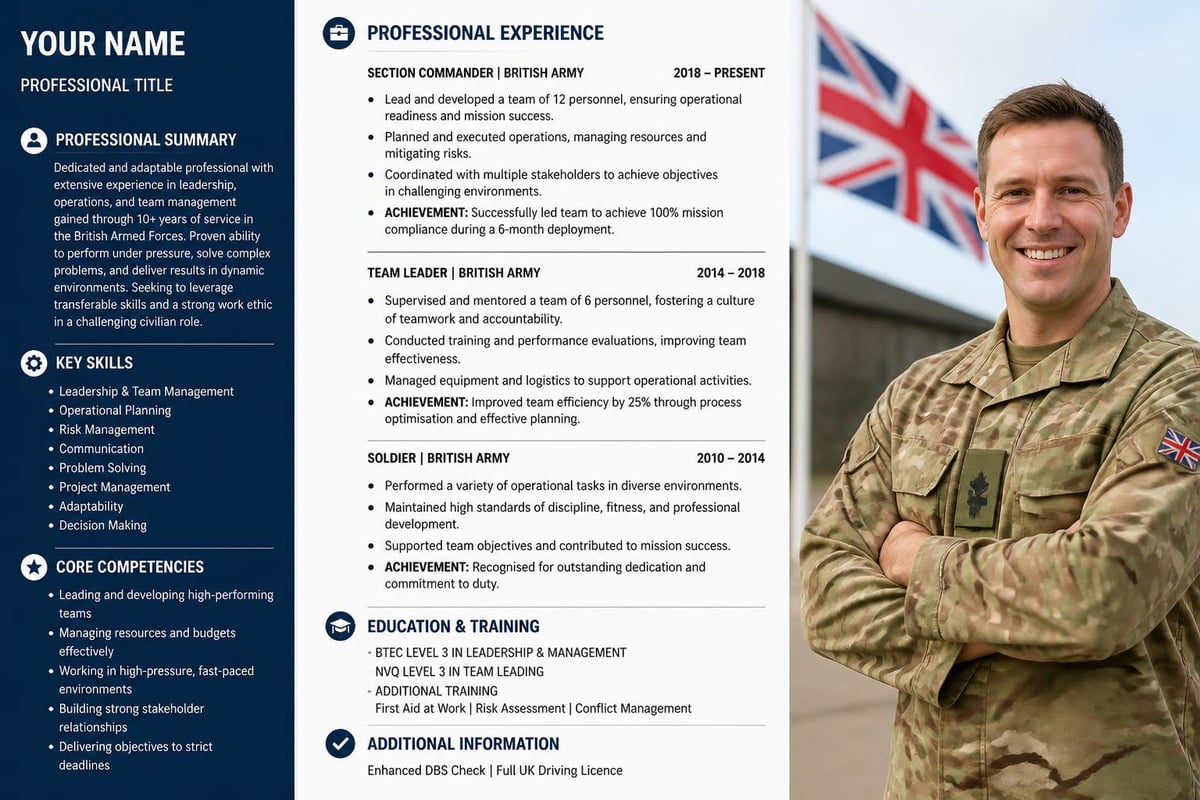
Creating an effective skills section requires balancing military-acquired competencies with civilian keyword requirements. Columbia Southern University’s guidance emphasises presenting military experience in language civilian hiring managers understand.
Recommended skills section structure:
- Leadership & Management: Team leadership, performance management, training delivery, conflict resolution
- Operations & Logistics: Supply chain coordination, inventory management, process improvement, resource allocation
- Technical Proficiencies: [Specific civilian-relevant systems, software, or equipment]
- Project Management: Strategic planning, risk assessment, deadline management, stakeholder communication
- Professional Qualities: Security clearance (if applicable), adaptability, decision-making under pressure
Notice how these categories use civilian terminology whilst accurately representing military-developed capabilities. A military to civilian resume writing service ensures every skill listed is both truthful and optimised for applicant tracking systems.
Professional Experience Section: The Translation Process
The professional experience section requires the most extensive translation work. Each military role must be reframed to highlight civilian-relevant responsibilities and achievements.
Converting Military Job Titles
Military ranks don't translate directly to civilian organisational structures. The solution is creating hybrid titles that acknowledge service whilst providing civilian context.
| Military Title | Translated CV Title | Reasoning |
|---|---|---|
| Warrant Officer Class 1 | Senior Operations Manager (WO1) | Establishes seniority and functional area |
| Colour Sergeant | Logistics Team Leader (CSgt) | Focuses on role rather than rank |
| Lieutenant | Project Coordinator (Lt, British Army) | Emphasises civilian-equivalent responsibility |
| Chief Petty Officer | Training and Development Specialist (CPO) | Highlights functional expertise |
This approach maintains integrity about military service whilst helping civilian recruiters understand your career level and functional responsibilities.
Achievement-Focused Bullet Points
Military CVs often list duties rather than achievements. Civilian employers want evidence of impact. Every bullet point should answer: "What improved because of your work?"
Duty-focused (weak): Responsible for equipment maintenance for battalion operations
Achievement-focused (strong): Maintained 100% operational readiness across 45 vehicles through preventative maintenance programme, reducing breakdown incidents by 67% over 18-month period
The second version quantifies team size (45 vehicles), demonstrates measurable improvement (67% reduction), adds timeframe context (18 months), and focuses on outcomes (operational readiness) rather than tasks.
For professional guidance on creating bespoke, achievement-focused CVs that effectively position your military experience for civilian roles, a consultative CV writing process ensures every element of your service is translated into compelling, employer-ready content.
Addressing Common Military CV Mistakes
Even experienced service personnel make predictable errors when creating civilian CVs. A military to civilian resume writing service helps you avoid these pitfalls before they cost you interview opportunities.
Overusing Military Jargon
Military acronyms and terminology create immediate barriers. Terms like "CBRN," "Op Order," or "FIBUA" mean nothing to civilian recruiters, regardless of how central they were to your role.
Problematic: Led section through Op HERRICK rotation, managing ISTAR coordination and liaison with FOB command
Improved: Led 8-person team during overseas deployment, managing intelligence gathering operations and coordinating with base command structure
The improved version maintains the essence whilst removing terminology barriers. Context matters more than specific operation names for most civilian roles.
Insufficient Quantification
Military professionals often underestimate how valuable metrics are to civilian employers. Numbers demonstrate scale, impact, and business relevance.
Adding quantification transforms vague statements into compelling evidence:
- Team size (managed 23 personnel)
- Budget scope (controlled £850K operational budget)
- Geographical reach (coordinated logistics across 4 regional sites)
- Time efficiency (reduced processing time from 6 hours to 90 minutes)
- Accuracy improvements (increased inventory accuracy from 78% to 99.2%)
- Cost savings (identified £125K in efficiency savings)
Every role contains quantifiable achievements. Professional military to civilian resume writing services excel at extracting these details through targeted questioning.
Sector-Specific Translation Strategies
Different civilian sectors value different aspects of military experience. Tailoring your CV to specific industries significantly improves application success rates.
Military to Corporate Sector
Corporate employers value military leadership, project management, and organisational skills. Emphasise:
- Strategic planning and execution capabilities
- Cross-functional team coordination
- Performance management and personnel development
- Process improvement and efficiency gains
- Stakeholder communication at multiple organisational levels
Military to Technical Industries
Engineering, technology, and manufacturing sectors focus on technical competencies and problem-solving abilities:
- Specific technical qualifications and certifications
- Equipment operation, maintenance, and optimisation
- Systems analysis and troubleshooting
- Quality assurance and compliance
- Health and safety management
Military to Public Sector
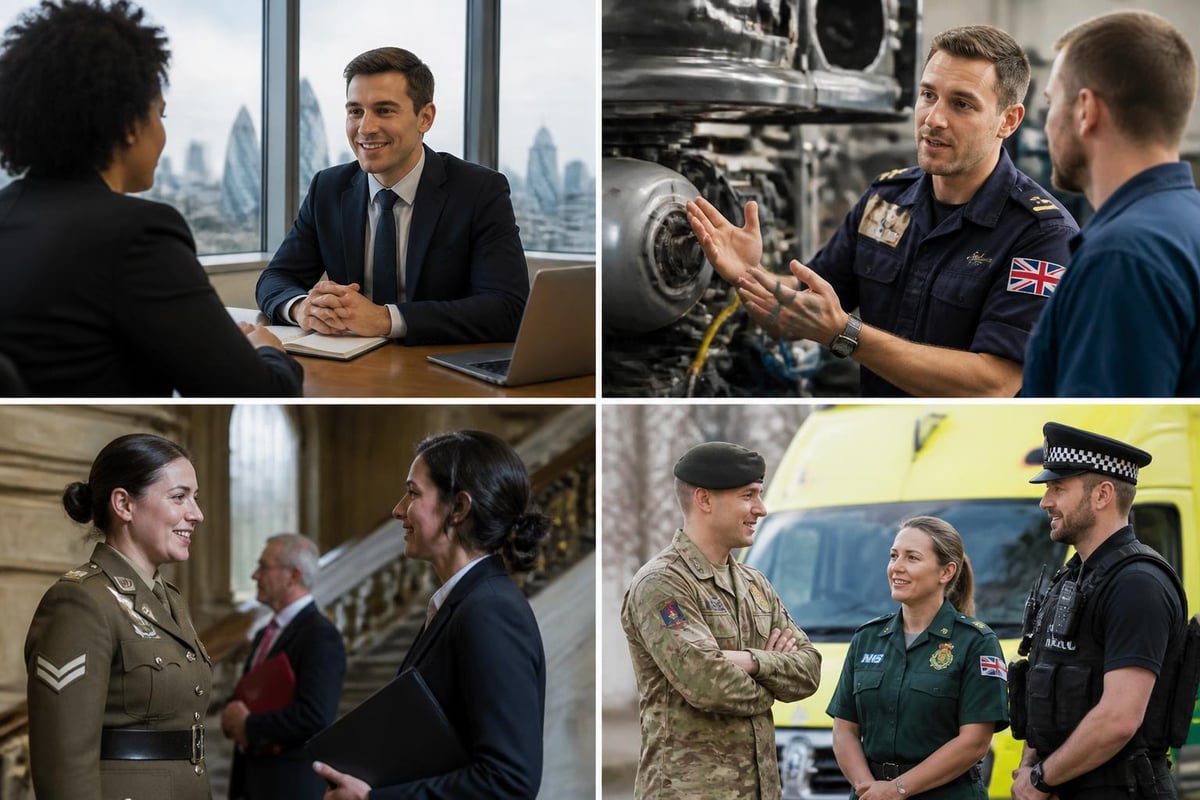
Government agencies, emergency services, and public organisations often better understand military experience but still require proper CV formatting:
- Security clearances and vetting levels
- Policy implementation and regulatory compliance
- Community engagement and public service orientation
- Crisis management and emergency response
- Multi-agency coordination experience
Optimising Military CVs for Applicant Tracking Systems
Modern recruitment relies heavily on applicant tracking systems (ATS) that scan CVs for keywords before human recruiters see them. Military to civilian resume writing services understand how to optimise CVs for both digital screening and human decision-makers.
Keyword Integration Strategy
ATS systems match CV content against job descriptions. Effective keyword integration requires:
- Analysing target job descriptions to identify recurring terms and required qualifications
- Naturally incorporating keywords throughout professional experience and skills sections
- Using industry-standard terminology rather than military-specific language
- Including both acronyms and full terms (e.g., "Project Management Professional (PMP)")
- Avoiding keyword stuffing that makes content unreadable
The ResumeGiants military-civilian resume guide emphasises keyword optimisation whilst avoiding common mistakes during the transition process.
Formatting for ATS Compatibility
Whilst creative CV designs appeal to human readers, ATS systems require clean, simple formatting:
ATS-friendly formatting choices:
- Standard section headings (Professional Experience, Education, Skills)
- Simple fonts (Arial, Calibri, Times New Roman)
- Conventional bullet points rather than symbols
- Clear date formatting (Month Year)
- No headers, footers, or text boxes
- No tables, columns, or graphics that confuse parsing software
Professional CV writers balance ATS requirements with visual appeal, creating documents that pass digital screening whilst making strong impressions when recruiters review them personally.
Education and Professional Development
Military service provides extensive training and qualifications that directly transfer to civilian roles. However, presenting this education effectively requires understanding civilian equivalency frameworks.
Translating Military Qualifications
Many military courses and certifications have civilian equivalents or recognised value. Research qualification frameworks to present military education appropriately:
- Defence qualifications often map to NVQ/SVQ levels
- Technical courses may align with civilian certifications
- Leadership development programmes demonstrate management training
- Specialist training shows commitment to professional development
Example education section:
Professional Qualifications
- Advanced Leadership Programme, British Army (2024) – Equivalent to Level 5 Leadership & Management
- Logistics Operations Specialist Certification (2022)
- HGV Class 1 Licence (2021)
- First Aid at Work Instructor (2020)
Continuing Professional Development
Demonstrating ongoing learning shows adaptability and growth mindset, qualities civilian employers value highly. Include:
- Recent courses or certifications relevant to target roles
- Professional memberships (Institute of Leadership & Management, etc.)
- Volunteer positions showing skill application
- Self-directed learning in target industry areas
Many veterans undervalue their extensive training history. Military to civilian resume writing services ensure every relevant qualification receives appropriate prominence.
Cover Letters and Application Documents
A comprehensive military to civilian resume writing service extends beyond CV creation to include supporting application documents. Cover letters play particularly important roles in military transitions.
Why Military Veterans Need Strong Cover Letters
Cover letters provide space to contextualise military experience and address potential employer concerns directly. They allow you to:
- Explain your transition decision and civilian career goals
- Connect specific military achievements to job requirements
- Demonstrate understanding of the civilian organisation and role
- Showcase communication skills and professionalism
- Address any potential concerns (employment gaps, career change, etc.)
Each cover letter should be tailored to specific applications rather than using generic templates. The Garrison Ledger’s conversion guide details how veterans can adapt their application materials by focusing on results and removing jargon.
LinkedIn Profile Optimisation
LinkedIn increasingly serves as the primary professional networking platform. Military professionals need optimised LinkedIn profiles that complement their CVs and extend their professional visibility.
LinkedIn optimisation priorities:
- Professional headline that identifies target role and key value proposition
- Comprehensive summary contextualising military background for civilian audiences
- Detailed experience sections using civilian-friendly language
- Skills endorsements for civilian-relevant competencies
- Recommendations from colleagues (military and civilian if possible)
- Engagement with industry-relevant content and groups
Your LinkedIn profile should tell the same career story as your CV whilst leveraging the platform's networking and visibility features.
Timeline and Investment Considerations
Understanding the timeline and investment required for professional military to civilian resume writing services helps veterans plan their transition effectively.
Typical Service Delivery Timeline
Professional CV writing isn't instant, nor should it be. Quality translation of military experience requires time:
| Phase | Duration | Activities |
|---|---|---|
| Initial Consultation | 1-2 hours | Detailed discussion of military roles, achievements, and civilian career goals |
| Research & Drafting | 3-5 days | Writer researches target sectors, translates experience, creates initial draft |
| Review & Refinement | 1-2 weeks | Client reviews draft, provides feedback, collaborative refinement process |
| Final Delivery | 1-2 days | Final polishing and delivery of completed CV and supporting documents |
Total timeline typically ranges from 2-3 weeks for comprehensive service. Rush services may be available but potentially compromise quality.
Investment in Professional Services
Military to civilian resume writing service costs vary based on experience level, service comprehensiveness, and provider expertise. Typical UK pricing ranges:
- Basic CV writing: £150-£300 (often template-based, limited consultation)
- Professional military CV services: £300-£600 (bespoke writing, consultative process)
- Comprehensive transition packages: £600-£1,200 (CV, cover letters, LinkedIn, interview coaching)
Consider this investment against potential salary increases and reduced job search time. A professionally written CV that secures a role £5,000 higher than you'd otherwise command pays for itself within weeks.
Questions and Answers
How long should a military to civilian CV be?
For most veterans, a two-page CV provides optimal length. This allows sufficient space to translate military experience into civilian terms whilst maintaining recruiter attention. Very senior professionals with extensive experience might extend to three pages, but concise, achievement-focused content always outperforms lengthy duty descriptions. Quality translation matters more than comprehensive history.
Should I include all my military experience or just recent roles?
Focus on the most relevant 10-15 years of experience, with particular detail on roles directly applicable to your target civilian sector. Earlier career positions can be summarised briefly unless they contain uniquely relevant experience. The goal is demonstrating capability for your target role, not documenting your entire service history.
How do I handle security-classified work on my CV?
Describe classified work in general terms that communicate scope and achievement without disclosing sensitive information. Focus on transferable skills, team sizes, and measurable outcomes rather than operational specifics. For example: "Led cross-functional team managing sensitive information systems, ensuring 100% compliance with security protocols across 18-month deployment."
Can I use my military email address for job applications?
No. Create a professional civilian email address using your name (john.smith@provider.co.uk format). Military email addresses signal you haven't fully transitioned to civilian mindset and may create delivery issues when you leave service. Update all application materials, LinkedIn, and professional networking profiles with your civilian contact details.
How important is tailoring my CV for each application?
Extremely important. Whilst your core CV provides the foundation, tailoring achievements and keywords to match specific job descriptions significantly improves success rates. A military to civilian resume writing service typically provides a master CV that you can then customise for individual applications, focusing on the most relevant 60-70% of requirements for each role.
Selecting the Right Military to Civilian Resume Writing Service
Not all CV writing services understand military transition challenges equally well. Selecting the right provider significantly impacts your results.
Key Selection Criteria
When evaluating military to civilian resume writing services, prioritise these factors:
Military experience understanding: Does the writer have military background or demonstrated expertise with veteran clients? Ask for examples of previous military CV work.
Consultative process: Avoid services using questionnaires rather than personal consultations. Quality translation requires detailed discussion, not form completion.
Industry knowledge: Does the service understand your target civilian sector? Sector-specific knowledge ensures appropriate terminology and achievement framing.
Portfolio and testimonials: Request examples of completed military CVs and client feedback. Look for specific results (interview rates, successful placements).
Revision policy: Ensure the service includes collaborative refinement rather than single-draft delivery. Your input improves accuracy and final quality.
ATS expertise: Confirm the writer understands applicant tracking systems and optimises CVs accordingly, not just for human readers.
According to Resumeble’s military transition guidance, translating military experience into language highlighting leadership and transferable skills is essential for civilian employer engagement.
Red Flags to Avoid
Certain warning signs indicate services unlikely to deliver quality results:
- Guaranteed interview promises (no writer can guarantee employer decisions)
- Extremely low prices suggesting template-based approaches
- No consultation or personal discussion of your experience
- Resistance to revisions or feedback incorporation
- Generic samples that don't demonstrate military translation expertise
- Automated or AI-based writing without human expertise
Professional military to civilian resume writing services invest time understanding your unique experience and career goals, creating truly bespoke documents rather than modified templates.
Managing the Transition Timeline
Effective military to civilian career transitions require strategic planning beyond CV creation alone. Understanding the broader timeline helps you coordinate job search activities effectively.
Pre-Transition Preparation (6-12 Months Before Discharge)
Begin preparation well before leaving service:
- Research target civilian sectors and typical qualification requirements
- Identify skills gaps and pursue relevant training or certifications
- Network with veterans in your target industry
- Start building civilian LinkedIn presence
- Commission professional CV and cover letter writing
- Research typical salary ranges for target roles
This preparation period allows you to address any qualification gaps whilst still in service and enter the civilian job market with confidence.
Active Transition Period (3-6 Months Before and After Discharge)
Intensify job search activities as discharge approaches:
- Apply to roles matching your experience and career goals
- Attend veteran job fairs and networking events
- Engage with recruitment agencies specialising in veteran placement
- Prepare for interviews by practising civilian communication style
- Follow up on applications professionally
- Continue networking and industry research
Novoresume’s veteran resume guide provides updated examples and step-by-step guidance for creating effective CVs that appeal to civilian hiring managers.
Post-Transition Refinement (First 6 Months Civilian Employment)
Use initial civilian employment to refine your professional brand:
- Update CV with civilian role achievements
- Expand LinkedIn network within your industry
- Seek feedback on interview performance
- Continue professional development in your sector
- Mentor other transitioning veterans
Your first civilian role provides valuable experience that strengthens future applications and demonstrates successful transition to prospective employers.
Special Circumstances in Military Transitions
Some veterans face unique circumstances requiring specialised CV approaches beyond standard military to civilian resume writing service offerings.
Medical Discharge and Disability
Veterans leaving service due to medical reasons or with service-related disabilities should consider:
- Focusing CV content on capabilities and achievements rather than circumstances of discharge
- Addressing reasonable adjustments naturally in cover letters if relevant to role performance
- Emphasising transferable skills developed before and after medical challenges
- Considering whether to disclose disability in initial applications (generally only if requiring reasonable adjustments for interviews)
- Highlighting resilience, adaptability, and problem-solving demonstrated through medical challenges
Career Change Within Transition
Some veterans use military discharge as opportunity to change career direction entirely. This double transition (military to civilian plus career change) requires:
- Identifying genuinely transferable skills applicable to new sector
- Addressing career change motivation clearly in cover letters
- Highlighting relevant training, certifications, or volunteer experience in target field
- Networking intensively in new industry to compensate for lack of direct experience
- Considering bridge roles that leverage military experience whilst building new sector credentials
International Military Service
Veterans of foreign armed forces seeking UK civilian employment face additional translation challenges:
- Explaining foreign military structures and ranks to UK employers
- Demonstrating UK work authorisation clearly
- Translating foreign qualifications to UK equivalency frameworks
- Addressing cultural adaptation and UK market understanding
- Leveraging any UK deployment experience or training prominently
Professional CV writers with international military experience can navigate these additional complexities effectively.
The Return on Investment
Investing in professional military to civilian resume writing service delivers measurable returns through reduced job search time, improved interview rates, and enhanced salary negotiations.
Quantifying Career Transition Success
Veterans using professional CV writing services typically report:
- 40-60% increase in interview invitations compared to self-written CVs
- 25-35% reduction in job search duration through more effective applications
- 15-20% higher starting salaries through better positioning and negotiation confidence
- Improved confidence in civilian job market navigation
- Clearer career direction through consultative process
These outcomes justify service investment many times over, particularly when compounded across entire civilian career trajectories.
Long-Term Career Benefits
The skills and confidence gained through professional CV development extend beyond initial transition:
- Understanding how to articulate value in civilian terms
- Recognition of transferable skills applicable across multiple sectors
- Framework for ongoing CV updates throughout civilian career
- Professional presentation standards for future applications
- Network connections through service provider referrals
A well-executed military to civilian transition establishes foundation for long-term civilian career success, making initial investment in professional services exceptionally valuable.
Successfully translating military experience into compelling civilian CVs requires specialist expertise that honours your service whilst speaking the language of business. The consultative process, achievement-focused content, and ATS optimisation that professional writers provide significantly improves transition outcomes. If you're preparing to leave the British Armed Forces or struggling to gain traction in civilian job applications, John Logan Consulting and Mentoring offers the bespoke, personal CV writing expertise that transforms military experience into interview-winning applications. Contact John@johnlogan.co.uk today to begin your successful transition to civilian employment.
Send me your CV for a free review to John@johnlogan.co.uk. I'll look through it myself and give you honest, constructive feedback as a professional CV writer.