

Transitioning from military service to civilian employment represents one of the most significant career shifts you’ll ever make. The challenge isn’t your capability or experience, it’s communicating your value in a language civilian employers understand. A military resume format differs fundamentally from the documents you’ve prepared throughout your service career. Where military records emphasise rank, unit, and operational details, civilian CVs must prioritise transferable skills, measurable achievements, and business-relevant competencies. Understanding this distinction forms the foundation of a successful transition, and choosing the right military resume format can dramatically improve your interview success rate.
Understanding the Military Resume Format
The military resume format serves as a bridge between two distinct professional worlds. Unlike standard CVs, it requires careful translation of military terminology whilst maintaining the integrity of your achievements. This format prioritises clarity above all else, ensuring recruitment managers without military backgrounds can immediately grasp your experience and potential.
Core Structure Elements
A proper military resume format typically follows a chronological structure, though functional formats work well for those with employment gaps or career changers. The chronological approach presents your service history in reverse order, starting with your most recent position. This method works particularly well when your military progression demonstrates clear leadership development and increasing responsibility.
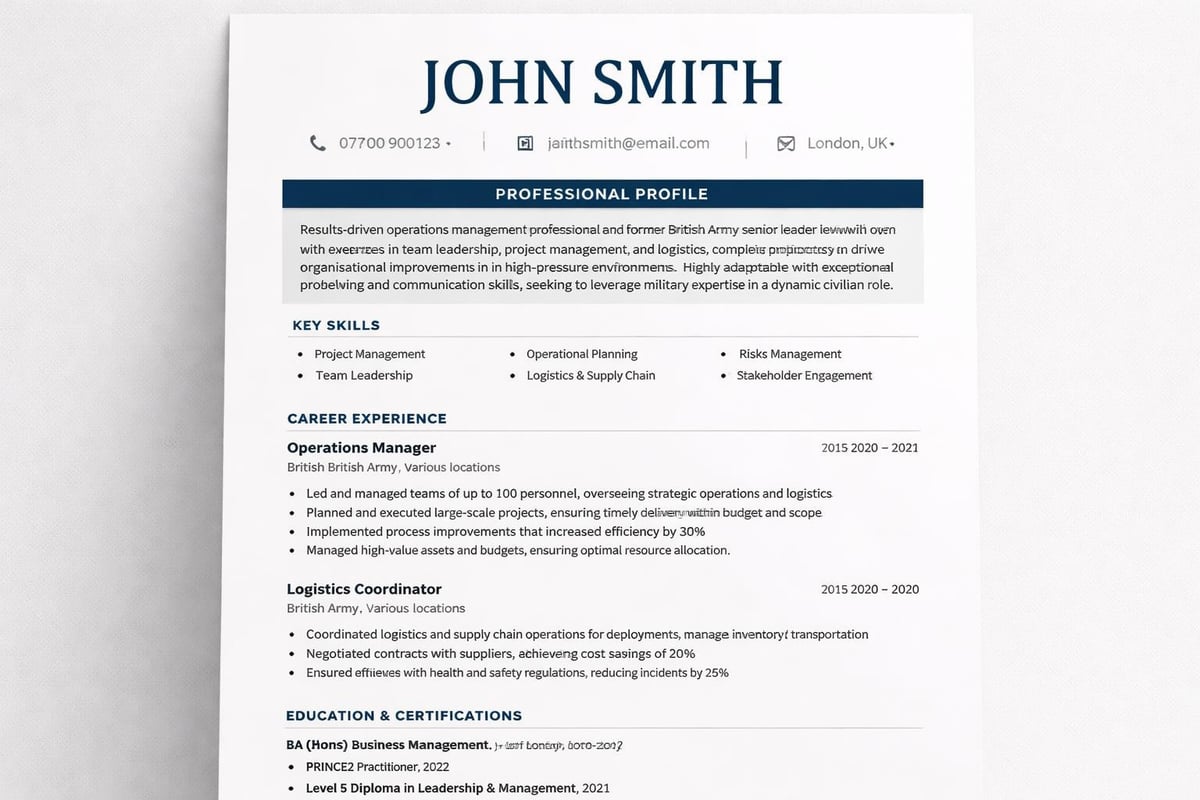
A well-structured military CV should guide employers logically through your experience, beginning with a strong professional profile, followed by relevant skills, employment history and qualifications. Each section should reinforce your suitability for the role whilst presenting military experience in language that civilian employers immediately recognise and understand.
Length and Formatting Standards
Civilian employers expect concise, focused documents. Your military resume format should ideally span two pages, occasionally extending to three if you’ve served 15-plus years with substantial leadership experience. British employers particularly value brevity-they want evidence of impact, not exhaustive duty lists.
Formatting consistency matters enormously. Use a single professional font (Calibri, Arial, or Times New Roman at 11-12 point), maintain consistent spacing, and employ clear section headers. Avoid graphics, photographs, or overly designed templates that can confuse Applicant Tracking Systems (ATS).
Civilian employers expect concise, achievement-focused CVs that clearly demonstrate value rather than listing responsibilities. The strongest military CVs replace technical terminology with commercial language, focus on measurable achievements and present information in a format that is easy for recruiters to scan quickly.
Translating Military Experience Effectively
The most critical aspect of any military resume format involves converting your service experience into civilian-relevant achievements. This translation process requires you to step outside military culture and view your experience through an employer’s lens.
Demilitarising Job Titles and Responsibilities
Military ranks and roles mean little to civilian hiring managers. A “Squadron Leader” becomes a “Senior Operations Manager,” whilst a “Warrant Officer Class 1” translates to “Senior Technical Specialist” or “Senior Training Manager,” depending on your specific duties.
When describing your responsibilities, eliminate military jargon entirely. Instead of “commanded a platoon of 30 soldiers,” write “managed a team of 30 professionals in high-pressure operational environments.” Replace “conducted reconnaissance operations” with “gathered and analysed critical intelligence to inform strategic decision-making.”
Quantifying Achievements
Numbers provide concrete evidence of your capability. Your military resume format should incorporate specific metrics wherever possible:
Managed operational budgets exceeding £2.5 million annually
Reduced equipment downtime by 34% through preventative maintenance programmes
Trained and developed 150+ personnel across multiple skill levels
Coordinated logistics for operations involving 500+ personnel
Achieved 98% mission success rate across 45 deployments
These quantified achievements demonstrate impact in universal terms. Even if your role didn’t involve obvious metrics, you can quantify team sizes, timeframes, success rates, or efficiency improvements.
When compiling your CV, remember that civilian employers want evidence of leadership, problem-solving, and measurable results-all areas where military personnel excel.
Choosing Between Resume Format Types
The military resume format you select depends on your specific circumstances, career goals, and the nature of your service. Understanding the strengths and limitations of each format helps you present your experience most effectively.
Chronological Format
This traditional approach lists your employment history in reverse chronological order, starting with your most recent position. It’s the preferred military resume format for veterans with continuous service records and clear career progression.
A chronological format is usually the strongest choice for military personnel with continuous service and clear career progression. It allows employers to follow your increasing levels of responsibility whilst demonstrating leadership development and long-term professional growth.
The chronological format works particularly well when applying for roles in security, logistics, project management, or operations-fields where military experience directly translates.
Functional Format
This approach emphasises skills and competencies rather than chronological work history. Your military resume format organises functionally groups achievements under skill categories like “Leadership,” “Project Management,” or “Technical Expertise.”
A functional CV format can work well for service leavers changing career direction or those wishing to place greater emphasis on transferable skills rather than military job titles. It focuses attention on capability rather than career history.
Hybrid Format
The hybrid military resume format combines chronological employment history with skill-based sections. This approach provides the best of both worlds, demonstrating career progression whilst highlighting transferable competencies.
A hybrid format typically begins with a skills summary, followed by professional experience in reverse chronological order. This structure allows you to immediately showcase relevant capabilities whilst providing the traditional employment timeline employers expect.
Optimising for Applicant Tracking Systems
Modern recruitment relies heavily on ATS software that scans, parses, and ranks CVs before human eyes ever see them. Your military resume format must account for this technological gatekeeper whilst remaining readable and compelling.
ATS-Friendly Formatting Rules
Applicant Tracking Systems struggle with complex formatting, graphics, and unusual structures. Follow these principles to ensure your military resume format passes ATS screening.
Applicant Tracking Systems favour clear layouts, recognised section headings and straightforward formatting. Using simple fonts, logical document structure and relevant keywords improves the likelihood of your CV progressing through automated screening whilst remaining easy for recruiters to read.
Keyword Integration Strategy
Every job posting contains keywords-specific skills, qualifications, and competencies the employer seeks. Your military resume format should naturally incorporate these terms without appearing forced or repetitive.
Research shows that achieving approximately 1% keyword density for critical terms improves ATS performance without triggering spam filters. For a 2,000-word CV, that means using each primary keyword roughly 20 times throughout the document.
Before submitting any application, carefully review the job description to identify the language, skills and qualifications the employer values most. Incorporating these terms naturally throughout your CV helps improve relevance for both Applicant Tracking Systems and hiring managers.
Understanding what makes a successful CV includes recognising how ATS systems evaluate and rank applications, particularly for candidates transitioning from military service.
Sector-Specific Adaptations
Your military resume format should adapt to the industry you’re targeting. Different sectors value different aspects of military experience, requiring strategic emphasis adjustments.
Corporate and Business Roles
When targeting corporate positions, your military resume format should emphasise project management, budget control, strategic planning, and people leadership. Focus on achievements that demonstrate:
Change management and organisational development
Cross-functional team leadership
Stakeholder engagement and communication
Performance management and development
Strategic planning and execution
Corporate recruiters value military veterans for their discipline, reliability, and leadership capabilities, but you must frame these qualities in business language.
Technical and Engineering Positions
For technical roles, your military resume format should prioritise technical competencies, certifications, and problem-solving achievements. Highlight:
Specific technical skills and equipment expertise
Maintenance and reliability improvements
Safety record and compliance achievements
Technical training and certification
Innovation and process improvement
Translate military technical qualifications into civilian equivalents. A “Class 1 HGV licence” remains valuable, whilst electronics or communications training might align with civilian certifications.
Public Sector and Emergency Services
Transitioning into police, fire service, or other public sector roles allows for a more relaxed approach to demilitarisation. These employers understand military culture and value service experience directly. Your military resume format for these applications can retain more military terminology whilst still explaining achievements clearly.
The CV writing guide for police officers shares many principles with military resume formats, particularly regarding transferable skills and leadership experience.
Different industries value different aspects of military experience. Corporate employers often focus on leadership and commercial awareness, technical sectors prioritise qualifications and problem-solving, whilst public sector organisations recognise operational experience, integrity and decision-making under pressure. Tailoring your CV to emphasise the strengths most relevant to each sector significantly improves your chances of success.
Writing a Compelling Professional Profile
Your professional profile sits at the top of your military resume format and serves as your elevator pitch. This 2-4 sentence section must immediately communicate your value proposition to civilian employers.
An effective professional profile should provide a concise overview of your experience, highlight your strongest transferable skills and clearly communicate the type of role you are targeting. This section should immediately demonstrate the value you can bring to a civilian employer.
Example: “Experienced operations manager with 12 years leading high-performing teams in demanding, fast-paced environments. Proven expertise in logistics coordination, budget management, and strategic planning. Seeking to apply operational excellence and leadership capabilities within the manufacturing sector.”
Avoid generic statements like “hard-working professional” or “team player.” These qualities are assumed. Instead, demonstrate specific value aligned with your target role. AARP’s resume writing guidance emphasises the importance of this opening section for capturing employer attention immediately.
Tailoring for Each Application
Never use a one-size-fits-all profile across all applications. Your military resume format should adapt to each role, with the professional profile reflecting specific requirements from the job posting. This customisation takes minutes but dramatically improves your application’s relevance and impact.
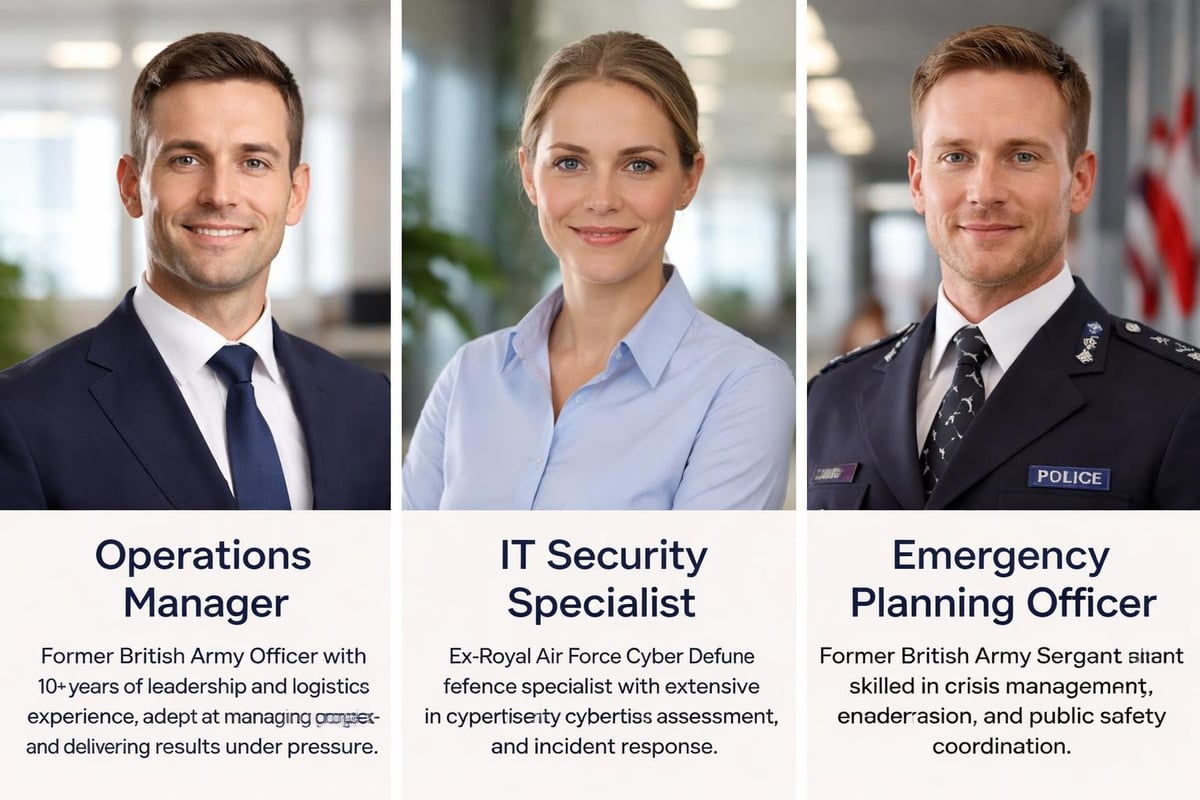
When writing your CV personal statement, consider how each word contributes to positioning you as the ideal candidate for that specific role.
Common Military Resume Format Mistakes
Even experienced service members make critical errors when developing their civilian CVs. Understanding these pitfalls helps you create a stronger military resume format from the outset.
Overuse of Military Jargon
The single biggest mistake involves failing to translate military language adequately. Terms like “force multiplier,” “tactical operations,” or military-specific acronyms confuse civilian recruiters and trigger immediate rejection. Every single term in your military resume format should be immediately understandable to someone with no military background.
Replace military terminology systematically:
“Op orders” becomes “operational plans”
“After action reviews” becomes “performance evaluations”
“Command and control” becomes “leadership and oversight”
“Theatre of operations” becomes “operational environment”
Listing Duties Instead of Achievements
Your military resume format should showcase what you achieved, not merely what you were responsible for. Recruiters assume you completed your duties-they want evidence of excellence and impact.
Weak: Responsible for maintaining equipment and managing inventory.
Strong: Reduced equipment failure rates by 28% through implementation of a preventative maintenance schedule, whilst maintaining 99.7% inventory accuracy across £1.2 million of assets.
Emphasise achievement-focused writing that demonstrates measurable impact.
Excessive Length and Detail
Military culture values comprehensive documentation. Civilian recruitment values concise communication. Your military resume format must respect this difference. No civilian employer will read a four-page CV, regardless of your experience level.
Be ruthlessly selective about what you include. Ask yourself: “Does this information directly support my application for this specific role?” If not, remove it. Focus on the most recent 10-15 years of experience unless earlier roles are particularly relevant.
Addressing Security Clearances and Classifications
Security clearances represent significant value in certain civilian sectors. Your military resume format should mention these credentials prominently while respecting classification restrictions.
Presenting Clearances Effectively
List active security clearances in your professional profile or a dedicated “Clearances and Certifications” section. Specify the clearance level and validity status:
“Current SC (Security Check) clearance valid until 2028”
“Developed Vetting (DV) clearance maintained throughout 15-year service”
“Counter-Terrorist Check (CTC) clearance active”
These credentials prove particularly valuable when applying for defence contractors, government agencies, or organisations working on sensitive projects.
Describing Classified Work
When your experience involves classified operations or information, describe your achievements in general terms that convey capability without revealing sensitive details:
Instead of: “Led classified intelligence gathering operations in [specific location]”
Use: “Managed complex intelligence analysis projects requiring multi-source integration and strategic assessment, delivering actionable insights to senior decision-makers”
This approach demonstrates your capability whilst respecting security obligations-a balance that civilian employers in relevant sectors will appreciate and respect.
Professional Development and Training
Military service provides extensive training opportunities. Your military resume format should present this development in civilian-relevant terms, particularly when targeting sectors valuing continuous learning.
Military qualifications often have strong civilian relevance when presented correctly. Leadership programmes, technical training, health and safety qualifications and project management courses should all be described using terminology that employers immediately recognise and understand.
When listing education in your military resume format, explain what each qualification represents in civilian terms. Rather than “Junior Command and Staff Course,” write “Leadership and Strategic Management Programme (equivalent to Level 5 Management qualification).”
Continuing Professional Development
Demonstrate your commitment to ongoing learning by including recent civilian training, professional memberships, or certifications. This evidence shows employers you’re actively bridging the military-civilian gap and investing in your transition.
Professional memberships relevant to your target sector (Chartered Management Institute, Institute of Leadership & Management, sector-specific bodies) strengthen your military resume format considerably.
Many veterans benefit from working with a professional CV writer who understands both military experience and civilian recruitment expectations, particularly when addressing complex qualification translations.
A detailed one-to-one consultation often uncovers achievements, leadership responsibilities and transferable skills that service leavers may overlook when writing their own CV, resulting in a stronger and more targeted application.
Frequently Asked Questions
Should I include my military rank in my CV?
Include your final rank only if it demonstrates seniority and leadership, such as Officer ranks or Senior NCO positions. However, always provide a civilian equivalent in brackets-for example, “Squadron Leader (Senior Operations Manager)” or “Warrant Officer (Senior Technical Specialist).” For junior ranks, focus instead on your role and responsibilities rather than rank itself. The military resume format should prioritise what you did and achieved over hierarchical position.
How do I explain gaps in employment during my transition?
Brief transition gaps (3-6 months) require no special explanation in your military resume format. For longer periods, include a single line such as “Career transition and professional development (Jan-Jun 2026)” in your employment history. If you undertook training, volunteering, or freelance work during this period, include it as relevant experience. Most employers understand that military transitions require time and planning. What matters is demonstrating productive use of that time and clear career direction.
What’s the best way to describe combat or operational deployments?
Frame operational deployments in terms of leadership, problem-solving, and results rather than combat specifics. Focus on team size managed, logistical complexity, decision-making under pressure, and mission outcomes. For example: “Led 25-person team through six-month operational deployment, maintaining 100% personnel welfare whilst achieving all strategic objectives under challenging conditions.” This approach conveys capability without dwelling on combat details that may concern some civilian employers.
Should my military resume format differ for different job applications?
Absolutely. Your core military resume format structure remains consistent, but you should tailor content, keywords, and emphasis for each application. Adjust your professional profile, prioritise different achievements, and modify your skills section to align with specific job requirements. This customisation dramatically improves ATS performance and demonstrates genuine interest in each role. Save each tailored version with a clear filename referencing the company and position.
Tailoring your CV for each application becomes even more effective when supported by bespoke cover letters that explain your military-to-civilian transition and demonstrate why your experience matches the specific role.
How do I address medical discharge or redundancy in my CV?
Your military resume format need not explicitly mention discharge reasons unless specifically requested. In your employment history, simply list your service dates and roles. If asked about leaving reasons during interviews, be honest but brief: “I left military service as part of workforce reduction” or “I was medically discharged but remain fully fit for civilian employment.” Focus immediately on your skills, achievements, and enthusiasm for civilian opportunities. What matters is your capability and potential, not the circumstances of your departure.
You can also read my client testimonials to see how former service personnel have successfully secured interviews and civilian careers across a wide range of industries.
If you would like personalised support with your own military-to-civilian transition, you can also book a consultation to discuss your experience, career objectives and CV requirements.
As a former Royal Navy veteran who successfully transitioned into civilian leadership and business ownership, I understand the challenges service leavers face when presenting military experience to civilian employers. My consultative approach focuses on translating operational achievements, leadership experience and transferable skills into language that recruiters immediately recognise and value.
Mastering the military resume format transforms your transition from overwhelming challenge to structured process. By demilitarising your language, quantifying achievements, and presenting your experience through a civilian lens, you position yourself competitively for the opportunities you deserve. If you’re struggling to translate your service into compelling civilian terms or want expert guidance on your specific situation, I can help. With decades of experience helping veterans transition successfully, I create bespoke, ATS-optimised CVs that open doors to interviews and opportunities.
Many service leavers also benefit from specialist Ex-Military CV support designed specifically to translate military achievements into language that civilian employers immediately understand and value.