
Transitioning from military service to civilian employment represents one of the most significant career shifts you’ll ever make. Your military curriculum vitae serves as the critical bridge between your service record and your next professional chapter. Unlike a standard CV, a military curriculum vitae must translate years of specialised training, operational experience, and leadership responsibility into language that civilian recruiters and hiring managers understand and value. This document isn’t simply a list of postings and qualifications; it’s a strategic presentation of your capabilities, achievements, and potential contribution to civilian organisations. Whether you served as a commissioned officer, non-commissioned officer, or specialist rank, your military background has equipped you with transferable skills that employers actively seek, but only if you present them effectively.
Many service leavers also benefit from specialist Ex-Military CV support designed specifically for military-to-civilian career transitions.
Understanding the Military Curriculum Vitae Format
A military curriculum vitae differs fundamentally from both standard military documentation and typical civilian CVs. Service personnel often struggle with this transition because military records focus on postings, courses, and operational deployments rather than measurable business outcomes.
Your military curriculum vitae needs to bridge two distinct professional cultures. The challenge lies in reframing your experience without losing its impact or misrepresenting your role.
Key Structural Differences
A successful military curriculum vitae should follow a structure that civilian recruiters immediately recognise. Begin with a strong personal profile, followed by key skills, professional experience, education, qualifications and any additional information relevant to the role. Presenting your experience in a clear and familiar format makes it easier for employers to understand your capabilities and assess your suitability for civilian opportunities.
Most veterans make the mistake of listing duties rather than demonstrating impact. Civilian employers want to see what you achieved, not just what you were responsible for.
Translating Military Experience into Civilian Language
The single biggest obstacle in creating an effective military curriculum vitae is language translation. Terms like “battlegroup operations”, “company sergeant major”, or “logistic support group” mean nothing to civilian hiring managers.
Common Translation Challenges
Effective translation requires understanding what civilian employers value. They’re looking for leadership, project management, financial accountability, risk management, and team development. Your military curriculum vitae must demonstrate these competencies clearly.
Quantifying Your Achievements
Quantifiable achievements help employers understand the scale and impact of your responsibilities. Team size, budget accountability, project scope, operational improvements and professional recognition all provide valuable evidence of your capabilities. Wherever possible, support your experience with measurable outcomes that demonstrate the value you delivered.
When developing your military curriculum vitae, every significant role should include at least two to three quantified achievements that demonstrate your impact and capability.
Addressing Security Clearance and Sensitive Information
Many military roles involve classified operations or sensitive information that cannot be detailed in a civilian CV. This creates a genuine challenge when writing your military curriculum vitae.
You must balance transparency with operational security. Employers understand that certain details remain restricted, but they still need sufficient information to assess your suitability.
Strategies for Sensitive Roles
Personnel who have worked in sensitive or classified environments should focus on the transferable skills developed through their roles rather than operational details. Leadership, planning, risk management, stakeholder engagement and project delivery can all be demonstrated without disclosing restricted information. Where appropriate, security clearance should also be highlighted, as it represents a valuable asset for employers operating in defence, aerospace and government sectors.
Your military curriculum vitae should prominently feature current security clearances, as these represent significant value to employers and demonstrate your trustworthiness and reliability.
Optimising for Applicant Tracking Systems
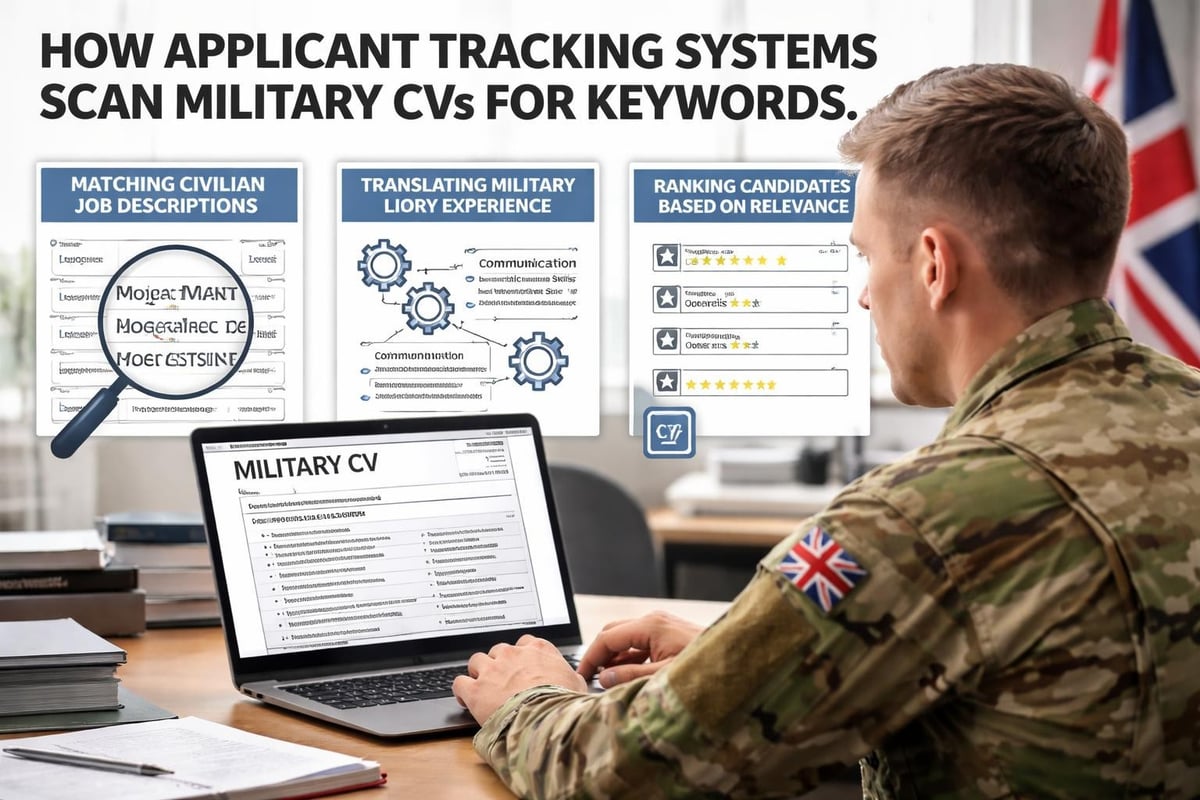
Modern recruitment relies heavily on Applicant Tracking Systems (ATS) that scan and rank CVs before human reviewers see them. Your military curriculum vitae must pass these digital gatekeepers.
ATS-Friendly Formatting
Applicant Tracking Systems work best when information is presented clearly and consistently. Using recognised section headings, relevant keywords and straightforward formatting helps recruitment software accurately identify your experience and qualifications. A professional layout also improves readability for recruiters, increasing the likelihood that your application progresses to the next stage.
Veterans with technical specialisms should research industry-specific keywords. If you were an avionics technician, your military curriculum vitae should include terms like “aircraft maintenance”, “diagnostic testing”, “regulatory compliance”, and “technical documentation” to match civilian aerospace job descriptions.
Addressing Employment Gaps and Career Progression
Military service often involves postings, deployments, and career breaks that don’t follow typical civilian career trajectories. Your military curriculum vitae needs to present this history positively.
Handling Deployments and Postings
Frequent moves demonstrate adaptability and resilience rather than instability:
Your military curriculum vitae should present your career progression clearly, explaining how each role built your capabilities and prepared you for civilian employment.
For those who left service at relatively junior ranks, focus on the maturity of your responsibilities rather than the rank itself. A corporal managing vehicle fleet maintenance has directly transferable skills to civilian transport management roles.
Highlighting Transferable Skills and Leadership
Military service develops capabilities that civilian employers desperately need but struggle to find. Your military curriculum vitae must make these connections explicit.
Core Transferable Competencies
Military service develops a broad range of transferable skills that are highly valued across civilian industries. Decision-making under pressure, leadership, resource management, strategic planning and cross-functional collaboration are all capabilities developed through military experience. Presenting these strengths in business-focused language helps employers understand how they apply directly to commercial environments.
When writing your military curriculum vitae, demonstrate these competencies through specific examples and measurable outcomes.
Industry-Specific Applications
Different sectors value different aspects of military experience:
Healthcare: Triage skills, emergency response, medical logistics
Construction: Project management, safety compliance, equipment operation
Technology: Systems thinking, cybersecurity, technical training
Finance: Risk assessment, process discipline, regulatory compliance
Education: Instructional design, assessment, mentoring
Tailor your military curriculum vitae to emphasise the aspects of your service most relevant to your target industry. This isn’t fabrication but strategic emphasis of genuine experience.

Incorporating Civilian Education and Certifications
Many service personnel complete civilian qualifications during or after their military career. Your military curriculum vitae should integrate these credentials strategically.
Balancing Military and Civilian Qualifications
Present education chronologically but group by type for clarity:
Professional Qualifications
Association of Project Management (APM) Practitioner, 2025
Chartered Management Institute (CMI) Level 5 Diploma, 2024
PRINCE2 Practitioner, 2023
Military Training
All Arms Commando Course, 2020
Junior Command and Staff Course, 2019
Combat Infantryman’s Course, 2017
Academic Education
BSc (Hons) Business Management, Open University, 2026
A-Levels: Mathematics (A), Physics (B), English (B), 2016
This structure shows progression and breadth whilst avoiding confusion about the level or relevance of purely military courses.
Veterans often undersell military qualifications that have direct civilian equivalents. An HGV licence gained in the military is identical to a civilian one. Leadership courses often map to recognised management qualifications. Research the civilian equivalents of your military training when developing your military curriculum vitae.
Crafting a Compelling Personal Profile
The opening profile on your military curriculum vitae determines whether recruiters continue reading. This 4-6 line summary must immediately establish your value.
Elements of an Effective Profile
Strong profiles follow a proven structure:
Your professional identity: What you are now and what you’re targeting
Key experience indicator: Years of service and level of responsibility
Core strengths: Two to three primary competencies
Career focus: What you’re looking for and what you offer
Example for a transitioning officer:
“Strategic operations manager with 12 years’ progressive leadership experience in the British Army, managing teams of up to 150 personnel and budgets exceeding £3M. Proven expertise in project delivery, risk management, and stakeholder engagement across complex, multi-phase operations. Now seeking senior management positions where operational excellence, decisive leadership, and strategic planning drive organisational success.”
This profile uses civilian language whilst conveying the depth of military experience. Your military curriculum vitae profile should be customised for each application, emphasising the aspects most relevant to that specific role.
Demonstrating Continuous Professional Development
Military culture emphasises continuous improvement and professional development. Your military curriculum vitae should reflect this commitment.
Presenting Ongoing Learning
Continuous professional development demonstrates commitment, adaptability and a willingness to learn. Recent qualifications, professional memberships, industry certifications, voluntary work and self-directed learning can all strengthen a military curriculum vitae by showing employers that your skills remain current and relevant to the demands of the civilian workplace.
A dedicated “Professional Development” section demonstrates that your growth didn’t stop when you left service. This is particularly important if there’s a gap between leaving the military and entering civilian employment.
Many veterans complete additional qualifications during resettlement. Your military curriculum vitae should highlight these prominently, showing initiative and commitment to successful transition.
Common Mistakes in Military Curriculum Vitae Writing
Even highly capable service personnel make predictable errors when creating their first civilian CV. Avoiding these pitfalls strengthens your application significantly.
Critical Errors to Avoid
The most damaging mistake is creating a military curriculum vitae that reads like a service record. Civilian employers cannot and will not translate your experience for you. That’s your responsibility as the applicant.
Questions and Answers About Military Curriculum Vitae
How long should my military curriculum vitae be?
Your military curriculum vitae should typically be two pages, regardless of length of service. Civilian recruiters expect concise, focused documents. If you have extensive experience (15+ years), you might extend to three pages, but only if every line adds genuine value. Prioritise recent, relevant experience over early career details. Focus on achievements and transferable skills rather than comprehensive service history.
Should I include my military rank on my CV?
Include your final rank, but translate it into civilian context. Rather than simply stating “Captain” or “Sergeant”, explain the level: “Captain (equivalent to middle management, responsible for 120 personnel)”. This helps recruiters understand your seniority without requiring military knowledge. Your rank demonstrates progression and responsibility, but the explanation makes it meaningful to civilian employers.
How do I explain specialist military roles that have no direct civilian equivalent?
Focus on the transferable components of specialist roles. Break down your responsibilities into core business functions: leadership, planning, technical expertise, risk management, training, or operations. For example, an infantry platoon commander emphasises team leadership, tactical planning, resource management, and performance under pressure rather than combat-specific details. Demonstrate how these competencies apply to civilian contexts through clear, business-focused language.
Can I use the same military curriculum vitae for all applications?
No. Each application requires customisation to match the specific role and employer. The core content remains consistent, but you should adjust your personal profile, emphasise different achievements, and mirror key terminology from the job description. This approach significantly improves your success rate with both ATS systems and human recruiters. Maintain a master document with all your experience, then create tailored versions for each application.
Should I mention medals and commendations on my military curriculum vitae?
Yes, but selectively. Include significant awards that demonstrate exceptional performance, leadership, or achievement. Operational service medals show deployment experience and commitment. Commendations for specific achievements provide third-party validation of your capabilities. However, avoid listing routine awards that all service personnel receive. Frame awards in terms of what they represent (for example, “Selected from 300 personnel for exceptional leadership award”) rather than assuming civilian recruiters understand their significance.
Incorporating Professional Support and Cover Letters
Creating an effective military curriculum vitae often benefits from professional guidance. The complexity of translating military experience into compelling civilian applications makes expert input particularly valuable.
A professional CV writer with military transition experience understands both cultures and can bridge them effectively. This isn’t about hiding your military background but presenting it in its most powerful, accessible form. Professional writers know exactly which aspects of military service civilian employers value most and how to demonstrate those competencies clearly.
Beyond the CV itself, applications typically require supporting documents. Bespoke cover letters provide essential context for your military curriculum vitae, explaining your transition motivation and connecting your military experience directly to the role requirements. These letters address potential employer concerns proactively whilst reinforcing your strongest selling points.
When engaging professional support, choose someone who takes a consultative approach rather than using templates. Your military experience is unique, and your military curriculum vitae should reflect your individual journey, achievements, and career aspirations. The investment in professional CV writing typically returns multiples through faster job placement and higher-level positions.
Leveraging Digital Presence Alongside Your CV
Your military curriculum vitae represents just one element of your professional presentation. In 2026, employers routinely research candidates online before inviting them to interview.
LinkedIn and Professional Networking
LinkedIn serves as your living, breathing military curriculum vitae. Many recruiters search LinkedIn directly rather than reviewing submitted applications. Your profile should mirror your CV messaging whilst taking advantage of LinkedIn’s additional features:
Headline: Use your 120 characters strategically to position yourself
About section: Expand on your personal profile with more detail and personality
Experience entries: Include the same achievement-focused content as your CV
Skills endorsements: List 10-15 key competencies relevant to your target roles
Recommendations: Request testimonials from former colleagues and supervisors
Ensure consistency between your military curriculum vitae and LinkedIn profile. Discrepancies raise concerns about accuracy and attention to detail.
Professional networking extends beyond LinkedIn. Industry associations, veteran employment programmes, and sector-specific groups all provide opportunities to build connections that lead to employment. Many veterans find their first civilian role through networking rather than formal applications.
Preparing for the Next Steps After Application
Your military curriculum vitae opens doors, but interview performance determines whether you walk through them. Preparation for civilian interviews requires different approaches than military promotion boards.
Translating Interview Responses
The STAR technique (Situation, Task, Action, Result) works well for veterans because it mirrors military briefing structures. However, remember to use civilian language throughout:
Situation: Set context without military jargon
Task: Explain your responsibility and the challenge
Action: Describe what you specifically did
Result: Quantify the outcome and business impact
Practice translating your best military achievements into compelling interview responses. Record yourself and listen critically for terminology that needs clarification or simplification.
Research the organisation thoroughly before interview. Understand their challenges, culture, and strategic priorities. Connect your military experience to their specific needs rather than presenting generic capabilities.
Many veterans struggle with the less formal structure of civilian interviews compared to military boards. Prepare for conversational exchanges, competency-based questions, and discussions about cultural fit alongside technical capability.
Regional Considerations for UK Military Veterans
The UK employment market has specific characteristics that affect how you position your military curriculum vitae. Understanding regional differences and sector concentrations helps target your applications effectively.
UK Employer Perspectives on Military Experience
British employers generally view military service positively, associating it with discipline, reliability, and a strong work ethic. However, some misconceptions persist:
Concern about rigid thinking: Counter this by demonstrating adaptability and innovation
Worry about authority issues: Show collaborative working and respect for civilian hierarchies
Questions about technical currency: Highlight recent civilian qualifications and continuous learning
Uncertainty about cultural fit: Emphasise team integration and communication skills
Your military curriculum vitae should proactively address these concerns through carefully chosen examples and a clear demonstration of civilian-compatible working styles.
Different regions offer varying opportunities. Scotland has significant defence, energy, and maritime sectors. The Southeast concentrates on financial services, technology, and professional services. The Midlands offer manufacturing and logistics opportunities. Consider geographical flexibility when beginning your job search.
Technical and IT-Focused Military Curriculum Vitae
Service personnel with technical specialisms face specific challenges and opportunities when transitioning. Your military curriculum vitae must demonstrate both technical proficiency and broader professional capabilities.
Presenting Technical Military Roles
Technical roles often involve equipment and systems without direct civilian equivalents:
Identify transferable technical principles: Electronics, diagnostics, systems integration
Highlight industry-standard tools: Software, testing equipment, programming languages
Emphasise certifications: Many military technical qualifications have civilian recognition
Demonstrate continuous technical learning: Recent courses, self-study, emerging technologies
Show technical leadership: Training others, process improvement, innovation
Your military curriculum vitae should balance hard technical skills with soft skills like communication, project management, and team leadership. Technical specialists often excel at the former whilst underselling the latter.
Many technical military roles involve troubleshooting complex problems under pressure with limited resources. This directly translates to civilian roles in IT support, engineering, manufacturing, and facilities management. Frame your experience in terms of problem-solving methodology rather than specific equipment.
If you’ve gained civilian-recognised certifications during service (Cisco, Microsoft, CompTIA, etc.), feature these prominently. They provide immediate credibility and demonstrate that your skills meet industry standards.
Healthcare and Medical Military Curriculum Vitae
Military medical personnel have highly transferable skills, but regulatory requirements add complexity to civilian transition. Your military curriculum vitae must navigate professional registration alongside experience translation.
Clinical and Support Roles
Medical roles range from combat medical technicians to qualified nurses, doctors, and specialists:
Clarify professional registration: GMC, NMC, HCPC status must be clear
Highlight clinical competencies: Specific procedures, patient groups, clinical settings
Demonstrate adaptability: Working in austere environments shows resilience
Emphasise emergency response: Triage, trauma care, mass casualty management
Show teaching experience: Training, mentoring, clinical supervision
Your military curriculum vitae should address the question that civilian healthcare employers always ask: can you work effectively in the NHS or private healthcare environment? Demonstrate understanding of civilian healthcare structures, governance, and patient-centred approaches.
Military medical experience often involves working with limited resources, making rapid decisions, and maintaining composure in traumatic situations. These capabilities are highly valued in civilian emergency medicine, but also in operational healthcare management, medical logistics, and healthcare training roles.
If you’re pursuing civilian clinical roles, ensure your military curriculum vitae clearly states your registration status and any required conversion training you’ve completed or are undertaking.
Executive and Senior Officer Transition
Senior military personnel face unique challenges when creating their military curriculum vitae. Your extensive experience must be distilled effectively whilst demonstrating executive-level capability.
Strategic Leadership Presentation
Executive-level CVs emphasise strategic thinking and organisational impact:
Your military curriculum vitae at senior level should focus heavily on strategic achievements, change management, stakeholder engagement, and measurable organisational impact. Tactical details become less relevant; strategic vision and executive decision-making take centre stage.
Senior officers often undersell their political and diplomatic skills. If you’ve worked with government departments, international partners, or complex stakeholder groups, this demonstrates the sophistication that executive civilian roles demand.
Board-level positions require demonstrating governance understanding, financial acumen, and strategic foresight. Your military curriculum vitae should show these competencies through concrete examples rather than claiming them abstractly.
For senior transitions, consider executive-level CVs that include a more substantial opening profile and a dedicated achievements section before detailed career history.
You can also read my client testimonials to see how former service personnel have successfully secured civilian employment
If you’re looking to translate your military experience into a compelling civilian CV, explore my Professional CV Writing Service and discover how a bespoke, consultative approach can help you secure more interviews and better opportunities.
Your military curriculum vitae represents the gateway to your civilian career, translating years of dedicated service into language that opens professional doors. The challenge isn’t your capability but communicating it effectively to employers unfamiliar with military contexts. Whether you’re transitioning after four years or forty, your experience has value that civilian organisations need. John Logan Consulting and Mentoring specialises in helping military veterans craft CVs that honour their service whilst positioning them competitively for civilian success, combining deep recruitment knowledge with a consultative, personal approach that ensures your unique story emerges clearly and compellingly.