
In a fiercely competitive job market, your letter and CV are your passport to opportunity in 2026. Employers make quick decisions, so presenting your best self is crucial. This guide demystifies the art of crafting a compelling letter and CV, ensuring you stand out from the crowd.
We will show you how to tailor every application, master the essential structure, and avoid common mistakes. You will gain actionable steps and expert insights to maximise your chances.
Are you ready to unlock your potential? Follow this guide to create a powerful letter and CV for success in 2026.
Understanding the 2026 Application Landscape
As we step into 2026, the letter and CV have become more than simple job application documents. They are your primary tools to make a memorable first impression in a market where digital processes, automation, and employer expectations are rapidly evolving. Understanding this landscape is essential to securing interviews and advancing your career.

The Evolving Role of CVs and Letters
The letter and CV remain your gateway to opportunity, serving as the first point of contact with potential employers. In 2026, competition is fiercer, with digital applications dominating and Applicant Tracking Software (ATS) scanning every submission before it reaches a human. Employers expect clarity, relevance, and professionalism above all else.
Recent data shows that graduate recruiters spend only about 10 seconds scanning a CV before making a decision, so your letter and CV must immediately highlight your suitability. Tailoring your documents to the sector and employer is now non-negotiable. For example, academic CVs require detailed lists of research and publications, while creative roles benefit from showcasing portfolios or creative output. Corporate CVs, in contrast, prioritise concise achievements and sector-specific skills.
A strong CV, especially when optimised for ATS, can boost your interview rate by up to 400% to 500%. This highlights why a generic, one-size-fits-all approach no longer works. Employers are searching for evidence that you understand their needs and can speak their language. For a deeper look at what makes a CV effective for 2026, see What Makes a Successful CV.
What Recruiters and Employers Look For
Recruiters want to see clear evidence of relevant skills and achievements in your letter and CV. Present your experience professionally and ensure your writing is error-free for maximum credibility. Your documents should align closely with the job description and person specification, using the employer’s language wherever possible.
Formatting is critical: use clear headings, concise bullet points, and logical structure to make information easy to scan. For example, aligning your skills directly with the advertised criteria and using keywords from the job ad helps both the ATS and recruiters quickly identify your strengths.
Today, your online presence is also scrutinised alongside your letter and CV. A well-maintained LinkedIn profile, consistent with your CV, can further enhance your chances. In summary, professional presentation, tailored content, and digital awareness are the foundations of application success in 2026.
Step-by-Step Guide to Crafting a Standout CV for 2026
Creating a standout Letter and CV for 2026 applications requires a blend of strategy, structure, and personalisation. By following this step-by-step guide, you will ensure your CV captures attention, meets employer expectations, and stands out in a crowded field.

Step 1: Gather and Analyse Job Requirements
Start by researching the company, the specific role, and the sector. Read job descriptions and person specifications carefully. Highlight the keywords, required skills, and essential qualifications.
Use the employer’s language in your Letter and CV to ensure maximum relevance. Make a list of your most relevant experiences and achievements that directly address each requirement. For example, if an employer asks for “strong leadership,” cite your experience leading a team or project.
This approach helps your Letter and CV pass initial screening and sets the foundation for targeted content.
Step 2: Structure and Essential Sections of a CV
A clear structure is key for every Letter and CV. Start with your personal details: name, professional email address, and LinkedIn profile URL. Do not include date of birth or nationality.
Add a concise profile summarising your skills and career goals. List your education, starting with your most recent qualifications, and highlight relevant modules or dissertations. Divide your experience into ‘relevant’ and ‘other’, including volunteering where appropriate. Use bullet points to showcase achievements, such as “raised over £2,000 for charity.”
Include a skills section using action verbs, and add languages, licences, or interests that demonstrate competencies. End with “References available on request” unless otherwise specified.
Step 3: Formatting for Impact and ATS Optimisation
Your Letter and CV must be easy to read and optimised for Applicant Tracking Systems (ATS). Use clear headings, bullet points, and a professional font such as Arial or Calibri, in 11 or 12 point. Keep the layout consistent and use reverse chronological order for experience and education.
Limit your CV to two pages. Avoid dense text or excessive white space. To pass ATS, incorporate relevant keywords from the job advert, avoid graphics or tables, and stick to simple formatting. For more tips on ATS, see Optimise Your Resume for Applicant Tracking Systems.
For ex-military or ex-police, include English uniforms in imagery where appropriate to highlight your background and skills.
Step 4: Language and Tone
Use active, professional language throughout your Letter and CV. Focus on what you have managed, led, or achieved. Quantify results where possible, such as “delivered training to a team of 20, increasing efficiency by 30%.”
Avoid underselling your accomplishments. Ensure your writing is clear and concise. A confident, precise tone helps your application stand out and demonstrates your value to employers.
Step 5: Tailoring and Customisation
Every LETTER and CV should be tailored for each application. Never use a generic version. Move your most relevant experience to the first page to maximise impact.
Match your skills and experience to the employer’s criteria, using their language and priorities. For example, if applying for a creative role, highlight portfolio pieces and creative outcomes early in your CV.
A tailored Letter and CV show genuine interest and greatly improve your chances of progressing to an interview.
Writing an Effective Cover LETTER for 2026 Applications
Crafting an outstanding cover letter is a crucial part of your 2026 letter and CV strategy. Your cover letter gives you the chance to show who you are beyond the facts and figures of your CV, allowing you to express motivation, address gaps, and make a memorable first impression.

Purpose and Power of the Cover LETTER
Your cover letter acts as your personal introduction in the letter and CV process. It’s your opportunity to showcase genuine enthusiasm for the job and organisation, while providing context that a CV cannot.
A strong cover letter complements your CV, instead of repeating details. Use it to address career gaps, disabilities, or international work eligibility, ensuring employers see the full picture. For example, if you have taken a career break or are applying from abroad, briefly explain this and highlight your readiness to contribute.
In 2026, employers expect candidates to use their cover letters to demonstrate motivation and alignment with company values. This is your chance to connect your journey to their needs, making your application stand out.
Structuring Your Cover Letter: Paragraph-by-Paragraph
A well-structured cover LETTER is essential in the letter and cv toolkit. Begin with your contact details and the date in the top right, followed by the employer’s details on the left. Address the letter to a named person if possible.
The opening paragraph should state the role you’re applying for and express your enthusiasm. In the second paragraph, explain why you’re interested in the organisation, showing you’ve done your research. The third and fourth paragraphs should highlight your skills and experiences that match the job requirements, using specific examples. Conclude with a positive closing, note your availability, and thank the reader.
For a detailed template and further step-by-step advice, refer to How to Write a Cover Letter.
Typical Paragraph Structure:
- Contact details and date
- Greeting (to a named person)
- Introduction: state the job and your motivation
- Why this company/role: show research
- Key skills/experience: match to job criteria
- Closing: positive sign off, availability, next steps
Tailoring and Customisation for Every Application
Every cover letter should be unique, just like every CV in the letter and CV process. Use the job advert or person specification as a checklist, addressing each criterion with concise, relevant examples.
A powerful approach is the STAR method (Situation, Task, Action, Result). For instance, if a role requires teamwork, describe a specific project, your actions, and the outcome. This gives tangible evidence of your suitability.
Keep your letter to one page unless otherwise specified. Place the most relevant information at the top, ensuring the employer sees your strongest points immediately.
Presentation and Professionalism
Presentation matters as much as content in your letter and CV documents. Ensure impeccable spelling and grammar throughout. Use a clear, consistent structure with professional formatting.
Do not copy content from your CV; instead, highlight unique selling points that set you apart. For example, you might say, “I am particularly drawn to your commitment to innovation, as demonstrated by your recent award for sustainability.” This shows you have researched the employer and are genuinely interested.
Employers notice when a cover letter is crafted with care. This attention to detail can make the difference between progressing to interview or being overlooked.
Common Cover letter Questions
- How long should my cover letter be?
One page is standard for most roles in the letter and CV process. - Should I repeat my CV content?
No, use your cover letter to add new insights and context. - What’s the best way to address a career gap?
Be honest and brief, focusing on skills gained or readiness to return. - Is research about the company important?
Yes, referencing specifics shows genuine interest and effort. - Can I use the same cover LETTER for multiple jobs?
No, tailor every cover letter and CV for each application to maximise your chances.
Types of CVs and Letters: Choosing the Right Format
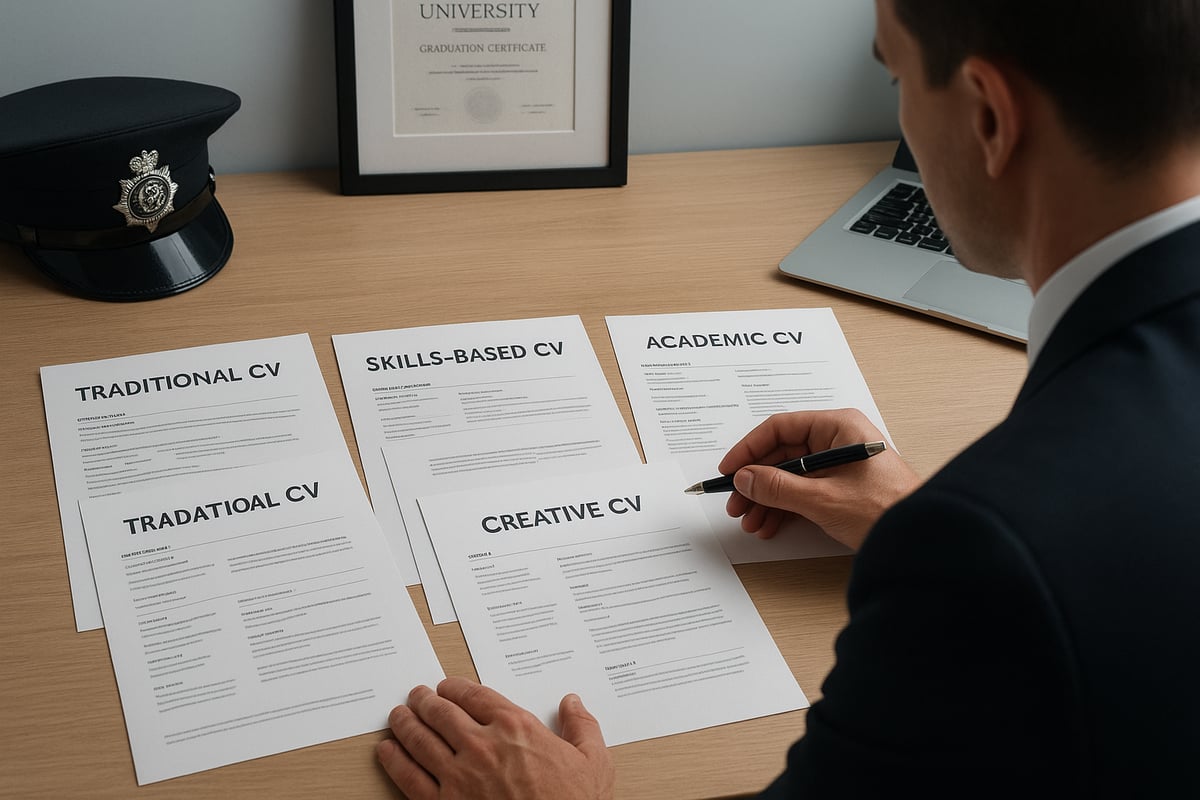
Selecting the right format for your letter and CV is crucial to presenting your experience and skills in the best possible light. The structure you choose should reflect your career stage, sector, and the role you are targeting. Let us explore the main types, each with its own strengths.
Traditional (Chronological) CV
The traditional CV is the most widely used format for a letter and CV. It presents your work and education history in reverse chronological order, making it easy for employers to see your career progression. This style suits recent graduates or those with a steady employment record. For example, a graduate applying for a corporate role would benefit from this straightforward layout, where achievements and responsibilities are clearly detailed.
Skills-Based CV
A skills-based CV works well for those making a career change or with employment gaps. This letter and CV format highlights your transferable skills rather than focusing on the timeline of your work history. Ex-military or ex-police candidates, for instance, can use this style to draw attention to leadership and problem-solving skills, supported by English uniform imagery for context. It is ideal when you want to showcase abilities over a job chronology.
Academic and Creative CVs
For academic careers, the letter and CV should include detailed qualifications, research, and publications. Academic CVs may run longer than two pages to cover all achievements. Creative CVs, on the other hand, allow for visual elements and portfolios to demonstrate creative output. An academic applying for a university research post, or a creative professional seeking a design role, will benefit from tailoring their documents to these sector-specific expectations.
Part-Time and Speculative Applications
When applying for part-time roles or submitting speculative applications, a concise letter and CV are key. Focus on relevant skills, immediate availability, and flexibility. For students, highlighting coursework or extracurricular achievements can make a difference. Speculative CVs should demonstrate initiative, with a brief, targeted approach that appeals to employers who may not be actively recruiting.
Types of Cover Letters & When and Why to Use Each Type
There are two primary cover letter types: responses to advertised jobs and speculative letters. Each letter and CV must be tailored to the opportunity. Advertised job responses directly address the criteria listed, while speculative letters outline what you can offer even if no vacancy is posted. For more on the importance of tailored cover letters, see Are Cover Letters Important and Why. Remember, there is no perfect CV—choose the approach that suits your sector and stage. Always contact John@johnloganbmc.co.uk for expert guidance.
Common Mistakes and How to Avoid Them
Mistakes in your letter and CV can quickly derail your application, even before you reach the interview stage. Understanding where applicants often go wrong is the first step towards a successful job search. By learning to spot these pitfalls, you give yourself a much stronger chance of standing out.
Frequent Pitfalls in CVs
Many applicants make basic errors in their letter and CV that can lead to instant rejection. Common CV pitfalls include:
- Using generic content that is not tailored to the job.
- Spelling and grammar mistakes, even in job titles.
- CVs that are too long, exceeding the two-page limit.
- Inconsistent formatting, unclear headings, or messy layout.
- Including unnecessary personal details, such as date of birth or marital status.
A simple typo can cost you an interview, as recruiters often dismiss CVs with errors in seconds. For more guidance, see Avoid These Common CV Mistakes for a detailed breakdown.
Frequent Pitfalls in Cover Letters
A cover Letter should complement your letter and CV, not repeat it. Yet, many candidates fall into these traps:
- Copying CV content directly into the letter.
- Failing to address the employer’s criteria or person specification.
- Showing little enthusiasm or evidence of research.
- Poor structure or layout makes it hard to read.
- Use a generic salutation, such as “Dear Sir/Madam,” when a name is unavailable.
Sending the same letter to multiple employers is a common error. Employers can spot this lack of effort instantly, reducing your chances of success.
How to Fix and Prevent These Errors
Avoiding these mistakes in your letter and CV requires a proactive approach:
- Proofread all documents carefully and ask someone else to review them.
- Use the job description and person specification as a checklist.
- Customise every CV and LETTER for each application.
- Keep formatting clear and professional, with consistent headings.
- Consider using a CV review service for expert feedback.
By addressing these points, you can ensure your letter and CV reflect your professionalism and attention to detail, increasing your chances of progressing to an interview.
Expert Insights: Maximising Your Application Success
In the rapidly changing 2026 job market, investing in a bespoke letter and CV service can be the difference between landing an interview and being overlooked. John Logan is a leading UK expert renowned for his consultative approach, providing fully tailored support for candidates at every stage, from school leavers to executives and those transitioning from the military or police. Each letter and CV is crafted from scratch, ensuring no templates or AI tools are used, only genuine expertise and attention to detail.
Clients benefit from a free CV review, all-inclusive pricing, and direct, one-to-one support throughout their job search. John Logan’s clients have seen interview rates increase by up to 400% to 500% with ATS-optimised documents. For specialist advice, including unique CV imagery for ex-military or ex-police (featuring authentic English uniforms), contact John at John@johnloganbmc.co.uk. Over 184 five-star reviews highlight the quality and results of this service.
If you want to understand why cover letters remain vital for 2026, see what hiring experts say about their enduring importance.
Five Essential Q&A for 2026 CV and LETTER Success
- How long should my CV be for 2026 applications?
Your CV must be no longer than two pages. Focus on concise, relevant content that directly supports your application. A targeted letter and CV are more effective than a lengthy, generic one. - What’s the best way to tailor my CV and letter for each job?
Study the employer’s criteria, mirror their language, and use specific examples that match their requirements. Adapting your letter and CV for each role will significantly boost your chances. - How important is ATS optimisation in 2026?
ATS optimisation is crucial. Use keywords from the job description, keep formatting simple, and avoid graphics. This helps ensure your letter and CV are seen by human recruiters. - Should I include references on my CV?
List “References available on request” unless asked otherwise. Always seek permission before sharing referee details. - Can I use the same CV and letter for multiple applications?
Never send the same letter and CV to different employers. Customisation is key to standing out. For a professional review, contact John@johnloganbmc.co.uk or visit John Logan’s website.As you set your sights on the opportunities 2026 has to offer, remember that a well-crafted CV and letter can make all the difference in a crowded job market. If you want personalised guidance or a truly tailored approach—no templates, no shortcuts—I’m here to help you present your achievements with confidence and clarity. Whether you’re just starting out, making a career change, or aiming for your next big role, let’s showcase your strengths together and maximise your chances of success. Discover more about my bespoke support at Professional CV Writer UK Bespoke CV Writing Service for Results.