

Send me your CV for a free review to John@johnlogan.co.uk. I'll look through it myself and give you honest, constructive feedback as a professional CV writer.
Creating a graduate level CV represents a pivotal moment in your professional journey. Unlike the academic CVs you may have prepared during university, a graduate level CV must translate your educational achievements, research experience, and academic accomplishments into compelling evidence of your professional potential. This document serves as your introduction to employers, recruiters, and hiring managers who are seeking candidates with advanced qualifications and the ability to contribute meaningfully from day one. Understanding how to craft a graduate level CV that balances academic rigour with professional accessibility is essential for securing interviews and advancing your career prospects in 2026's competitive job market.
Understanding the Graduate Level CV Structure
A graduate level CV differs significantly from both undergraduate CVs and traditional academic curriculum vitae. The structure must accommodate advanced degrees, research experience, publications, and professional competencies whilst remaining concise and accessible to non-academic readers.
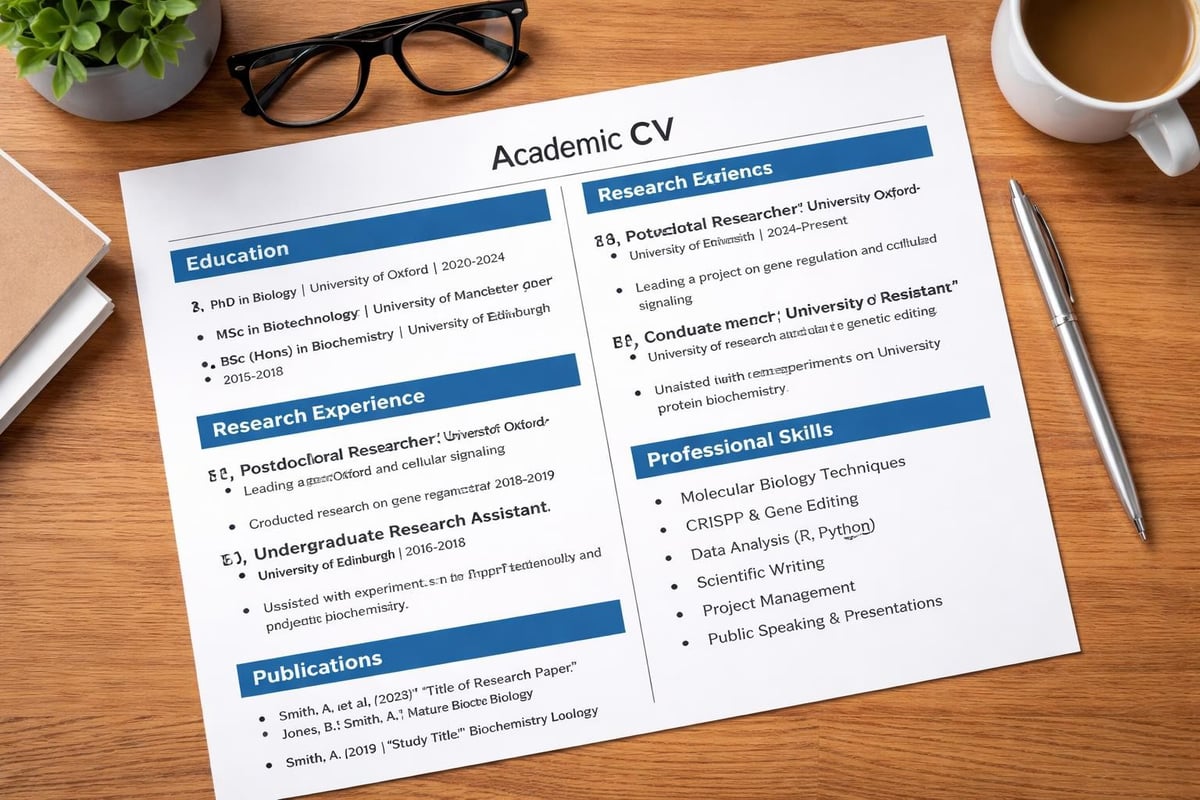
The fundamental sections include personal details, professional profile, education, research experience, publications (if applicable), work experience, skills, and professional memberships. Each section requires careful consideration of what employers actually need to know versus what might be academically impressive but professionally irrelevant.
Essential sections for your graduate level CV:
- Personal Details: Full name, professional email address (John@johnloganbmc.co.uk format), telephone number, and location (city level sufficient)
- Professional Profile: 3-4 lines summarising your graduate-level expertise, research focus, and career objectives
- Education: Master's and doctoral qualifications with institution names, dates, thesis titles, and supervisors
- Research Experience: Detailed account of research projects, methodologies, and outcomes
- Publications and Presentations: Peer-reviewed articles, conference papers, and academic contributions
- Professional Experience: Relevant employment, teaching, and consultancy work
- Technical and Professional Skills: Software, methodologies, languages, and certifications
The University of Wisconsin-Madison’s Writing Center provides comprehensive guidance on CV structure that emphasises the importance of tailoring content to your specific field and target audience.
Length and Format Considerations
Graduate level CVs typically span two to four pages, depending on your research output and professional experience. Unlike undergraduate CVs that should rarely exceed two pages, graduate-level documents warrant additional space to properly showcase research contributions and academic achievements.
However, length must never compromise clarity. Each additional page should add genuine value rather than simply listing every minor academic activity. Employers spend an average of 30-45 seconds on initial CV screening, so your document must communicate key qualifications quickly.
| CV Element | Recommended Length | Priority Level |
|---|---|---|
| Professional Profile | 3-4 lines | High |
| Education Section | 0.5-1 page | High |
| Research Experience | 1-2 pages | High |
| Publications | 0.5-1 page | Medium-High |
| Professional Experience | 0.5-1 page | High |
| Skills and Certifications | 0.25 page | Medium |
Presenting Your Academic Credentials Effectively
Your graduate qualifications form the cornerstone of your CV, but presentation matters enormously. Simply listing degree titles and institutions misses the opportunity to demonstrate the depth and relevance of your advanced study.
For each graduate qualification, include the institution name, qualification title, dates of study, and a brief description of your research focus or dissertation topic. This contextualises your expertise for readers who may not be familiar with specific academic programmes.
Strong example for a Master's degree:
MSc Advanced Computer Science (Distinction) | University of Edinburgh | 2024-2025
Dissertation: "Machine Learning Applications in Healthcare Diagnostics" (Supervised by Prof. Sarah Mitchell)
Specialised modules: Artificial Intelligence, Data Mining, Neural Networks, Advanced Algorithms
This approach immediately communicates not just the qualification itself but the specific expertise you've developed. Cornell University’s Graduate School offers detailed guidance on distinguishing between academic and professional CV formats.
Highlighting Research Contributions
Research experience represents one of the most valuable differentiators in a graduate level CV. However, many candidates struggle to present research in ways that resonate with employers outside academia.
Focus on three key elements: the research question or problem addressed, the methodologies employed, and the outcomes or impact achieved. Avoid excessive jargon whilst maintaining enough technical detail to demonstrate genuine expertise.
Research presentation framework:
- Project title and duration: Clear, descriptive title with specific dates
- Research objectives: What problem were you solving or question addressing?
- Methodologies: Specific techniques, tools, or approaches utilised
- Key findings: Measurable outcomes, discoveries, or contributions
- Impact or applications: How the research contributes to the field or has practical applications
Translating Academic Achievement into Professional Value
The greatest challenge in crafting a graduate level CV involves translating academic accomplishments into language that demonstrates professional value. Employers seek evidence of analytical thinking, problem-solving, project management, and communication skills rather than purely academic credentials.
Consider how your research experience demonstrates project management capabilities. Did you manage timelines, budgets, or collaborations? Did your work require stakeholder engagement, presentation skills, or the ability to synthesise complex information for different audiences?
Academic experience reframed for professional contexts:
- Conducting literature reviews becomes "synthesising complex information from multiple sources to inform decision-making"
- Research design and methodology translates to "developing structured approaches to solve complex problems"
- Data analysis and interpretation demonstrates "extracting actionable insights from quantitative and qualitative data"
- Academic writing shows "communicating technical information clearly to specialist and non-specialist audiences"
- Conference presentations evidences "presenting complex concepts persuasively to diverse stakeholders"
This reframing doesn't diminish your academic achievements; it makes them accessible and relevant to employers who need to understand how your capabilities translate to their organisational challenges. The Studential blog provides additional strategies for positioning graduate qualifications in professional contexts.

Optimising for Applicant Tracking Systems
Modern recruitment increasingly relies on Applicant Tracking Systems (ATS) to filter and rank CVs before human review. Understanding how these systems work proves essential for ensuring your graduate level CV reaches actual decision-makers.
ATS software scans CVs for keywords, qualifications, and specific criteria mentioned in job descriptions. A graduate level CV might contain exceptional research credentials but fail to pass ATS screening if it lacks appropriate keyword optimisation.
ATS Optimisation Strategies
Start by carefully analysing job descriptions for roles you're targeting. Identify recurring keywords, required qualifications, preferred skills, and specific terminology used within the industry or organisation.
Incorporate these keywords naturally throughout your CV, particularly in your professional profile, skills section, and experience descriptions. However, avoid keyword stuffing, which both ATS systems and human readers find off-putting.
ATS-friendly formatting principles:
- Use standard section headings (Education, Experience, Skills) rather than creative alternatives
- Avoid tables, text boxes, headers, and footers that ATS may not parse correctly
- Include both acronyms and full terms (e.g., "Machine Learning (ML)")
- Use standard fonts (Arial, Calibri, Times New Roman) in 10-12 point size
- Save as .docx format unless specifically requested otherwise
- List skills explicitly rather than only embedding them in descriptions
Working with a professional CV writer ensures your graduate level CV achieves optimal ATS performance whilst maintaining the readability and impact essential for human reviewers. Every CV should be written from scratch through a consultative process, with particular attention to how ATS systems evaluate and rank candidates.
Publications, Presentations, and Academic Contributions
For many graduate-level candidates, publications and presentations represent significant achievements that warrant prominent placement. However, the presentation format and level of detail requires careful consideration based on your target roles.
Academic positions demand comprehensive publication lists with full citations. Professional roles outside academia typically require more selective presentation focused on demonstrating expertise and thought leadership rather than exhaustive cataloguing.
| Audience Type | Publication Detail Level | Format |
|---|---|---|
| Academic Employers | Full citations, all publications | Chronological, complete bibliography |
| Research-Focused Organisations | Selected key publications, full citations | Highlight most relevant or impactful |
| General Professional Roles | Brief mention, limited detail | Summary statement or top 2-3 items |
| Industry Positions | Focus on applicable research | Emphasise practical implications |
Publication presentation example (professional context):
Selected Publications:
Logan, J., & Smith, A. (2025). "Sustainable Supply Chain Optimisation Through Predictive Analytics." Journal of Operations Management, 43(2), 156-178.
Logan, J. (2024). "Data-Driven Decision Making in Modern Healthcare." Presented at International Healthcare Innovation Conference, London.
This selective approach maintains credibility whilst avoiding overwhelming readers with extensive academic bibliographies. Grad Central offers additional guidance on balancing academic achievements with professional CV requirements.
Skills Articulation for Graduate Candidates
The skills section of a graduate level CV requires strategic thought beyond simple lists of technical capabilities. Employers seek evidence of both specialist knowledge developed through graduate study and transferable skills applicable across contexts.
Technical Skills Categories:
- Research methodologies (qualitative, quantitative, mixed methods)
- Statistical and analytical software (SPSS, R, Python, MATLAB)
- Laboratory techniques or field research methods
- Discipline-specific tools and technologies
- Data visualisation and presentation software
- Academic and professional writing conventions
Transferable Skills to Emphasise:
- Critical analysis and evidence-based decision making
- Project planning and time management
- Stakeholder communication and collaboration
- Problem-solving and innovative thinking
- Adaptability and continuous learning
- Teaching, mentoring, and knowledge transfer
Demonstrate skills through specific examples rather than unsupported claims. Instead of stating "excellent analytical skills," reference "applied advanced statistical analysis to datasets exceeding 50,000 observations" or "developed novel analytical framework adopted by research team."

Language and International Experience
Graduate study frequently involves international collaboration, conference attendance, or research conducted across multiple countries. These experiences demonstrate cultural competence, adaptability, and global perspectives increasingly valued by employers.
Highlight language capabilities with specific proficiency levels (native, fluent, conversational, basic) and any relevant certifications. International research experience should emphasise collaboration skills, cross-cultural communication, and the ability to work effectively in diverse environments.
Professional Experience Integration
Many graduate-level candidates possess limited traditional employment history, having focused primarily on academic pursuits. However, teaching assistantships, research positions, consultancy projects, and relevant work experience all contribute valuable professional credentials.
Present each role with the same structure you'd use for conventional employment: job title, organisation, dates, and bullet points highlighting responsibilities and achievements. Focus on transferable skills and measurable outcomes rather than purely academic tasks.
Teaching experience example:
Graduate Teaching Assistant | Department of Psychology, University of Manchester | Sept 2024 – June 2025
- Delivered weekly seminars to groups of 25+ undergraduate students, receiving average student satisfaction rating of 4.7/5
- Developed assessment materials and marking rubrics aligned with learning outcomes
- Provided individual academic support through office hours, mentoring 15 students through dissertation projects
- Collaborated with faculty to redesign module content, improving student engagement by 23%
This presentation demonstrates pedagogical skills, communication abilities, mentoring capabilities, and measurable impact, all relevant to employers beyond academic institutions.
According to guidance from Graduate Talent, effectively presenting varied experience types helps graduate candidates compete successfully against those with more traditional career paths.
Tailoring Your Graduate Level CV
Generic CVs rarely succeed in competitive graduate recruitment. Each application demands careful tailoring that aligns your qualifications, research focus, and capabilities with specific role requirements and organisational contexts.
Begin by thoroughly researching the organisation, understanding their challenges, values, and strategic priorities. Review the job description multiple times, identifying not just stated requirements but underlying competencies the employer seeks.
Tailoring checklist:
- Professional profile: Rewrite to emphasise experience and skills most relevant to the specific role
- Research descriptions: Highlight aspects most applicable to the employer's work
- Skills emphasis: Reorder and expand skills matching job requirements
- Achievement selection: Feature accomplishments demonstrating desired capabilities
- Keywords: Incorporate terminology from job description naturally throughout
- Examples: Choose illustrations that resonate with the organisation's context
This tailoring process typically requires 30-60 minutes per application but dramatically increases your success rate. A perfectly tailored graduate level CV demonstrates genuine interest and helps employers immediately recognise your fit for their specific requirements.
Common Graduate CV Mistakes to Avoid
Even highly qualified graduate candidates frequently make preventable mistakes that undermine their CV effectiveness. Understanding these pitfalls helps you craft stronger applications that showcase your capabilities appropriately.
Critical errors to avoid:
- Excessive length without justification: Four pages of marginally relevant detail serves no purpose
- Academic jargon overload: Inaccessible language alienates non-specialist readers
- Lack of achievement quantification: Generic descriptions without measurable outcomes lack impact
- Poor visual hierarchy: Dense text blocks without clear organisation exhaust readers
- Omitting practical applications: Failing to connect research to real-world value
- Inconsistent formatting: Variable date formats, fonts, or spacing appears unprofessional
- Typos and grammatical errors: Mistakes suggest insufficient attention to detail
- Generic objective statements: Vague career goals that could apply to any candidate
Additionally, many graduates either completely omit cover letters or submit generic versions that add no value. Each package should include bespoke cover letters tailored to specific roles you're targeting, as they provide essential context for your graduate level CV and demonstrate genuine interest in particular opportunities.
Questions and Answers
How long should a graduate level CV be?
A graduate level CV typically spans two to four pages, depending on your research output, publications, and professional experience. Master's graduates with limited research output might comfortably fit credentials into two pages, whilst doctoral candidates with extensive publications and research projects may require three or four pages. However, every page must add genuine value. Quality always trumps quantity, so avoid padding your CV with marginally relevant information simply to increase length.
Should I include my undergraduate degree on a graduate level CV?
Yes, include your undergraduate degree with institution name, qualification title, classification, and dates. However, the detail required differs from your graduate qualifications. Whilst your Master's or PhD warrants extensive description including research focus and methodology, your undergraduate degree typically requires only basic information unless it's directly relevant to target roles or represents exceptional achievement (such as a first-class degree from a prestigious institution).
How do I present ongoing doctoral research on my CV?
List your PhD with expected completion date and include "Expected submission: [month, year]" or "Current candidate" to indicate ongoing status. Describe your research project, methodology, and preliminary findings or contributions to date. This demonstrates you possess advanced research capabilities even before formal completion. Include any publications, presentations, or awards achieved during your doctoral study, as these validate your research quality and professional standing.
What's the difference between an academic CV and a graduate level CV for industry positions?
Academic CVs prioritise comprehensive documentation of research, publications, teaching, and scholarly activities, often extending to 10+ pages for senior academics. Graduate level CVs for industry positions require more selective presentation, typically 2-4 pages, emphasising transferable skills, practical applications of research, and professional competencies. Industry CVs should translate academic achievements into language demonstrating business value rather than purely scholarly contribution, whilst maintaining credibility through selective detail.
How can I demonstrate professional experience with limited employment history?
Treat teaching assistantships, research positions, consultancy projects, and relevant internships as professional experience, presenting them with the same structure as conventional employment. Emphasise transferable skills like project management, collaboration, communication, and problem-solving rather than purely academic tasks. Additionally, include volunteer work, professional society involvement, or freelance projects that demonstrate relevant capabilities. Focus on achievements and measurable outcomes that prove your ability to contribute professionally regardless of the formal employment context.
Professional Profile and Personal Statement
The professional profile at the top of your graduate level CV serves as your elevator pitch, distilling your qualifications, expertise, and career objectives into 3-4 compelling lines. This section determines whether readers engage with the detailed content below or move to the next candidate.
Effective profiles balance specificity with accessibility, demonstrating advanced expertise without alienating non-specialist readers. Include your highest qualification, research focus area, key capabilities, and the type of opportunity you're seeking.
Strong profile example:
"Doctoral researcher in Environmental Engineering with expertise in sustainable water treatment technologies and advanced filtration systems. Published author with demonstrated ability to translate complex technical research into practical applications for industrial contexts. Seeking research and development positions where innovative problem-solving and environmental sustainability converge to create measurable impact."
This profile immediately communicates qualification level, specialist knowledge, practical orientation, and clear career direction whilst remaining accessible to HR professionals and hiring managers who may lack technical backgrounds.
Avoid generic statements like "hardworking graduate seeking opportunities to apply skills" or overly academic language that obscures rather than clarifies your value proposition. Every word should serve a strategic purpose in positioning you as an ideal candidate.
Final Presentation and Quality Checks
Before submitting your graduate level CV, invest time in rigorous quality checking that extends beyond simple spell-checking. Professional presentation reflects your attention to detail and commitment to excellence.
Comprehensive quality checklist:
- Consistency: Verify date formats, punctuation, capitalisation, and spacing remain uniform throughout
- Contact details: Ensure email address (John@johnloganbmc.co.uk) and telephone number are current and professional
- Accuracy: Confirm all dates, qualifications, publications, and institutional names are precisely correct
- Grammar and spelling: Review multiple times, ideally with fresh eyes after time away from the document
- Formatting: Check that sections align properly, bullet points are consistent, and visual hierarchy guides readers naturally
- File naming: Save as "Firstname_Lastname_CV.docx" rather than generic "CV.docx" or "Document1.docx"
- PDF conversion: When submitting as PDF, verify all formatting transfers correctly and links function
Consider seeking feedback from careers services, mentors, or professional contacts in your target industry. External perspectives often identify unclear sections or opportunities for stronger presentation that you've overlooked through familiarity with your own materials.
Send me your CV for a free review to John@johnlogan.co.uk. I'll look through it myself and give you honest, constructive feedback as a professional CV writer.
Crafting an effective graduate level CV requires strategic thinking about how to present advanced qualifications, research achievements, and academic credentials in ways that resonate with employers across diverse contexts. The investment you make in developing a tailored, professionally presented CV directly influences your access to career opportunities worthy of your graduate-level expertise. John Logan Consulting and Mentoring offers bespoke CV writing services specifically designed for graduate-level candidates, with a completely personal and consultative approach that ensures your CV showcases your achievements, strengths, and career story compellingly and professionally.