

Creating a compelling CV for uni students presents unique challenges that differ significantly from traditional career documents. University students often lack extensive work history, yet they possess valuable skills, academic achievements and experiences that employers genuinely value. Understanding how to translate your academic journey, society memberships, volunteer work and part-time roles into professional language can transform a simple CV into a powerful marketing tool. This guide explores the strategies that help student CVs stand out and secure internships, graduate schemes and entry-level opportunities.
Understanding What Makes a Student CV Different
A CV for uni students requires a fundamentally different approach compared to CVs written by established professionals. Rather than focusing primarily on employment history, your document must showcase potential, transferable skills, and academic excellence.
Your education becomes the cornerstone of your CV, particularly when you’re in your first or second year. This isn’t a weakness but an opportunity to demonstrate intellectual capability, subject expertise, and analytical thinking. Employers recruiting graduates understand this dynamic and actively look for evidence of learning agility and curiosity.
A strong CV for university students should begin with contact details and a concise professional summary, followed by education, relevant work experience, additional experience, skills, achievements and certifications. Interests can also be included where they add value or demonstrate qualities relevant to the role being applied for.
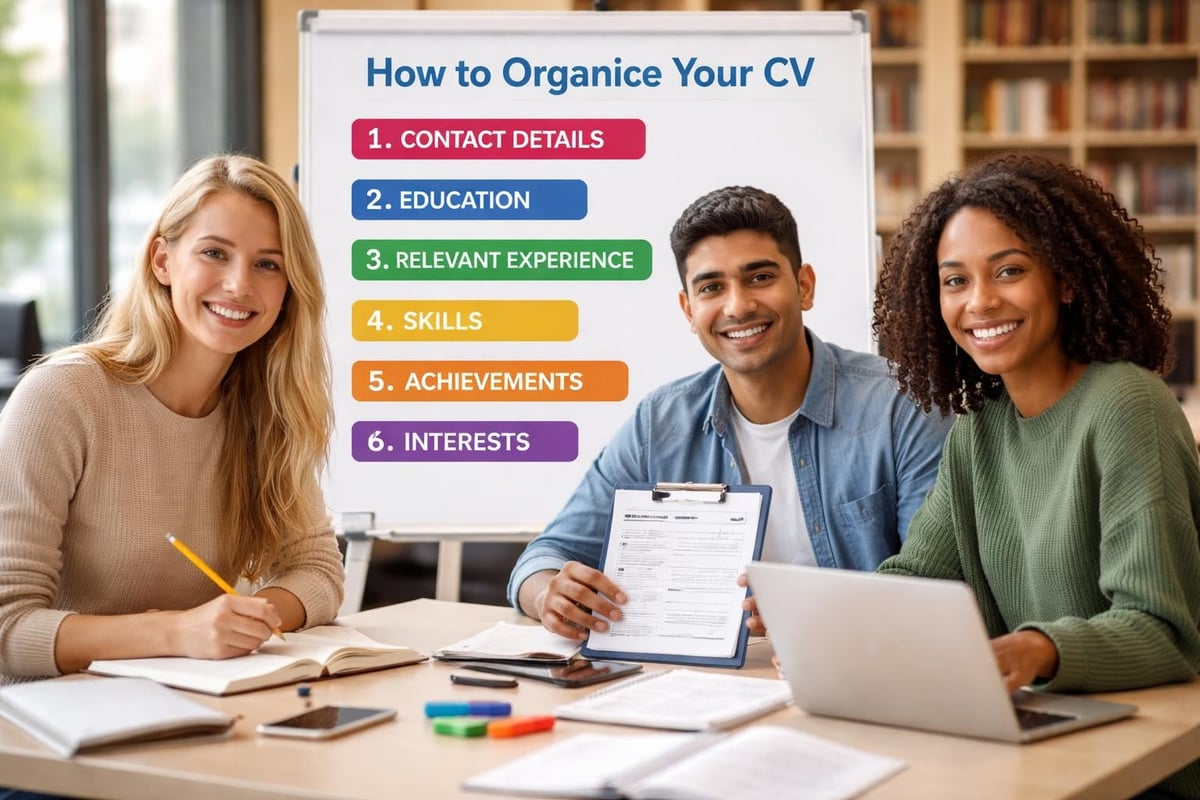
Crafting Your Education Section for Maximum Impact
Your education section deserves considerably more detail than it would on an experienced professional’s CV. This is where a CV for uni students truly differentiates itself.
Your education section should clearly include your degree title, university, expected graduation date, relevant modules, dissertation or major project details and any notable academic achievements such as scholarships, awards or strong module results. This section should provide employers with a clear understanding of your academic strengths and areas of expertise.
Making Your Modules Work Harder
Rather than listing every module you’ve studied, select those most relevant to your career aspirations. If you’re targeting marketing roles, highlight modules in consumer behaviour, digital marketing, or brand management. For finance positions, emphasise econometrics, financial analysis, or corporate finance.
Consider this approach:
Relevant Modules: Digital Marketing Strategy (76%), Consumer Psychology (81%), Data Analytics for Business (78%)
Including your marks for strong-performing modules demonstrates academic excellence whilst showing subject-specific knowledge. This detail matters particularly for competitive graduate schemes where hundreds of applications arrive for limited positions.
Translating Academic Work into Professional Experience
Many students underestimate the professional value of their academic projects, group work, and research assignments. A well-crafted CV for uni students transforms these experiences into compelling evidence of workplace-ready skills.
Your dissertation or major project often represents months of independent research, problem-solving, and project management. Frame it professionally:
Final Year Dissertation: “The Impact of Social Media Influencers on Gen Z Purchasing Behaviour”
Designed and conducted a primary research survey with 300+ respondents
Analysed quantitative data using SPSS statistical software
Presented findings to academic panel, achieving 74% mark
Developed time management skills whilst balancing research alongside part-time employment
This approach demonstrates research methodology, technical skills, presentation abilities, and time management rather than simply stating a dissertation title.
Group Projects as Team Experience
Collaborative academic work provides a genuine teamwork experience. Academic projects, presentations, research assignments and group work all help develop transferable skills that employers value. These experiences demonstrate communication, teamwork, analytical thinking, problem-solving and project management capabilities that are directly relevant to graduate employment.
Maximising Part-Time Work and Volunteering
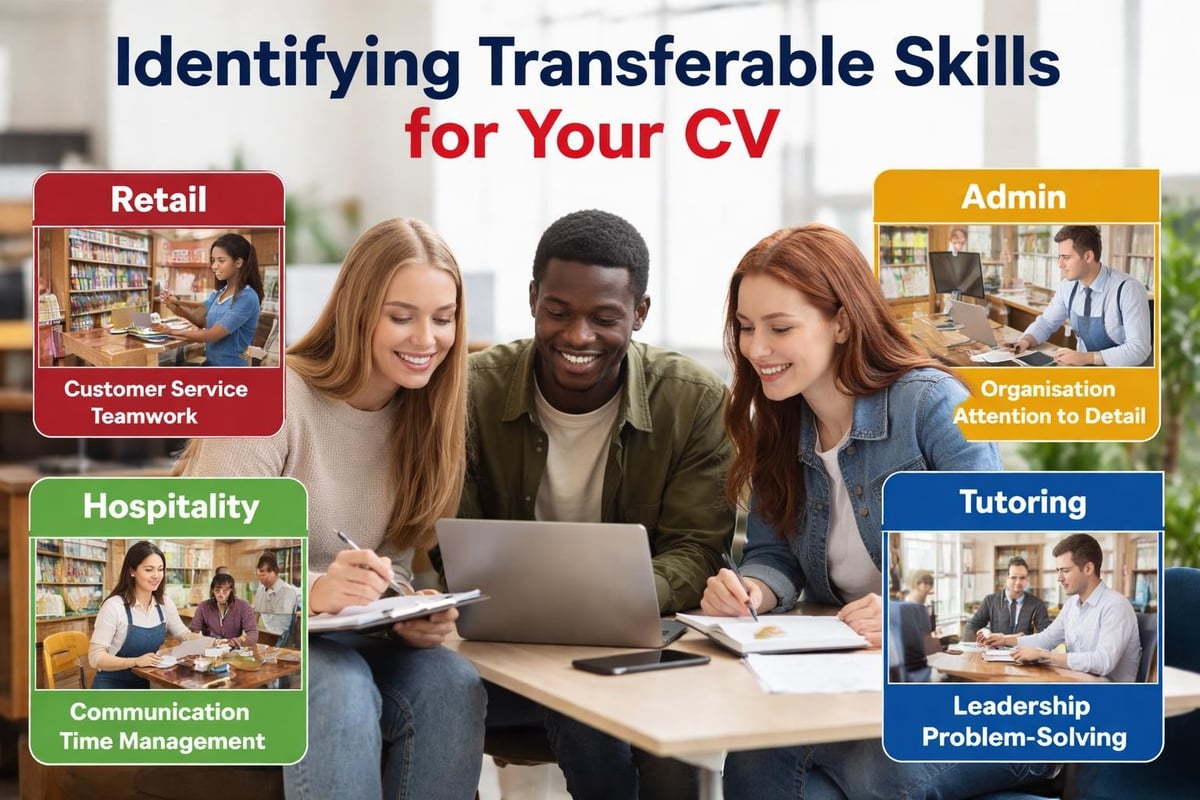
The part-time work section of a CV for uni students often contains hidden gold that students fail to extract. Whether you’ve worked in retail, hospitality, tutoring, or administrative roles, these positions develop crucial transferable skills.
Transforming “Basic” Jobs into Skill Demonstrations
A position as a retail assistant becomes evidence of customer service excellence, cash handling accuracy, sales performance, and potentially supervisory experience. Frame these roles using achievement-focused bullet points:
Sales Assistant, High Street Retailer (September 2024 – Present)
Consistently exceed monthly sales targets by 15-20% through product knowledge and customer engagement
Train new team members on till systems and customer service protocols
Manage stock inventory and coordinate with suppliers to maintain optimal product availability
Resolve customer complaints professionally, maintaining 98% satisfaction rating
Volunteering That Demonstrates Values and Skills
Volunteering experience strengthens a CV for uni students considerably, particularly when it demonstrates commitment, values, and skill development. Whether you’ve volunteered at charity shops, mentored younger students, or organised fundraising events, these experiences matter.
Present volunteering with the same professional approach as paid work:
Student Mentor, University Access Programme (October 2025 – March 2026)
Mentored five Year 12 students from underrepresented backgrounds, considering university applications
Delivered weekly sessions on UCAS applications, personal statements, and student finance
Supported mentees in selecting appropriate courses and universities based on their strengths
Four of five mentees successfully secured university offers for September 2026 entry
This demonstrates leadership, communication, planning, and genuine commitment to social mobility.
Society Involvement and Leadership Positions
Active participation in university societies provides excellent content for a CV for university students. Committee positions, event organisation, and society leadership demonstrate initiative, teamwork, and often budget management.
Presenting Society Roles Professionally
Many students list society memberships without conveying the actual responsibilities or achievements involved. Transform these into meaningful experiences:
Social Secretary, University Marketing Society (September 2025 – Present)
Organise monthly networking events attracting 50-80 students and industry professionals
Manage society’s social media accounts, growing Instagram following from 200 to 850 followers
Coordinate with local businesses to secure sponsorship worth £2,000 for the annual conference
Work collaboratively with a committee of eight students to deliver society’s strategy
This approach shows event management, digital marketing, stakeholder engagement, and financial awareness rather than merely stating “member of marketing society.”
Skills Section: Showing Rather Than Telling
The skills section of a CV for uni students must balance honesty with confidence. Avoid vague claims like “excellent communication skills” without context or evidence.
Technical and Digital Skills
List specific software, tools, and technical capabilities:
Data Analysis: Advanced Excel (pivot tables, VLOOKUP, macros), SPSS, Tableau
Design: Adobe Creative Suite (Photoshop, InDesign, Illustrator – intermediate level)
Programming: Python (basic), HTML/CSS (proficient), SQL (learning)
Languages: Spanish (fluent – C1), French (conversational – B1)
Providing proficiency levels adds credibility and helps employers assess your capabilities accurately. When discussing professional CV writing services, the emphasis on specificity and evidence-based claims consistently produces stronger candidate positioning.
Transferable Soft Skills with Context
Rather than listing soft skills in isolation, integrate them throughout your experience descriptions. However, if including a skills section, provide a brief context:
Project Management: Successfully delivered six group projects to deadline whilst coordinating teams of 4-6 members
Problem-Solving: Resolved technical issues for 20+ customers weekly in an IT support role
Commercial Awareness: Regularly analyse market trends and competitor activity for retail position
Tailoring Your CV for Different Opportunities
A critical element of an effective CV for uni students involves customisation for each application. Generic CVs rarely succeed in competitive recruitment processes.
Before applying for any role, carefully analyse the job description to identify essential requirements, desirable skills and key competencies. Research the organisation, understand its values and consider how your experiences, studies and achievements align with what the employer is seeking.
Adjusting Content Strategically
Tailoring your CV involves prioritising the most relevant experience, highlighting achievements that align with the role and selecting examples that demonstrate the competencies requested by the employer. Small adjustments can significantly improve the relevance and effectiveness of your application.
For a marketing role, emphasise your social media management, content creation, and campaign analysis. For a finance position, highlight numerical analysis, attention to detail, and financial modelling projects.
Different opportunities require different emphasis. Graduate schemes often prioritise academic achievement and leadership potential, internships focus on enthusiasm and relevant coursework, whilst part-time and voluntary roles may place greater emphasis on reliability, availability and transferable skills.
Addressing Common Student CV Challenges
Creating a CV for uni students means confronting several common obstacles. Understanding how to navigate these challenges strengthens your final document significantly.
Limited Work Experience
If you have limited work experience, focus on academic projects, coursework, volunteering, society involvement and extracurricular activities that demonstrate transferable skills. Employers understand that students may not have extensive employment histories and are often more interested in potential, attitude and evidence of capability.
Quality matters more than quantity. Two well-described relevant experiences outperform five vague bullet points.
Employment Gaps
Many students work during term time but not holidays, or vice versa. Address this naturally by including date ranges that explain the pattern:
Retail Assistant, Local Bookshop (Term-time only, September 2024 – Present)
This transparency prevents recruiters from questioning unexplained gaps whilst demonstrating your ability to balance work and studies.
Explaining Career Changes
If you’re studying a subject different from your previous career interests or A-level choices, briefly explain this transition in your personal statement. This shows self-awareness and clear decision-making rather than appearing unfocused.

Formatting and Presentation Standards
A CV for uni students must meet professional formatting standards whilst remaining readable and visually appealing. Poor formatting can undermine strong content immediately.
Essential Formatting Guidelines
A student CV should be professionally formatted, easy to read and no longer than two pages. Use a clear font, consistent spacing and straightforward section headings. Save the document as a PDF wherever possible to ensure formatting remains consistent across different devices and recruitment systems
Visual Hierarchy and Readability
Good formatting helps recruiters navigate your CV quickly. Use bold text for job titles, employers and educational institutions, maintain consistent formatting throughout and ensure section headings are clear and easy to identify. A clean and professional layout improves readability and creates a stronger first impression.
The Personal Statement for Student CVs
A personal statement or professional summary at the top of a CV for uni students serves as your elevator pitch. This 3-4 line paragraph must capture attention immediately.
Crafting an Effective Opening
Your opening personal statement should briefly explain who you are, what you are studying, your key strengths and the type of opportunity you are seeking. The objective is to give employers an immediate understanding of your potential and career direction.
Example:
“Second-year Business Management student at the University of Manchester with strong analytical capabilities and demonstrated commercial awareness through retail leadership roles. Seeking summer internship opportunities in marketing to apply academic knowledge of consumer behaviour and digital strategy whilst developing practical industry experience in fast-paced commercial environments.”
This tells the reader exactly who you are, what you offer, and what you’re seeking in fewer than 50 words.
Tailoring Your Personal Statement
Write a master version, then adapt it for each application. Change the target role, emphasise different strengths, and adjust the tone to match the company culture (more creative for agencies, more formal for professional services firms).
Beyond the Basics: Standing Out Strategically
Whilst a solid CV for uni students covers all essential sections competently, exceptional CVs incorporate strategic elements that differentiate candidates in competitive markets.
Quantifying Achievements
Whenever possible, support your achievements with measurable evidence such as percentages, team sizes, budgets managed, people mentored, projects completed or improvements achieved. Quantifiable results provide credibility and help employers understand the impact of your contributions.
Compare these statements:
Weak: “Helped increase sales in retail position”
Strong: “Contributed to 23% quarter-on-quarter sales increase through proactive customer engagement and product recommendations”
Industry-Relevant Certifications
Short online courses, certifications, and professional qualifications strengthen a CV for uni students considerably. Industry-relevant certifications can strengthen a student CV considerably. Qualifications such as Google Analytics, HubSpot certifications, Microsoft Office Specialist accreditation, First Aid training or Mental Health First Aid demonstrate initiative, continuous learning and a genuine commitment to professional development beyond academic studies.
Many of these are free or low-cost but signal a genuine interest in professional development beyond your degree requirements.
Awards and Recognition
Academic and non-academic awards provide valuable third-party validation of your abilities. Scholarships, bursaries, academic excellence awards, sports achievements, leadership awards, competition successes and recognition for volunteering all help demonstrate achievement, commitment and potential to future employers.
Understanding ATS and Digital Applications
Modern recruitment processes for graduate positions typically involve Applicant Tracking Systems (ATS) that scan CVs before human review. A CV for uni students must navigate this technology effectively.
ATS-Friendly Formatting
To maximise compatibility with Applicant Tracking Systems, use standard section headings, straightforward formatting and keywords that appear naturally within the job description. Avoid excessive graphics, unusual fonts and complex layouts that may prevent recruitment software from reading your CV correctly.
Keyword Integration
Review job descriptions carefully and incorporate relevant terminology naturally throughout your CV. If a graduate scheme mentions “stakeholder management,” and you’ve coordinated with multiple societies or departments, use that exact phrase when describing the experience.
However, avoid keyword stuffing. ATS technology has become sophisticated enough to identify and penalise obviously manipulated content.
Cover Letters: The Essential Companion Document
Whilst this guide focuses on CVs, it’s worth noting that a CV for uni students rarely succeeds in isolation. Bespoke cover letters provide essential context, explain your motivation for specific roles, and demonstrate your understanding of the organisation and its needs. They allow you to address directly how your academic background and limited experience still make you an excellent candidate for particular opportunities.
Proofreading and Quality Control
Even the most impressive content loses impact when undermined by typos, grammatical errors, or inconsistencies. A CV for uni students represents your attention to detail and professionalism.
Multi-Stage Review Process
Before submitting your CV, review the content carefully for accuracy, consistency and relevance. Check spelling and grammar, confirm that dates and formatting are consistent throughout and ask another person to review the document for errors or areas that could be strengthened.
Keeping Your CV Current and Dynamic
A CV for uni students should evolve continuously as you gain new experiences, complete additional modules, and develop fresh skills. Treat it as a living document rather than something created once and forgotten.
Regular Update Schedule
Your CV should be reviewed regularly throughout your studies. Update it whenever you complete a new project, gain work experience, achieve strong academic results, receive an award or take on additional responsibilities. Regular updates ensure opportunities can be pursued quickly without having to reconstruct achievements from memory.
This approach ensures you never scramble to remember details from months ago when opportunities arise unexpectedly.
Maintaining Multiple Versions
Many students benefit from maintaining several versions of their CV tailored towards different career paths. For example, one version may focus on marketing opportunities, another on finance, consulting or graduate schemes. This makes tailoring applications quicker and improves relevance when applying for specific roles.
Save these with clear file names and update them in parallel. When opportunities arise, you’ll have targeted foundations ready for final customisation.
Writing a student CV can be challenging when you have limited professional experience. However, employers are often looking for potential, transferable skills and evidence that you can learn, adapt and contribute positively to their organisation.
I work with students and graduates across the UK to create bespoke CVs that highlight academic achievements, transferable skills and future potential. Every CV is developed through detailed one-to-one consultation, ensuring your strengths, achievements and career ambitions are presented clearly and professionally.
Learn more about my Professional CV Writing Service and discover how a professionally written CV can help you secure internships, placements and graduate opportunities.
Frequently Asked Questions
How long should a CV for uni students be?
For first and second-year students with limited experience, one page is often sufficient and preferable. Third-year students and those with substantial work experience, internships, or society involvement can extend to two pages. Never exceed two pages regardless of content volume, as recruiters expect concise, relevant information rather than exhaustive detail.
Should I include my secondary school qualifications on my CV?
Yes, include your A-levels (or equivalent) with subjects and grades, particularly if they’re strong and relevant to your target roles. However, as you progress through university and gain more experience, this section becomes less prominent. By graduation, A-levels typically appear as a single line. GCSEs can be summarised as “10 GCSEs including Maths and English (Grades 4-9)” rather than listing each subject individually.
How do I write a CV when I have no work experience at all?
Focus heavily on your education section, including relevant modules, projects, and academic achievements. Expand on group work, presentations, and research that demonstrate transferable skills. Include any volunteering, society involvement, or extracurricular activities. Consider whether you have informal experience like babysitting, tutoring, or helping with family business that demonstrates responsibility and reliability. Even without formal employment, you possess valuable skills and experiences that employers recognise.
Is it appropriate to include hobbies and interests on a student’s CV?
Yes, when they’re relevant, distinctive, or demonstrate valuable qualities. Generic interests like “reading” or “socialising” add little value. However, specific interests that show dedication (competitive sport, musical performance to high standard), creativity (blogging, photography with portfolio), or relevance to target roles (economics podcast enthusiast for finance roles) strengthen your application. Interests provide conversation starters in interviews and help you stand out as a rounded individual.
How often should I tailor my CV for different applications?
Every application deserves a tailored CV that responds to the specific requirements and company culture. This doesn’t mean rewriting from scratch each time, but rather adjusting emphasis, reordering experiences, selecting different examples, and ensuring keywords from the job description appear naturally. The investment of 20-30 minutes per application significantly increases your success rate compared to sending identical generic CVs to multiple opportunities.
Creating an effective CV for uni students requires strategic thinking about how to position limited professional experience alongside valuable academic achievements and transferable skills. By focusing on relevant content, professional presentation, and tailored applications, you can create a compelling document that opens doors to internships, placements, and graduate opportunities. If you’re struggling to translate your university experiences into professional language or need expert guidance on crafting a CV that truly represents your potential, John Logan Consulting and Mentoring provides bespoke, consultative CV writing services that help students compete confidently in graduate recruitment markets.