
Send me your CV for a free review to John@johnlogan.co.uk. I'll look through it myself and give you honest, constructive feedback as a professional CV writer.
Creating a well-structured CV is the foundation of any successful job application in the UK. Whether you're entering the workforce for the first time, changing careers, or seeking progression, having a solid basic UK CV template gives you the framework to present your qualifications clearly and professionally. Understanding the fundamental structure, essential sections, and British conventions ensures your CV meets employer expectations whilst showcasing your individual strengths. In 2026, the competition for quality roles remains fierce, making it crucial that your CV follows recognised standards whilst standing out through content quality rather than unconventional formatting.
Understanding the Core Structure of a Basic UK CV Template
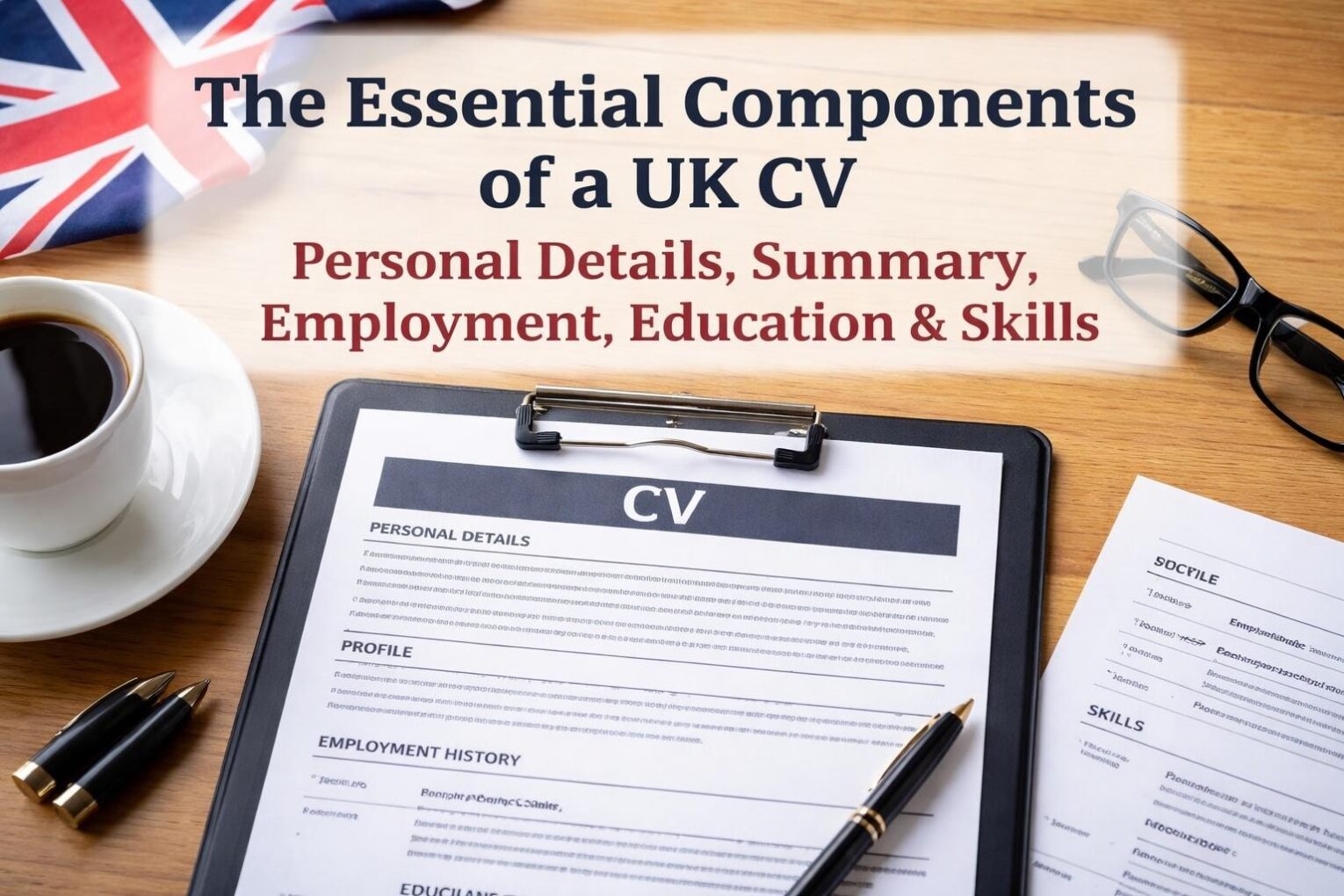
A basic UK CV template follows a logical hierarchy that makes information easy to locate and digest. The standard structure begins with personal contact details at the top, followed by a professional summary or personal statement, employment history in reverse chronological order, education, and relevant skills.
Essential sections every basic UK CV template must include:
- Personal contact information
- Professional summary or profile
- Employment history with dates and achievements
- Education and qualifications
- Key skills relevant to your target role
- References line (or available upon request)
The beauty of a basic UK CV template lies in its simplicity and universal applicability. Unlike creative industries where design-led CVs might be appropriate, most sectors prefer a clean, straightforward layout that prioritises content over decoration. According to guidance from CV layout experts, clarity and legibility should always take precedence over complex formatting.
Personal Details Section
Your personal details section requires minimal but essential information. Include your full name prominently at the top, professional email address (avoid outdated or unprofessional addresses), mobile number, and location (city and county are sufficient). There's no need to include your full postal address, date of birth, nationality, or photograph unless specifically requested. In 2026, data protection awareness means less is genuinely more when it comes to personal information on CVs.
Most recruiters spend approximately 30 seconds on an initial CV scan, so making contact details immediately visible and professional sets the right tone from the outset.
Crafting an Effective Professional Summary
The professional summary sits directly beneath your contact details and serves as your elevator pitch. This paragraph of 3-5 sentences should encapsulate who you are professionally, your key strengths, and what you're seeking. A basic UK CV template typically allocates 50-80 words to this section, making every word count.
Rather than generic statements about being "hardworking" or a "team player," focus on tangible expertise and measurable experience. For example, "Qualified accountant with seven years' experience in SME financial management, specialising in cost reduction strategies that have saved employers an average of 15% annually" conveys far more value than vague descriptors.
Tailoring Your Summary to Each Application
Whilst your basic UK CV template provides the structure, the content should never be entirely static. The professional summary offers the perfect opportunity to align your CV with specific role requirements. If applying for a project management position emphasising stakeholder engagement, your summary should highlight relevant relationship-building achievements. For a role focused on process improvement, emphasise efficiency gains you've delivered.
This tailored approach demonstrates genuine interest in the specific opportunity rather than mass-application tactics that recruiters instantly recognise. When working through a professional CV writer service, this strategic customisation forms a core part of the consultative process, ensuring your CV speaks directly to each employer's priorities.
Structuring Your Employment History
The employment history section forms the substantive core of any basic UK CV template. List positions in reverse chronological order, with your most recent or current role first. For each position, include the job title, employer name, location (city), and dates of employment (month and year format).
| Element | Format | Example |
|---|---|---|
| Job Title | Bold, clear | Senior Marketing Manager |
| Company & Location | Regular text | Digital Solutions Ltd, Manchester |
| Dates | Month Year – Month Year | March 2022 – Present |
| Responsibilities | Bullet points | • Managed £500K annual budget |
Beneath each role heading, describe your responsibilities and achievements using bullet points. This format enhances readability and allows recruiters to quickly identify relevant experience. Start each bullet point with strong action verbs like "delivered," "managed," "implemented," or "achieved" rather than passive phrases beginning with "responsible for."
Quantifying Achievements Within Your Template
Numbers speak louder than descriptions alone. Whenever possible, quantify your contributions within the basic UK CV template structure. "Increased sales by 34% year-on-year" or "reduced processing time from 48 hours to 6 hours" provides concrete evidence of your impact. Even in roles where metrics aren't obvious, you can reference team sizes managed, budgets controlled, projects completed, or stakeholders served.
The Institute of the Motor Industry advises that demonstrating measurable impact significantly strengthens any CV, regardless of sector. This principle applies whether you're in automotive engineering, healthcare, education, or financial services.
Handling Employment Gaps
Employment gaps are increasingly common and less stigmatised in 2026, but they still require thoughtful handling within your basic UK CV template. Brief gaps (under six months) rarely need explanation on the CV itself. For longer periods, consider including a simple line such as "Career break for family responsibilities" or "Professional development period" with dates. The CV isn't the place for lengthy explanations; save detailed context for cover letters or interviews.
Education and Qualifications Section
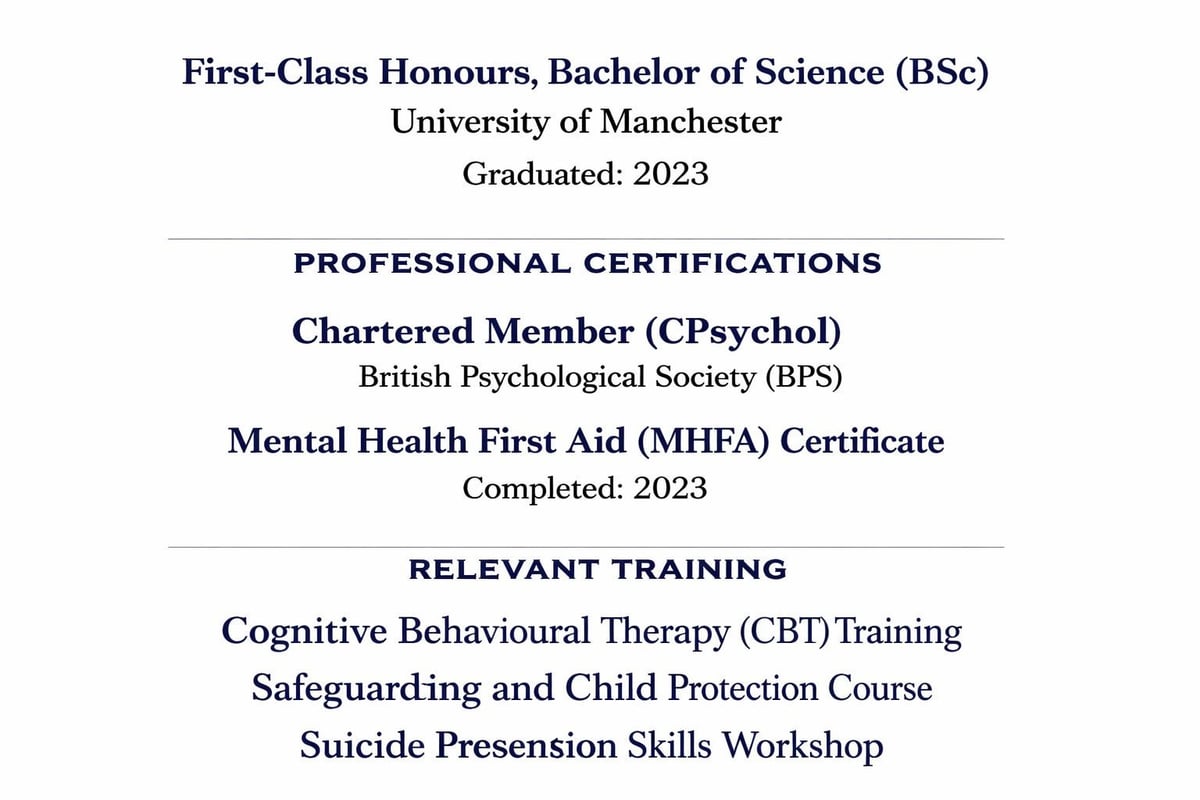
The education section in a basic UK CV template should be concise yet comprehensive. List qualifications in reverse chronological order, including the qualification name, institution, and dates. For recent graduates, education typically appears before employment history. For experienced professionals, it moves below your work experience.
What to include in the education section:
- Degree classifications and subjects
- A-Levels with grades (if recent or particularly strong)
- Professional certifications and memberships
- Relevant training courses and CPD
- Industry-specific qualifications
There's no need to include GCSEs if you have higher qualifications, unless specific subjects are directly relevant to your target role. Similarly, whilst module details might seem impressive, they consume valuable space better used highlighting achievements and skills unless the modules directly match job requirements.
Skills Section Configuration
The skills section in a basic UK CV template serves multiple purposes. It provides a snapshot of your capabilities, helps with Applicant Tracking System (ATS) keyword matching, and offers recruiters quick confirmation that you possess essential requirements. Organise skills into logical categories rather than listing them randomly.
Technical and Professional Skills
Technical skills encompass software proficiency, machinery operation, technical methodologies, or specialised knowledge. In 2026, digital literacy across most roles means including relevant software packages (Microsoft Office Suite, industry-specific platforms, project management tools) has become standard practice. However, avoid listing outdated or universally expected skills unless specifically mentioned in job descriptions.
Professional skills might include project management methodologies (Agile, PRINCE2), quality frameworks (Six Sigma, ISO standards), or sector-specific competencies. When using a basic UK CV template, resist the temptation to include every skill you've ever developed. Focus on those most relevant to your target roles, as highlighted by recruitment specialists who review thousands of applications annually.
Soft Skills and Their Place
Soft skills (communication, leadership, problem-solving) pose a challenge within a basic UK CV template because they're harder to evidence and easier to claim. Rather than simply listing "excellent communication skills," demonstrate them through achievements: "Presented quarterly results to board of 12 directors" or "Managed team of 8 through organisational restructure."
If you include a dedicated soft skills section, keep it brief (4-6 items maximum) and ensure each skill is substantiated somewhere within your employment history descriptions.
Formatting and Presentation Standards
A basic UK CV template succeeds through clean, professional presentation. Use a standard, readable font like Arial, Calibri, or Times New Roman in 10-12 point size. Maintain consistent formatting throughout: if you bold job titles, bold all job titles; if you use bullet points in one role description, use them in all.
Formatting best practices for British CVs:
- Set margins to 2-2.5cm on all sides
- Use single line spacing within sections, double between sections
- Limit use of italics, bold, and underline to essential emphasis
- Ensure adequate white space for readability
- Keep to two A4 pages maximum (one page for recent graduates)
- Save and send as PDF to preserve formatting
The two-page standard for UK CVs is well-established, unlike some international markets where single pages or lengthy documents are normal. As UK CV format guides consistently emphasise, British employers expect concise, focused CVs that respect their time whilst providing sufficient detail to assess suitability.
Digital Considerations for 2026
In 2026, approximately 75% of medium-to-large employers use Applicant Tracking Systems (ATS) to filter applications before human review. Your basic UK CV template must be ATS-friendly, which means avoiding tables for your main content, headers/footers containing crucial information, or complex formatting that software can't parse. Stick to standard section headings that ATS algorithms recognise: "Employment History" or "Work Experience" rather than creative alternatives like "My Journey."
Simple, clean templates consistently outperform elaborate designs when it comes to ATS compatibility, making the basic UK CV template approach not just traditional but strategically sound for modern recruitment processes.
Common Mistakes to Avoid
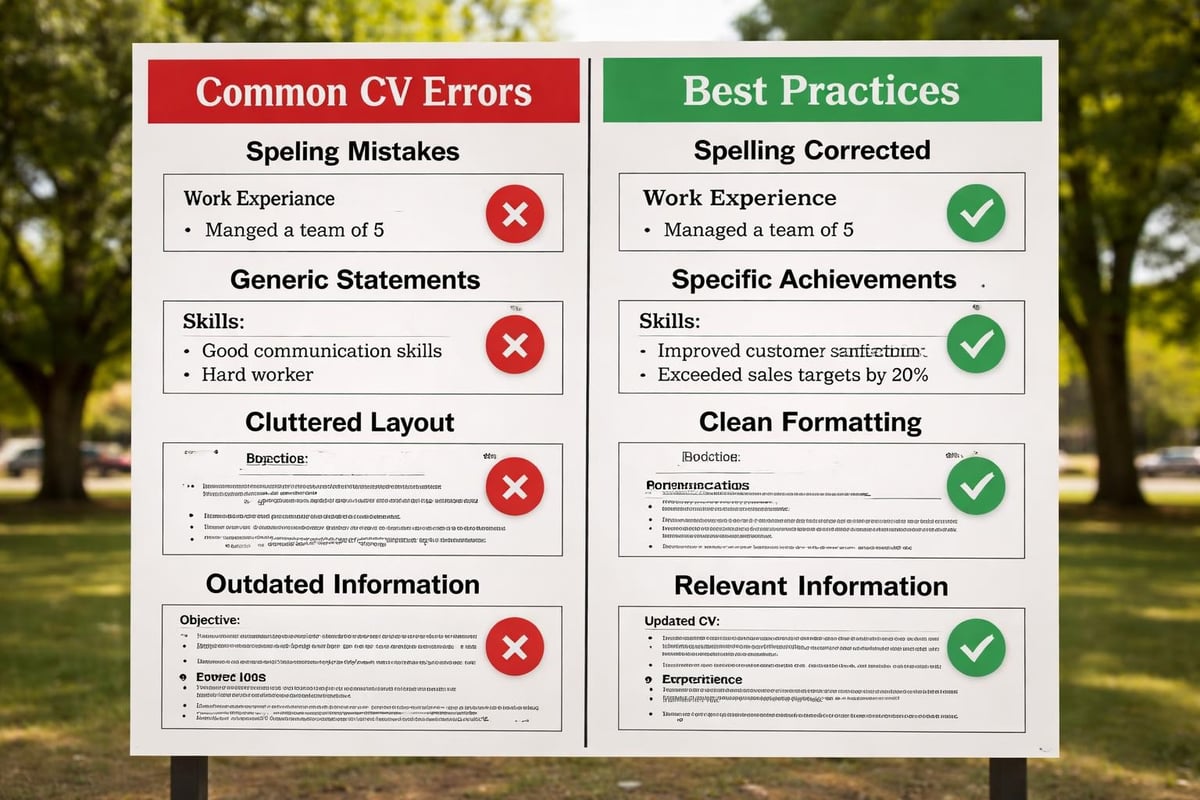
Even with a solid basic UK CV template, certain errors can undermine your application. Spelling and grammatical mistakes remain the most common CV killers, with research suggesting 58% of recruiters reject CVs containing errors. Proofread meticulously, use spell-check tools, and ideally have someone else review your CV before submission.
| Mistake | Why It Matters | Solution |
|---|---|---|
| Unexplained employment gaps | Raises concerns about reliability | Address briefly with context |
| Generic personal statements | Suggests mass applications | Tailor to each role |
| Overcrowding with information | Reduces readability | Be selective and concise |
| Irrelevant work history | Wastes valuable space | Focus on relevant experience |
| Poor contact details | Can't reach you for interview | Use professional, current information |
Another frequent mistake is including references directly on the CV. The standard practice in the UK is simply stating "References available upon request" at the bottom. This saves space and allows you to prepare referees appropriately when employers actually request contact.
Length and Relevance Balance
Struggling to fit everything into two pages often indicates insufficient editing rather than exceptional experience. A basic UK CV template forces prioritisation, which is actually beneficial. Entry-level positions from 15 years ago that bear no relation to your current career direction don't deserve the same space as recent, relevant roles. Consider condensing older or less-relevant positions into a single line or omitting them entirely if they don't strengthen your application.
Adapting Your Template for Different Career Stages
The basic UK CV template structure remains consistent, but emphasis shifts depending on career stage. Recent graduates with limited employment history should expand the education section to include relevant coursework, dissertations, or academic projects. They might also include a more substantial skills section and incorporate university society involvement or volunteer work to demonstrate capabilities.
Mid-career professionals typically lead with substantial employment history, with education becoming a brief factual section. The professional summary gains importance, positioning you for progression rather than entry. Skills become more specialised, reflecting expertise rather than foundational knowledge.
Senior professionals face the challenge of extensive experience requiring strategic selection. A basic UK CV template for executive roles might condense positions held more than 15 years ago whilst expanding recent leadership achievements. Board memberships, advisory roles, and thought leadership activities (publications, speaking engagements) become relevant additions.
Additional Sections to Consider
Beyond the core components, certain optional sections can strengthen a basic UK CV template when relevant. Professional memberships demonstrate ongoing commitment to your field (Chartered Institute of Marketing, Royal Institute of British Architects, Association of Chartered Certified Accountants). Include membership number and chartered status where applicable.
Volunteer experience merits inclusion when it demonstrates transferable skills or fills employment gaps constructively. "Treasurer for local sports club managing £40K annual budget" shows financial capability regardless of whether it was paid work.
Languages are worth listing if you have functional proficiency or better, using recognised frameworks (Common European Framework levels: A1-C2) to indicate competency. In 2026's globalised workplace, additional languages increasingly provide competitive advantages even for UK-based roles.
Publications and Professional Development
For academic, research, or technical roles, a publications section listing relevant papers, articles, or presentations can be valuable. Keep to the most significant or recent items, using consistent citation formatting. Similarly, recent professional development courses, certifications, or training programmes show commitment to staying current in your field.
When incorporating these sections into a basic UK CV template, ensure they add genuine value rather than padding. Each section should support your target role; irrelevant qualifications or memberships dilute impact rather than enhancing it.
Working with Your Template Effectively
A basic UK CV template is a starting framework, not a finished product. The real work lies in populating it with compelling, relevant content that positions you effectively for your target roles. Save your master CV containing everything, then create tailored versions for different application types, adjusting the professional summary, emphasising different achievements, and reordering skills to match job descriptions.
When applying for roles requiring bespoke cover letters, ensure your CV and covering letter work in harmony, with the letter providing context and narrative whilst the CV delivers factual evidence. The two documents should complement rather than simply repeat each other.
Regular updates keep your basic UK CV template current. Rather than scrambling to remember achievements when job hunting, maintain a running document of accomplishments, metrics, and projects. Every quarter, review and update your CV with recent developments, ensuring you never lose track of valuable examples.
Digital Formats and Versions
Maintain your basic UK CV template in both Word and PDF formats. Word allows easy editing for tailoring applications, whilst PDF preserves formatting when submitting. Name files professionally: "John_Smith_CV_2026" rather than "CV_final_version2_updated." Some employers specify their preferred format; always follow application instructions precisely.
Consider maintaining a plain text version for applications requiring cut-and-paste submissions or form completions. Strip all formatting but maintain clear section breaks and readability.
Questions and Answers
Should a basic UK CV template include a photograph?
No, unless specifically requested. Unlike some European countries where photographs are standard, UK recruitment best practice excludes photos to support bias-free hiring. Including an unsolicited photograph can actually disadvantage you, as employers may remove it or discount your application to avoid discrimination concerns. Focus instead on content that demonstrates your suitability for the role.
How far back should employment history extend in a basic UK CV template?
Generally, 10-15 years of detailed employment history is sufficient for most roles. Earlier positions can be briefly listed under "Previous Employment" with job title, employer, and dates only, or omitted entirely if they don't add value. Recent graduates naturally have shorter histories, but mid-career and senior professionals should prioritise recent, relevant experience over comprehensive career chronicles.
Can I use colour in a basic UK CV template for 2026?
Minimal, professional colour use is acceptable but not necessary. A subtle colour for headings (navy, dark grey) can add polish whilst maintaining professionalism. However, avoid multiple colours, bright shades, or anything that compromises readability when printed in black and white. Many recruiters still print CVs for interviews, and ATS systems ignore colour entirely, so it should never carry essential information.
Is it acceptable to have a one-page CV using a basic UK CV template?
For recent graduates or those with limited experience, a one-page CV is acceptable and sometimes preferable to a sparsely populated second page. However, most professionals with 3+ years' experience should use the full two pages available in British CV conventions. A one-page CV from an experienced candidate often suggests insufficient detail or poor space utilisation rather than admirable conciseness.
Should hobbies and interests feature in a basic UK CV template?
Hobbies merit inclusion only if they're genuinely relevant, impressive, or demonstrate valuable attributes. "Marathon runner" suggests determination and goal-setting; "Captain of regional hockey team" shows leadership. Generic interests like "reading" or "socialising" waste space. For senior roles, hobbies typically disappear entirely as professional achievements take precedence. If you're struggling for space, this section should be the first to go.
Optimising for Applicant Tracking Systems
Understanding how ATS software processes your basic UK CV template helps ensure your application reaches human reviewers. These systems scan CVs for keywords matching job descriptions, parse information into databases, and rank candidates based on relevance scores. Approximately 70% of applications never reach human eyes due to ATS filtering.
ATS optimisation strategies:
- Use standard section headings (Education, Employment, Skills)
- Include keywords from job descriptions naturally within your content
- Avoid headers/footers for important information
- Use standard fonts and simple formatting
- Spell out acronyms at first use, then use abbreviations (e.g., "Customer Relationship Management (CRM)")
- Submit in requested format (usually .docx or .pdf)
Don't keyword-stuff your basic UK CV template; ATS systems in 2026 are sophisticated enough to penalise obvious manipulation. Instead, genuinely align your content with role requirements, using industry terminology naturally within achievement descriptions.
Sector-Specific Considerations
Whilst a basic UK CV template provides universal structure, certain sectors have specific expectations. Healthcare professionals typically include professional registration numbers and detailed clinical competencies. Teaching CVs often expand on qualifications, safeguarding training, and specific subject expertise. Engineering roles might require project details and technical specifications that other sectors wouldn't need.
Legal CVs traditionally follow a highly standardised format emphasising education credentials prominently, whilst creative sector CVs might incorporate portfolio links (though the fundamental structure remains consistent). Understanding your sector's norms ensures your basic UK CV template aligns with employer expectations rather than working against them.
For military personnel transitioning to civilian roles, translating service experience into business-relevant language is crucial. Rather than military-specific terminology, reframe achievements in terms civilian employers recognise: leadership, project management, logistics, training delivery, or risk assessment.
Maintaining Professional Standards Throughout
Consistency demonstrates attention to detail, a quality every employer values. Throughout your basic UK CV template, ensure date formats match (either "March 2026" or "03/2026" but not both), bullet point styles remain consistent, and spacing is uniform. These small details collectively create an impression of professionalism and thoroughness.
Contact details deserve particular attention. Ensure your email address is professional (firstname.lastname@provider.co.uk rather than party_animal94@provider.co.uk) and that your voicemail message is appropriate should employers call. In 2026, your online presence extends your CV; ensure LinkedIn profiles align with your CV content to avoid discrepancies that raise concerns.
If you're uncertain whether your basic UK CV template meets professional standards, seeking expert review can provide valuable perspective. Sending your CV to John@johnloganbmc.co.uk for professional feedback helps identify areas for improvement before submitting applications to employers.
A well-structured basic UK CV template provides the foundation for successful applications, but the quality of content within that framework determines outcomes. By following British conventions, prioritising relevant achievements, and tailoring content to specific roles, your CV becomes a powerful tool for career progression. If you'd like expert guidance on transforming your CV from functional to exceptional, John Logan Consulting and Mentoring offers personalised, consultative CV writing services that position you confidently for your next opportunity, with every document crafted from scratch to reflect your unique strengths and career aspirations.
Send me your CV for a free review to John@johnlogan.co.uk. I'll look through it myself and give you honest, constructive feedback as a professional CV writer.