

Send me your CV for a free review to John@johnlogan.co.uk. I’ll look through it myself and give you honest, constructive feedback as a professional CV writer.
Creating a CV for experienced professionals requires a fundamentally different approach than entry-level applications. With years of achievements, multiple roles, and expanded responsibilities, the challenge isn’t finding content to include but rather selecting the most strategic information that positions you for your next senior opportunity. Your CV must communicate leadership capability, strategic thinking, and measurable impact whilst remaining concise and ATS-compliant. This comprehensive guide explores how to craft a compelling document that opens doors to executive and senior-level positions.
Understanding the Senior-Level CV Framework
A CV for experienced professionals serves as a strategic marketing document rather than a comprehensive career history. The fundamental difference lies in focus: whilst junior CVs emphasise potential and education, senior CVs must demonstrate proven leadership, commercial acumen, and transformational achievements.
The typical structure includes:
- Professional profile highlighting strategic expertise
- Core competencies aligned with target roles
- Career achievements with quantified results
- Employment history focused on recent, relevant positions
- Education and professional qualifications
The optimal length remains two pages, regardless of experience level. Many professionals mistakenly believe extensive experience justifies a longer document, but managing extensive work experience effectively requires ruthless editing and strategic selection.
Positioning Your Professional Profile
Your opening profile sets the tone for the entire document. This 4-6 line summary must communicate your seniority, sector expertise, and unique value proposition immediately. Unlike junior CVs that focus on aspirations, experienced professional profiles articulate established credibility.
Consider these elements:
- Current or most recent senior title and sector
- Years of experience at strategic level
- Key areas of expertise (commercial, operational, transformational)
- Quantified career highlight or defining achievement
- Professional approach or leadership philosophy
The language must reflect senior-level thinking. Replace phrases like “responsible for managing” with “directed” or “led strategic transformation of”. Every word should convey authority and capability.
Crafting Achievement-Focused Content
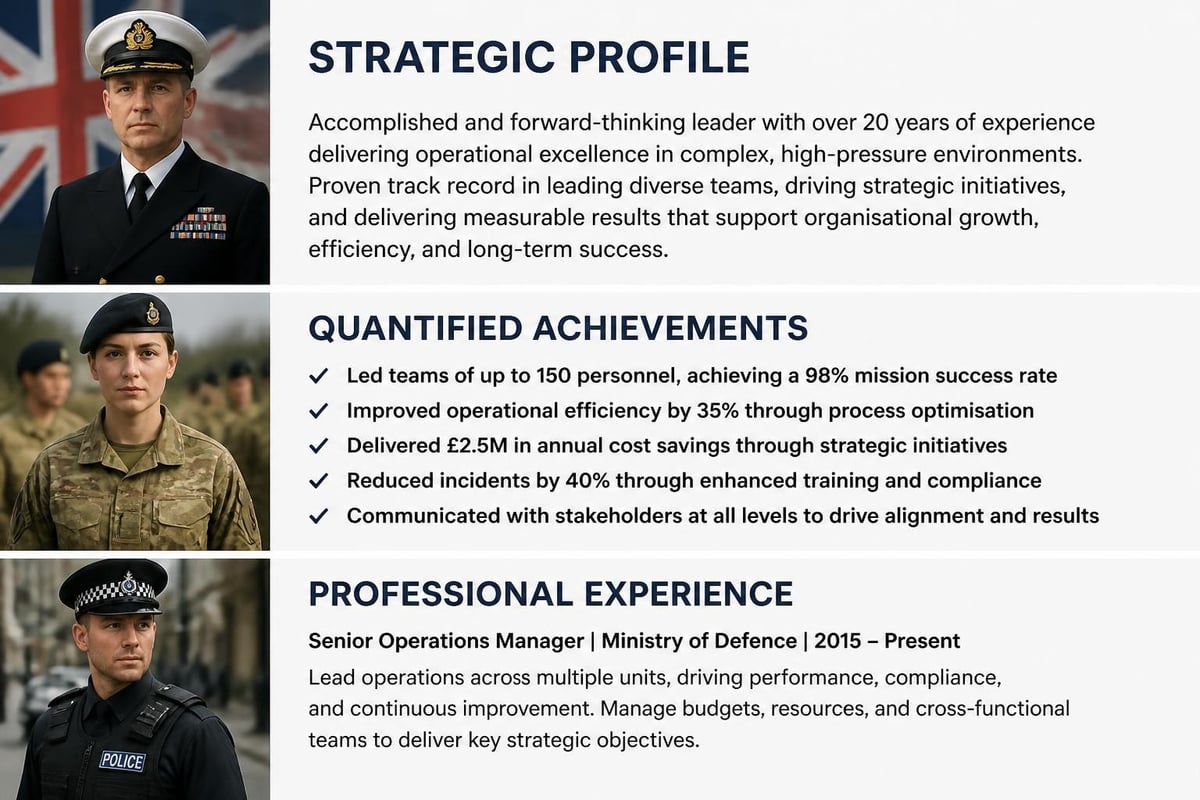
The most critical element of a CV for experienced professionals involves transforming job descriptions into achievement narratives. Hiring managers at senior level aren’t interested in duties; they want evidence of impact, innovation, and results.
The Achievement Formula
Each achievement should follow this structure:
- Context: What was the situation or challenge?
- Action: What strategic approach did you implement?
- Result: What measurable outcome did you deliver?
| Weak Statement | Achievement-Focused Statement |
|---|---|
| Managed finance team | Restructured finance function of 12 professionals, implementing automated reporting systems that reduced month-end close from 10 days to 4 days whilst improving forecast accuracy by 23% |
| Responsible for client relationships | Developed strategic partnership framework that elevated 15 key accounts to preferred supplier status, generating £4.2M additional revenue and improving retention by 34% |
| Led marketing department | Directed integrated marketing transformation across digital and traditional channels, delivering 156% ROI improvement and reducing customer acquisition cost by 41% |
When selecting which achievements to include, prioritise those demonstrating:
- Revenue generation or cost reduction
- Team leadership and development
- Process improvement and efficiency gains
- Strategic initiatives and transformation
- Cross-functional collaboration and stakeholder management
According to research on effective CV content organization, experienced professionals should emphasise accomplishments that showcase progression in responsibility and strategic thinking.
Navigating ATS Systems at Senior Level
Applicant Tracking Systems (ATS) present particular challenges for experienced professionals. The sophistication required in senior-level CVs must be balanced with ATS compatibility, ensuring human readers appreciate your strategic capability whilst algorithms successfully parse your information.
ATS optimisation strategies include:
- Using standard section headings (Professional Experience, Education)
- Incorporating relevant keywords from job descriptions naturally
- Avoiding complex formatting, tables, or graphics
- Presenting dates and locations consistently
- Saving documents as .docx format unless specified otherwise
Understanding how to optimise CVs for AI bots and ATS systems has become essential in 2026. However, experienced professionals must resist the temptation to keyword-stuff, which appears unsophisticated and undermines credibility.
Balancing Keywords with Executive Presence
The challenge involves weaving industry terminology and role-specific keywords throughout your CV whilst maintaining the polished, strategic tone expected at senior level. Rather than creating a separate “skills” section listing keywords, integrate them within achievement statements and your professional profile.
For a Finance Director role, instead of listing “financial planning, budgeting, forecasting”, write: “Directed comprehensive financial planning transformation, implementing zero-based budgeting methodology and rolling forecasting models that improved accuracy by 28% and supported £15M strategic investment decisions.”
This approach satisfies ATS requirements whilst demonstrating sophisticated application of these capabilities. When you work with a professional CV writer, this balance between ATS optimisation and executive positioning becomes seamless, ensuring your document performs well in both automated and human review processes.

Addressing Career Complexity and Longevity
A CV for experienced professionals often involves navigating complex career histories: multiple roles at one organisation, career changes, redundancies, or periods of consulting. Strategic presentation of this complexity separates effective senior CVs from problematic ones.
Managing Multiple Roles at One Organisation
When you’ve progressed through several positions at a single employer, demonstrate this advancement clearly:
Company Name, Location | 2018 – Present
Operations Director | January 2023 – Present
[3-4 achievement bullets]
Senior Operations Manager | March 2020 – December 2022
[2-3 achievement bullets]
Operations Manager | June 2018 – February 2020
[1-2 achievement bullets]
This structure showcases progression whilst avoiding repetition. Focus detailed achievements on your most recent, senior position.
Handling Career Gaps Strategically
Experienced professionals may have gaps due to redundancy, further education, sabbaticals, or family commitments. Address these confidently:
- For redundancy: Focus on the role’s achievements, not the departure circumstances
- For career breaks: Include if relevant (e.g., “Career Break” with dates, brief explanation if value-adding)
- For consulting periods: Consider consolidating multiple short assignments under a consulting heading
The key principle: your CV should raise questions you’re comfortable answering in interview, not create concerns that prevent you reaching that stage.
Selecting Relevant Experience
One of the biggest challenges in creating a CV for experienced professionals involves deciding which roles to include and how much detail each deserves. With potentially 20+ years of experience, comprehensive inclusion creates an unwieldy, unfocused document.
Strategic selection criteria:
- Recency: Roles from the past 10-15 years deserve detailed treatment
- Relevance: Positions aligning with target roles merit more space
- Seniority: Senior positions require more comprehensive coverage
- Achievement quality: Roles with exceptional, quantifiable achievements justify inclusion
For positions beyond 15 years or early-career roles, consider a brief “Early Career” section:
Early Career Background
Marketing Manager, ABC Corporation (2008-2011)
Marketing Executive, XYZ Limited (2005-2008)
This acknowledges your full career whilst maintaining focus on recent, relevant experience. Guidance on structuring content for senior-level positions emphasises this selective approach.
Formatting and Presentation Excellence
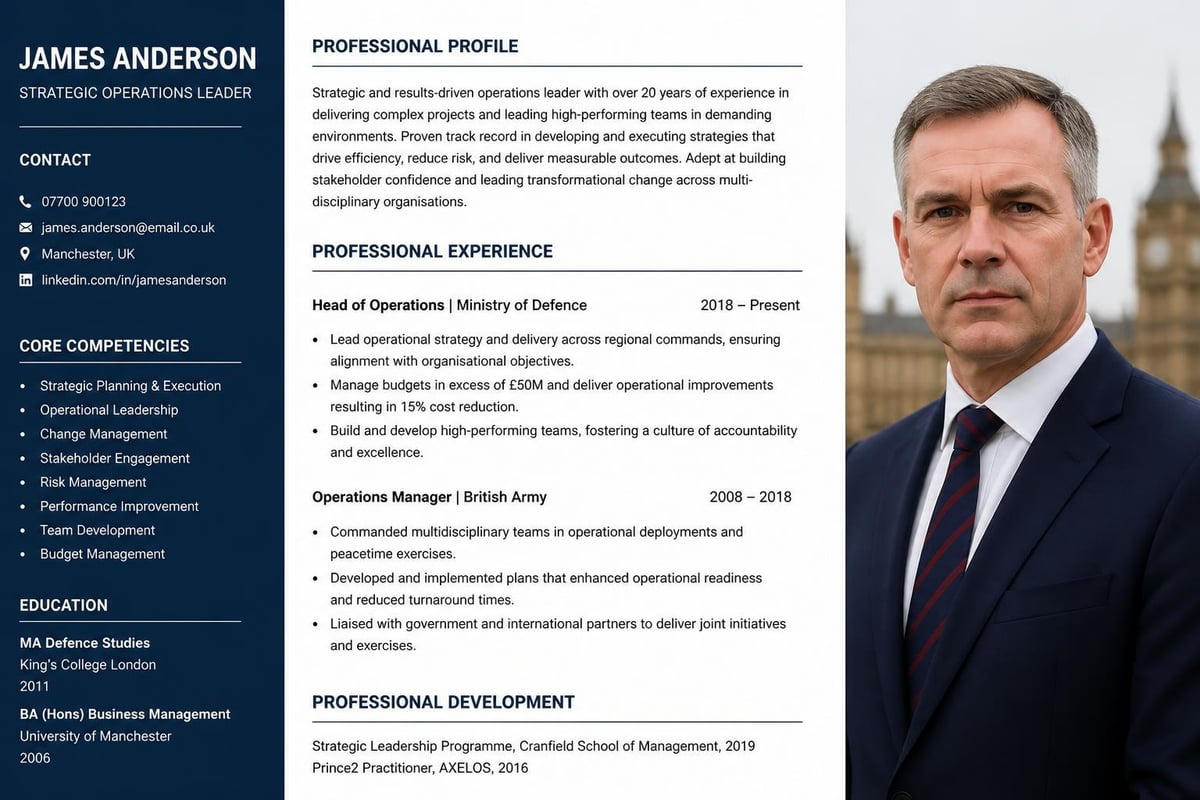
At senior level, your CV’s visual presentation communicates professionalism before a single word is read. Whilst ATS compatibility limits design complexity, experienced professionals can still create polished, sophisticated documents.
| Element | Recommended Approach | Avoid |
|---|---|---|
| Font | Professional (Arial, Calibri, Cambria) 10-11pt | Decorative or serif fonts below 10pt |
| Margins | 1.5-2cm all sides | Margins below 1cm appearing cramped |
| Length | Two pages maximum | Three+ pages or single-page compression |
| Colour | Black text, possible subtle accent colour for name/headings | Multiple colours, backgrounds, graphics |
| File name | “John-Smith-CV.docx” | Generic “CV.docx” or version numbers |
Professional Profile vs. Personal Statement
Experienced professionals should use a “Professional Profile” or “Executive Summary” heading rather than “Personal Statement” or “About Me”. The terminology reflects seniority and strategic positioning.
Similarly, avoid including:
- Date of birth or age
- Marital status or children
- Full address (city/region sufficient)
- Photograph (unless specifically required in your sector)
- References or “References available upon request”
These elements either waste valuable space or introduce potential bias unrelated to your professional capability.
Tailoring for Specific Opportunities
Generic CVs rarely succeed at senior level. Each application deserves a tailored version emphasising the most relevant experience, achievements, and competencies for that specific role. This doesn’t mean rewriting your entire CV; rather, strategic adjustment of emphasis and keywords.
The Tailoring Process
- Analyse the job specification: Identify critical requirements, desired experience, and key competencies
- Review your CV through this lens: Which achievements best demonstrate these capabilities?
- Adjust your professional profile: Incorporate role-specific keywords and priorities
- Reorder achievement bullets: Place most relevant accomplishments first
- Update competencies section: Align with the role’s technical and leadership requirements
This process typically takes 45-60 minutes per application but dramatically increases your success rate. Research into creating effective CVs consistently shows tailored applications significantly outperform generic submissions.
When targeting roles at https://johnloganbmc.co.uk/cv-writing/, this consultative, bespoke approach ensures every element aligns with your specific career goals and target positions.
Education and Professional Development
For experienced professionals, education moves toward the end of your CV, but its presentation still matters. The approach differs significantly from graduate applications.
Include:
- Degree title, institution, and year (class of degree optional unless First or Distinction)
- Professional qualifications relevant to your field (ACCA, CIPD, CMI, etc.)
- Significant executive education or leadership programmes
- Current professional memberships
Omit:
- GCSEs or Standard Grades (A-Levels only if no degree)
- Modules, dissertation titles, or academic details
- Grades unless exceptional and recent
- Incomplete qualifications unless currently in progress and relevant
Continuous Professional Development
Including recent, relevant professional development demonstrates commitment to excellence and current knowledge. However, don’t list every webinar or half-day workshop attended over your career.
Strategic inclusion might feature:
- Executive leadership programmes from recognised business schools
- Industry-specific certifications or accreditations
- Significant training in emerging areas (AI, digital transformation, etc.)
- Speaking engagements or publications demonstrating thought leadership
Position these strategically: significant programmes might warrant mention in your professional profile, whilst others appear in a dedicated “Professional Development” section.
Common Pitfalls to Avoid
Creating a CV for experienced professionals involves avoiding mistakes that undermine your senior positioning. These errors frequently appear in self-written senior CVs:
The autobiography approach: Your CV isn’t a comprehensive career history but a targeted marketing document. Resist including every role, project, or responsibility you’ve ever held.
Jargon overload: Whilst industry terminology demonstrates expertise, excessive jargon or acronyms without context creates confusion. Remember, your CV might be initially reviewed by HR professionals rather than technical experts.
Underselling achievements: Many experienced professionals feel uncomfortable “boasting” and present their accomplishments too modestly. Strategic self-promotion isn’t arrogance; it’s professional necessity.
Template dependency: Generic CV templates rarely serve experienced professionals well. Your career complexity, sector requirements, and strategic positioning need bespoke structure and content organisation.
Inconsistent formatting: Dates presented differently across sections, varying bullet styles, or inconsistent spacing appears unprofessional at senior level.
For further guidance on writing competitive applications, consider how your document compares to best-practice standards for experienced professionals.
Industry-Specific Considerations
Different sectors require nuanced approaches to CV presentation. Whilst core principles remain consistent, understanding industry expectations enhances your CV’s effectiveness.
| Sector | Key Considerations |
|---|---|
| Finance | Emphasise regulatory knowledge, commercial acumen, and quantified financial impact |
| Technology | Balance technical expertise with strategic leadership and business transformation |
| Healthcare | Highlight clinical governance, operational improvement, and patient outcome metrics |
| Education | Feature academic leadership, research impact, and institutional development |
| Public Sector | Emphasise policy development, stakeholder management, and service improvement |
Experienced professionals transitioning between sectors face additional challenges. Your CV must translate achievements into language and metrics the new sector values. A manufacturing Operations Director targeting retail operations might reframe “production efficiency improvements” as “supply chain optimisation” and “quality management systems” as “operational excellence frameworks”.
Questions and Answers
How long should a CV for experienced professionals be?
A CV for experienced professionals should remain two pages maximum, regardless of career length. Senior hiring managers expect concise, strategic documents focused on recent, relevant achievements rather than comprehensive career histories. If you struggle to fit 20+ years into two pages, prioritise the past 10-15 years with detailed achievements, summarise earlier roles briefly, and eliminate less relevant positions entirely.
Should I include all my work experience on my CV?
No. Include detailed information for roles from the past 10-15 years, with decreasing detail for older positions. Consider creating an “Early Career” section summarising roles beyond 15 years in a single line per position. Focus on relevance: if an older role demonstrates critical experience for your target position, include more detail. The goal is strategic selection, not comprehensive documentation.
How do I handle multiple promotions at the same company?
List the company once with your tenure dates, then show each role separately underneath with individual date ranges and achievement bullets. Focus most detail on your current or most recent position, with progressively fewer bullets for earlier roles. This structure demonstrates career progression whilst avoiding repetition and maintaining appropriate emphasis on senior-level achievements.
What’s the difference between a senior CV and a junior CV?
A CV for experienced professionals emphasises strategic leadership, measurable business impact, and transformational achievements rather than duties and responsibilities. The language reflects executive-level thinking, focusing on directing, transforming, and delivering results. Senior CVs prioritise recent, relevant experience over comprehensive career history and assume sector knowledge rather than explaining basic concepts. The tone is confident and authoritative, with sophisticated vocabulary and strategic positioning.
How do I make my CV stand out for executive roles?
Focus on quantified achievements demonstrating commercial impact, strategic thinking, and leadership capability. Use powerful, executive-level language that conveys authority. Tailor every application to the specific role, emphasising the most relevant experience and competencies. Ensure flawless presentation, sophisticated vocabulary, and strategic content organisation. Consider the value of working with a professional who understands executive positioning and can help you articulate your career story compellingly.
Leveraging Professional Expertise
Creating an effective CV for experienced professionals requires not just understanding best practices but implementing them with sophistication and strategic insight. The difference between a good senior CV and an exceptional one often lies in subtle positioning, language choices, and achievement articulation that only comes from extensive recruitment and CV writing experience.
Many experienced professionals understandably struggle with self-promotion, translating technical achievements into business language, or knowing which of their many accomplishments will resonate most powerfully with hiring managers. This challenge intensifies when balancing ATS requirements with the executive presence expected at senior level.
Working with someone who understands both recruitment processes and strategic CV positioning can transform your application success rate. A consultative approach that involves detailed discussion of your career journey, achievements, and goals produces far superior results to template-based or AI-generated documents. The investment in professional CV writing typically returns itself many times over through faster job search timelines, better role quality, and improved salary negotiations.
When selecting support, look for professionals with recruitment backgrounds who understand what hiring managers actually want, can articulate your achievements compellingly, and create bespoke documents tailored to your specific situation and goals rather than using generic templates or automated processes.
Maintaining Your CV Strategically
Your CV shouldn’t be a document you update only when job hunting. Experienced professionals benefit from maintaining their CV as a living document, updated quarterly with new achievements, qualifications, and responsibilities.
Quarterly maintenance approach:
- Review recent projects and initiatives for quantifiable achievements
- Update job titles, responsibilities, or reporting lines if changed
- Add new qualifications, certifications, or professional development
- Remove or condense older, less relevant information
- Refresh language to reflect current industry terminology
This ongoing approach serves multiple purposes beyond job applications. An updated CV supports:
- Annual performance reviews and promotion discussions
- Professional accreditation renewals
- Speaking engagement or conference submissions
- LinkedIn profile optimisation
- Unexpected opportunities requiring quick response
Keep a separate “achievement bank” document where you record accomplishments, projects, and metrics as they occur. When updating your CV, you’ll have rich material to draw from rather than trying to remember details from months or years ago.
Crafting a compelling CV for experienced professionals requires strategic thinking, achievement-focused content, and sophisticated presentation that positions you for senior opportunities. By focusing on measurable impact, tailoring each application, and maintaining executive-level language throughout, you’ll create a document that opens doors to your next career advancement. If you’re ready to transform your career story into a powerful, professionally written CV that truly represents your experience and potential, John Logan Consulting and Mentoring offers bespoke CV writing services built on decades of recruitment expertise, with a consultative approach that ensures your unique achievements and strategic capabilities are positioned compellingly for your target roles.
Send me your CV for a free review to John@johnlogan.co.uk. I’ll look through it myself and give you honest, constructive feedback as a professional CV writer.