

Transitioning from military service to civilian employment represents one of the most significant career shifts you’ll ever make. The challenge isn’t your capability or experience-it’s how you present it. The resume format for military to civilian transition requires a completely different approach to showcasing your expertise, achievements, and skills. Where military documentation emphasises rank, units, and operational procedures, civilian employers need to understand your transferable skills, leadership capabilities, and tangible results. Getting this translation right can mean the difference between securing interviews at leading organisations and having your CV overlooked entirely. Many service leavers benefit from a Professional CV Writing Service during this transition.
Understanding the Fundamental Differences Between Military and Civilian CVs
Military documentation follows strict protocols, standardised formats, and technical language that makes perfect sense within the Armed Forces. Civilian CVs operate in an entirely different environment where clarity, brevity, and commercial relevance take priority.
The most critical difference lies in language. Military acronyms, operation codes, and technical terminology that formed your daily vocabulary mean absolutely nothing to civilian hiring managers.
Why Standard Military Documentation Doesn’t Work
Your service record contains incredible achievements, but it’s written for a military audience. When you simply transfer this information onto a CV, civilian recruiters struggle to identify your value. They don’t understand what a Section Commander actually did day-to-day, they can’t visualise the scale of your logistics operation, and they have no context for the significance of your operational deployments.
Beyond language, the structure itself differs significantly. Military records are chronological and comprehensive, often running many pages. Civilian CVs in the UK should typically be two pages maximum, focused ruthlessly on relevant achievements that match the specific role you’re targeting.
Military records are comprehensive and written for an internal audience, whereas civilian CVs are concise, achievement-focused and tailored to recruiters who may have no understanding of military structures or terminology. The objective is to communicate value quickly and clearly.
Choosing the Right Resume Format for Military to Civilian Transition
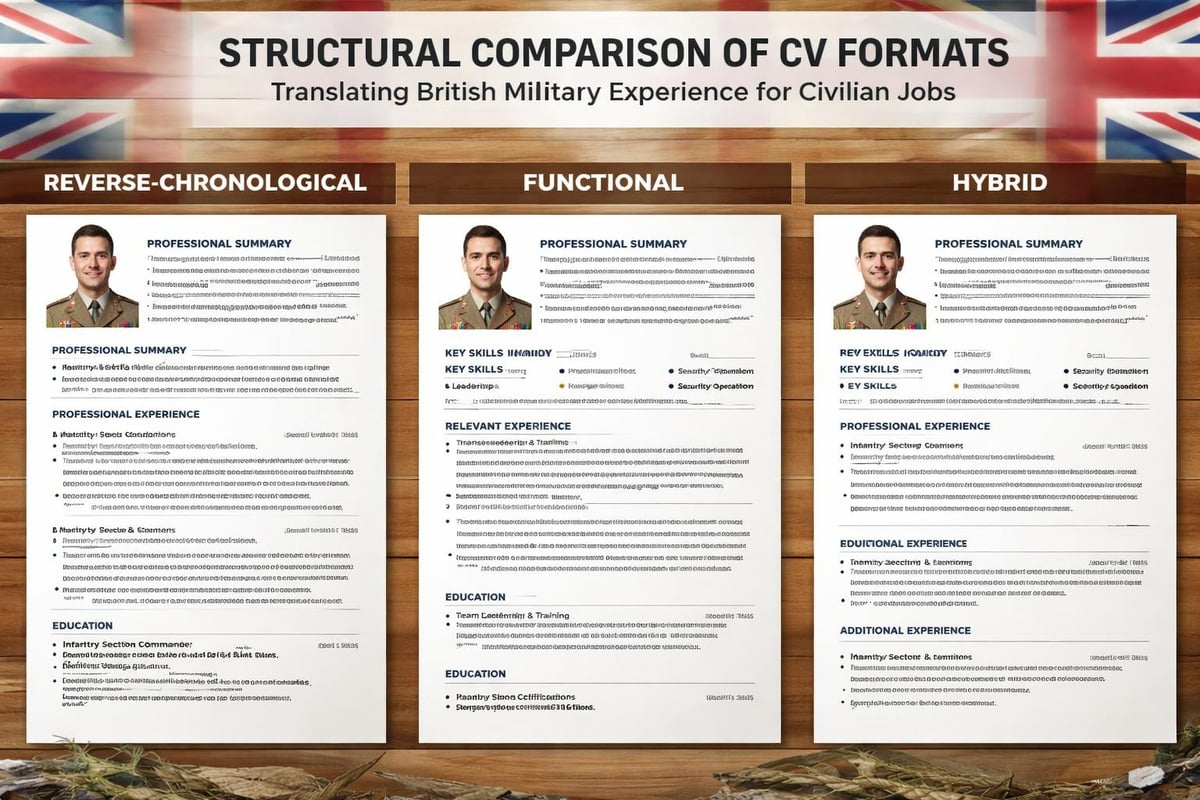
The format you select significantly impacts how employers perceive your experience. Three primary CV formats exist, but not all suit military-to-civilian transitions equally well.
The Reverse-Chronological Format
This traditional format lists your experience starting with your most recent position, working backwards. It’s the most recognised format among UK employers and works well when your military career shows clear progression and your recent roles closely align with your target civilian position.
A strong civilian CV should contain a professional profile, key skills section, professional experience, education and relevant qualifications presented in a logical and easy-to-read structure.
This format works particularly well for those transitioning into security, logistics, project management, or operations roles where military experience translates directly.
The Functional (Skills-Based) Format
This format prioritises your skills and competencies over your chronological work history. It groups your achievements under skill categories like “Leadership”, “Project Management”, “Strategic Planning”, and “Team Development” before providing a brief employment history.
The functional format can work when your military roles don’t have obvious civilian equivalents, or when your most relevant skills were developed across multiple positions rather than concentrated in your most recent role. However, many UK recruiters view this format with some suspicion, as it’s sometimes used to hide employment gaps or frequent job changes.
The Hybrid (Combination) Format
This approach combines the best elements of both formats-a strong skills summary at the top, followed by a detailed reverse-chronological employment history. For most military-to-civilian transitions, this hybrid format offers the optimal structure.
It allows you to immediately showcase your transferable skills in language civilian employers understand, whilst still providing the chronological career progression that demonstrates stability and advancement. This is the resume format for military to civilian applications that I most frequently recommend to clients making this transition.
Most military personnel benefit from a hybrid CV format that combines a strong skills summary with a reverse-chronological employment history. This approach allows transferable skills to be highlighted immediately whilst still demonstrating career progression and increasing ATS compatibility.
Translating Military Experience into Civilian Language
This translation process is where most military-to-civilian CVs fail. You need to completely reframe your experience without losing its impact or significance.
Decoding Your Military Role
Start by breaking down what you actually did, not what your military job title suggests. A “Vehicle Mechanic” might have managed a £2 million asset portfolio, led a team of 12 technicians, implemented preventive maintenance programmes that reduced downtime by 40%, and maintained 100% operational readiness across 45 vehicles. These are the elements civilian employers need to see.
Practical Translation Examples
Notice how the civilian versions eliminate jargon, add quantifiable metrics, and frame achievements in business language that resonates with commercial employers. This is where many service leavers struggle. One of the most common mistakes is relying on military terminology, acronyms and job titles that civilian employers do not understand. Another is focusing on responsibilities rather than measurable achievements. Successful military-to-civilian CVs translate experience into clear commercial value, making it easier for recruiters and ATS systems to recognise relevant skills and experience.
Structuring Your CV’s Core Sections
Each section of your resume format for military to civilian transition serves a specific purpose and requires careful consideration.
Professional Profile
Your opening profile sits directly below your contact details and provides a 4-6 line summary of who you are professionally. This isn’t the place to mention military service explicitly-instead, focus on your professional identity in civilian terms.
Effective example:
“Results-driven operations professional with 12 years of progressive leadership experience managing teams of up to 35 personnel in high-pressure, deadline-critical environments. Proven track record in project management, logistics coordination, and process improvement, delivering measurable efficiency gains and cost reductions. Strong communicator with experience training, developing, and mentoring diverse teams whilst maintaining exceptional safety and quality standards. Now seeking to leverage operational excellence and strategic planning capabilities in a civilian operations management role.”
Key Skills Section
The key skills section should highlight transferable capabilities such as leadership, strategic planning, project delivery, stakeholder engagement, risk management, communication and operational coordination. The exact skills included should align closely with the target role.
Professional Experience Section
This is where the bulk of your CV’s content lives. For each position, follow this structure:
Job Title (Civilianised) | Organisation | Dates
Brief 2-3 line overview of the role, your responsibilities, and the scale of your operation (team size, budget, geographic scope).
Key Achievements:
- Achievement one with quantifiable result
- Achievement two with quantifiable result
- Achievement three with quantifiable result
- Achievement four with quantifiable result
Focus on outcomes, not duties. “Responsible for maintaining vehicles” tells employers nothing. “Managed preventive maintenance programme for 45-vehicle fleet, reducing breakdown incidents by 43% and cutting annual maintenance costs by £28,000” demonstrates tangible value.
Education, Qualifications, and Professional Development
Military personnel often underestimate the value of their formal qualifications. List all relevant certifications, training courses, and educational achievements. Many military qualifications have direct civilian equivalents or are highly valued by employers.
Military personnel often underestimate the value of their qualifications and professional development. Alongside formal academic achievements, include any civilian-recognised certifications such as HGV licences, first aid qualifications, project management certifications and technical accreditations. Leadership training should also be presented in language that civilian employers understand, helping recruiters recognise the management and development skills gained throughout your military career. Any recent training, qualifications or ongoing professional development should also be included to demonstrate continued learning and commitment to career progression.
Optimising for Applicant Tracking Systems (ATS)
Modern recruitment relies heavily on Applicant Tracking Systems that scan CVs before human eyes ever see them. Your resume format for military to civilian applications must be ATS-friendly to succeed.
ATS-Friendly Formatting Rules
These systems parse your CV looking for keywords, qualifications, and experience that match the job specification. Poor formatting can cause the system to reject an excellent CV simply because it couldn’t read the information correctly.
ATS-friendly CVs use recognised section headings, simple formatting, standard fonts and clear document structures. Avoid graphics, text boxes and overly complex layouts that can interfere with how recruitment systems process information.
A professional CV writer with experience in military-to-civilian transitions will ensure your CV performs well with both ATS systems and human recruiters, balancing technical optimisation with compelling content.
Keyword Optimisation Strategy
Read the job specification carefully and identify key terms, required skills, and preferred qualifications. Naturally incorporate these keywords throughout your CV, particularly in your skills section and achievement bullets.
If the role emphasises “stakeholder management”, ensure this exact phrase appears in your CV where relevant to your experience. If they want “budget oversight”, use those specific words rather than “financial management” or “cost control” exclusively.
However, avoid keyword stuffing-your CV must still read naturally to human recruiters. The goal is strategic alignment with the role requirements, not gaming the system.
Addressing Common Military-to-Civilian CV Challenges
Several specific challenges arise repeatedly in military-to-civilian transitions. Understanding these helps you address them proactively.
Handling Deployment Gaps
Deployments are a normal part of military service, but they can appear as unexplained gaps in a civilian context. Address this by integrating deployments into your role descriptions rather than leaving them as separate entries.
Example approach:
“Operations Supervisor | Royal Air Force | 2019 – 2024
Including 14-month operational deployment to Middle East theatre
Led maintenance operations team of 22 personnel across UK and deployed environments, maintaining critical equipment availability…”
Demonstrating Civilian Relevance
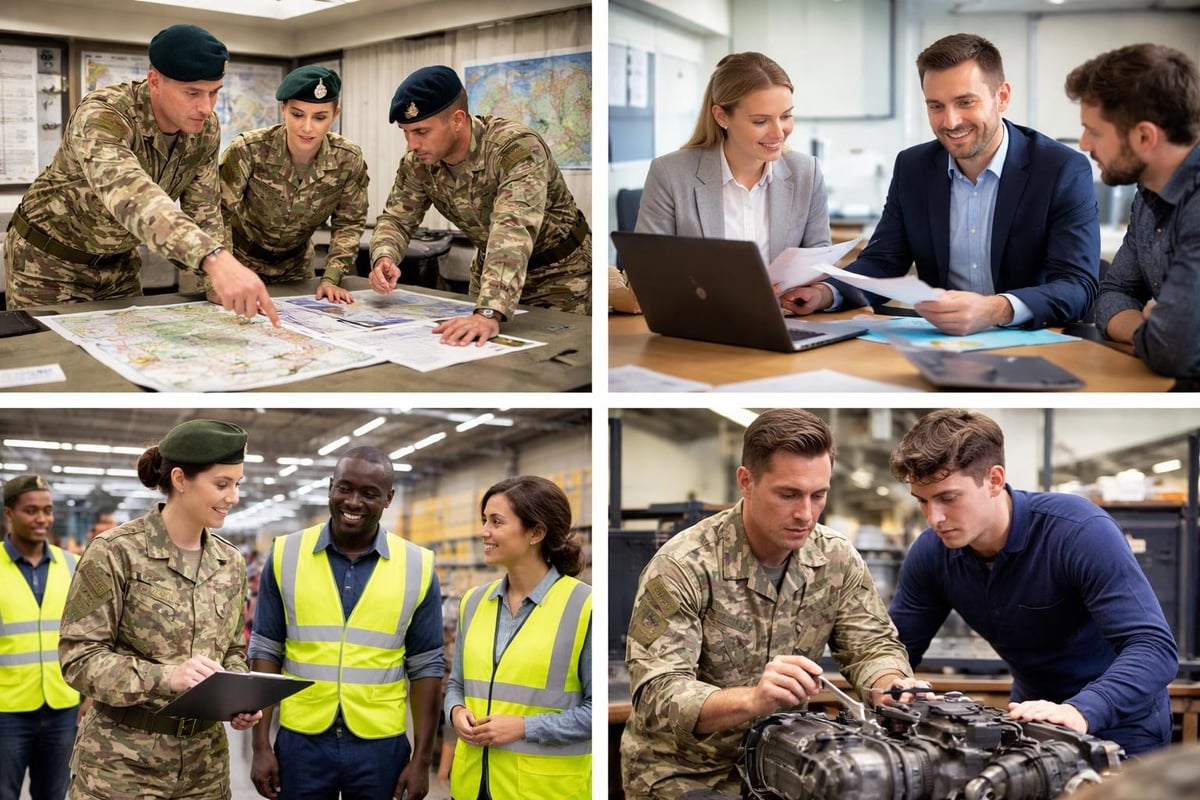
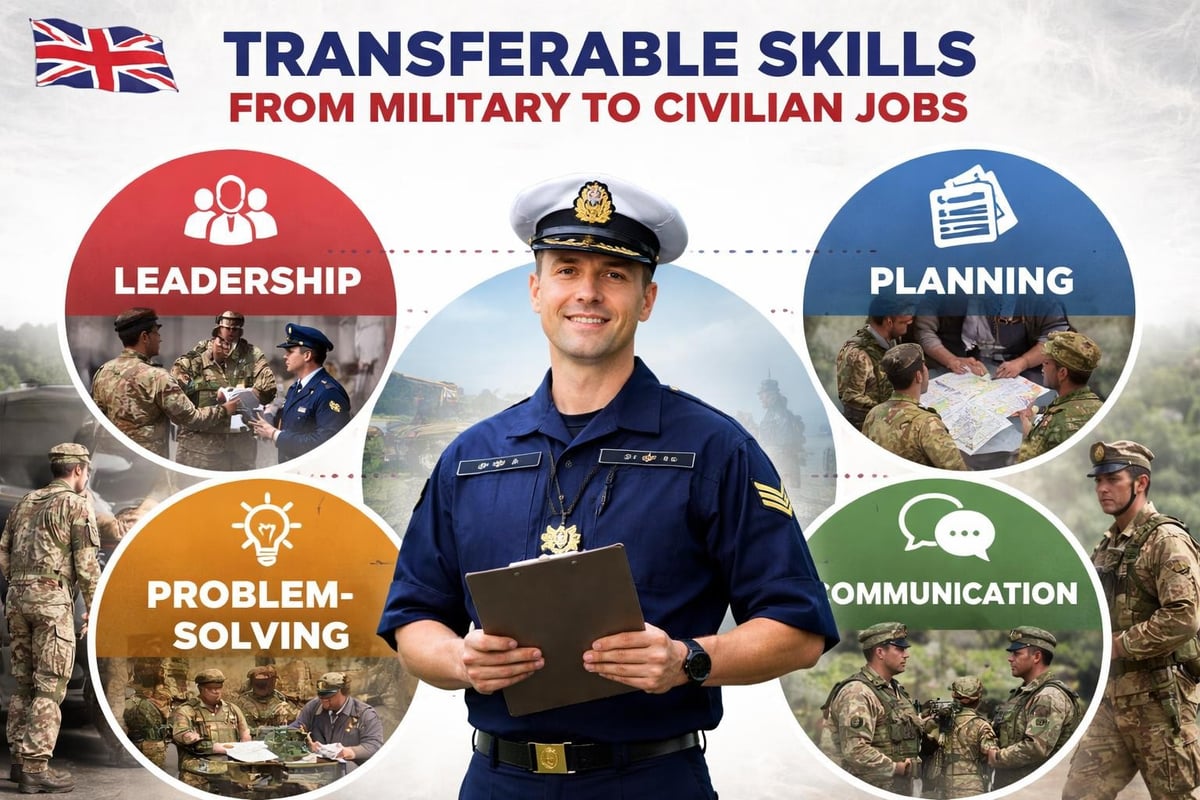
When your military role seems highly specialised, you need to extract and emphasise the universal business skills you developed. Every military role involves elements of planning, communication, teamwork, problem-solving, and working under pressure-these are exactly what civilian employers value.
Transitioning from Policing to Civilian Employment
Police officers face many of the same challenges as military personnel when moving into civilian roles. Skills such as leadership, investigation, risk management, stakeholder engagement and operational decision-making are highly transferable, but often require translation into language recognised by civilian employers and ATS systems.
A professionally written CV can help position policing experience effectively, improving visibility to recruiters and increasing interview opportunities.
Explaining Rank and Progression
Civilian employers won’t understand military rank structures, so translate these into familiar hierarchical terms. A Sergeant with 10 years’ service might be described as having “mid-level management experience”, whilst a Warrant Officer could be positioned as “senior management” or “subject matter expert”.
The key is demonstrating progression: “Advanced through four promotional levels in 12 years based on consistent performance excellence and leadership capabilities” communicates far more to civilian recruiters than listing rank progressions they don’t understand.
Tailoring Your CV for Specific Sectors
Different civilian sectors value different aspects of military experience. Your resume format for military to civilian transition should adapt accordingly.
Security and risk management employers value experience in threat assessment, incident response, compliance, investigation, operational planning and stakeholder management. Military experience often translates exceptionally well into these environments when positioned correctly.
Logistics and Supply Chain
Military logistics experience often includes inventory control, procurement, resource planning, distribution management and operational coordination. These capabilities are highly relevant to civilian supply chain and logistics roles.
Military operations frequently involve project management responsibilities including planning, resource allocation, stakeholder communication, risk management and delivery against strict deadlines. These experiences should be positioned using recognised project management terminology.
Engineering and Technical Roles
Technical military roles often provide extensive experience in diagnostics, maintenance management, technical documentation, compliance and team development. These capabilities are highly transferable to engineering and technical positions in civilian organisations.
Cover Letters for Military-to-Civilian Applications
Whilst your CV provides the facts, a well-crafted cover letter tells your story and explains your transition. Many military personnel overlook this critical document, but it provides the perfect opportunity to address potential employer concerns and demonstrate your understanding of the civilian role.
Your bespoke cover letter should acknowledge your military background whilst firmly positioning you as a serious civilian professional. Address why you’re transitioning, what attracts you to this specific sector and role, and how your military experience has uniquely prepared you for civilian success.
The cover letter is where you can add context that your CV cannot-explaining how managing equipment maintenance schedules for an armoured regiment translates directly to the fleet management role you’re pursuing, or how your experience coordinating multi-agency exercises demonstrates the stakeholder management skills the position requires.
Continuous Improvement and Professional Presentation
Your first version of a civilian CV is rarely your best. The transition from military to civilian documentation is a learning process, and refinement comes through feedback and iteration.
Seeking Professional Feedback
Before submitting applications, have your CV reviewed by someone who understands both military experience and civilian recruitment. Generic feedback from well-meaning friends and family often misses critical issues that professional CV writers immediately identify.
Testing and Refining Your Approach
Track your application success rate. If you’re sending dozens of applications without securing interviews, your CV needs work. The resume format for military to civilian transition should generate interview opportunities-if it’s not, something needs to change.
Refining a military-to-civilian CV often involves several adjustments. Language may need to be further civilianised, achievements may require stronger quantification, and content should be aligned more closely with the keywords and requirements of target roles. In many cases, transferable skills can be positioned more clearly, professional profiles strengthened and formatting improved to create a CV that performs better with both recruiters and ATS systems.
Professional Support for Your Transition
Transitioning from military service to civilian employment is challenging, but you don’t have to navigate it alone. Professional CV writers with specific experience in military-to-civilian transitions understand exactly how to position your experience for maximum impact. If you are leaving the Armed Forces, specialist Ex-Military CV support can significantly improve your chances of securing interviews.
The process starts with a detailed one-to-one consultation to understand your military background, achievements and career goals.
The investment in professional CV writing often pays for itself many times over through faster job search success, access to better opportunities, and higher salary offers. A professionally written CV that effectively translates your military experience can be the difference between months of frustrating job searching and quickly securing interviews at your target organisations.
When selecting a CV writer, look for someone who offers a consultative approach, takes time to understand your specific experience and goals, and can demonstrate success helping military personnel transition. Template-based services or automated CV builders cannot capture the nuance and complexity of your military background or position it effectively for civilian employers.
One of the biggest mistakes service leavers make is assuming civilian recruiters understand military terminology. Acronyms, ranks and operational language that are familiar within the Armed Forces often confuse hiring managers and ATS software. Another common issue is focusing on duties rather than achievements. Employers are far more interested in measurable outcomes, leadership impact and business value. Many military CVs also fail to quantify results or tailor content to a specific role, reducing their effectiveness during the application process.
Frequently Asked Questions
How long should my military-to-civilian CV be?
Your CV should typically be two pages maximum for most civilian roles in the UK. Military personnel often struggle with this because they’re accustomed to comprehensive documentation, but civilian recruiters want concise, relevant information. Focus on your most recent 10-15 years of experience and the achievements most relevant to your target role. If you have an extensive military career spanning 20+ years, prioritise recent positions and senior responsibilities whilst briefly summarising earlier roles.
Should I mention my military rank on my civilian CV?
Generally, no. Your rank means little to civilian employers and can actually create barriers by emphasising your military identity rather than your professional capabilities. Instead, translate your rank into civilian hierarchical terms. Rather than “Colour Sergeant”, describe yourself as having “mid-level management experience leading teams of 30+ personnel”. The exception is if applying to defence contractors or military-adjacent organisations where rank provides useful context.
How do I explain deployments and operational tours?
Integrate deployments naturally into your role descriptions rather than listing them separately. Frame them as project assignments or challenging operational periods where you demonstrated specific skills. For example: “Led maintenance operations across UK and deployed environments including 12-month Middle East operational tour, maintaining equipment readiness in austere conditions.” This approach demonstrates adaptability and resilience without requiring civilian employers to understand military operational contexts.
What if my military role has no obvious civilian equivalent?
Focus on the transferable skills and responsibilities rather than the job title itself. Break your role down into its core components: Were you managing people? Coordinating resources? Solving technical problems? Planning and executing complex activities? These elements exist in countless civilian roles. Research civilian job titles that involve similar responsibilities and use those as your position descriptor. A “Reconnaissance Troop Leader” might become “Field Operations Team Leader”, whilst “Stores Accountant” translates directly to “Inventory Manager”.
How important is keyword optimisation for military-to-civilian CVs?
Extremely important. Applicant Tracking Systems scan your CV for specific keywords and phrases from the job specification. Without proper keyword alignment, your CV may never reach a human reviewer regardless of how qualified you are. Carefully analyse each job posting, identify key requirements and preferred terminology, then ensure those exact phrases appear naturally throughout your CV. However, balance this with readability-your CV must engage human readers once it passes the ATS screening. For expert help with ATS optimisation whilst maintaining compelling content, contact John@johnloganbmc.co.uk for professional guidance.
What Clients Say
Many service leavers initially struggle to explain the value of their military experience to civilian employers. Through one-to-one consultation and bespoke CV development, clients regularly secure interviews, promotions and successful career transitions across a wide range of industries.
Read my client testimonials to see how military personnel have successfully moved into rewarding civilian careers.
Ready to Translate Your Military Experience into Civilian Success?
Your military career has equipped you with leadership, resilience, planning, problem-solving and operational expertise that civilian employers value highly. The challenge is presenting that experience in a way that recruiters immediately understand.
I work with service leavers across the UK through detailed one-to-one consultation, creating bespoke CVs that improve ATS performance, strengthen personal branding and increase interview opportunities.
Learn more about my Professional CV Writing Service, read my client testimonials and discover how a professionally written CV can support your transition into civilian employment.