

[et_pb_section fb_built=”1″ _builder_version=”4.16″ global_colors_info=”{}” theme_builder_area=”post_content”][et_pb_row _builder_version=”4.16″ background_size=”initial” background_position=”top_left” background_repeat=”repeat” global_colors_info=”{}” theme_builder_area=”post_content”][et_pb_column type=”4_4″ _builder_version=”4.16″ custom_padding=”|||” global_colors_info=”{}” custom_padding__hover=”|||” theme_builder_area=”post_content”][et_pb_text _builder_version=”4.27.6″ background_size=”initial” background_position=”top_left” background_repeat=”repeat” hover_enabled=”0″ global_colors_info=”{}” theme_builder_area=”post_content” sticky_enabled=”0″]

text][et_pb_button button_url=”https://johnloganbmc.co.uk/contact-john-logan-cv-writer/” button_text=”Contact” admin_label=”Button” _builder_version=”4.27.4″ _module_preset=”default” global_colors_info=”{}” theme_builder_area=”post_content”]button][et_pb_text admin_label=”Text” _builder_version=”4.27.6″ background_size=”initial” background_position=”top_left” background_repeat=”repeat” hover_enabled=”0″ global_colors_info=”{}” theme_builder_area=”post_content” sticky_enabled=”0″]
Send me your CV for a free review to John@johnlogan.co.uk. I’ll look through it myself and give you honest, constructive feedback as a professional CV writer.
Transitioning from military service to civilian employment represents one of the most significant career changes you’ll ever make. The challenge isn’t a lack of skills or experience; rather, it’s presenting your military background in language that civilian hiring managers and Applicant Tracking Systems (ATS) can immediately understand and value. A well-crafted military to civilian resume sample provides the blueprint for this transformation, showing you exactly how to translate ranks, responsibilities, and achievements into terms that resonate with employers outside the armed forces. Whether you served in the British Army, Royal Navy, Royal Air Force, or Royal Marines, your military experience has equipped you with transferable skills that civilian organisations desperately need. The key lies in articulating these competencies effectively.
Understanding the Core Differences Between Military and Civilian CVs
Military documentation follows a standardised format with specific terminology, acronyms, and hierarchical structures that make perfect sense within the defence community but can confuse civilian recruiters. Your military records detail courses, postings, and operational experience using language designed for internal use, not external job applications.
Civilian employers expect CVs that immediately highlight relevant achievements, quantifiable results, and skills that directly relate to their industry. They want to see commercial awareness, project outcomes, and leadership impact expressed in familiar business language. According to Kings College comprehensive guide, the most successful military-to-civilian transitions happen when veterans completely reframe their experience through the civilian employer’s lens.
The formatting expectations differ considerably as well:
- Military records often run multiple pages with comprehensive detail
- Civilian CVs typically condense everything to two pages maximum
- Military documents list duties and responsibilities
- Civilian CVs emphasise achievements and measurable outcomes
- Defence terminology uses ranks, units, and military-specific language
- Commercial CVs use job titles, departments, and industry-standard vocabulary
Translating Military Terminology Into Civilian Language
The single most critical element in any military to civilian resume sample is the effective translation of military jargon into language that civilian hiring managers recognise immediately. This doesn’t mean diminishing your experience; it means making it accessible and relevant.
Rank and Position Translation
Your military rank carried authority and responsibility, but civilian employers need to understand what that meant in practical terms. Rather than listing “Sergeant” or “Petty Officer,” describe the leadership scope and management responsibilities those positions entailed.
For example, a Sergeant who supervised fifteen soldiers and managed logistics for a battalion becomes “Operations Supervisor managing a team of 15 personnel and coordinating logistics for a 600-person organisation.” A Squadron Leader overseeing aircraft maintenance transforms into “Maintenance Manager directing technical teams ensuring operational readiness of £50M+ assets.”
Skills and Competencies Reframing
Military training develops exceptional competencies that transfer directly to civilian roles, but you must articulate them appropriately. The Pathfinders Career Centre guidance emphasises focusing on transferable skills rather than military-specific capabilities.
| Military Skill | Civilian Translation |
|---|---|
| Led combat operations | Crisis management and strategic planning under pressure |
| Weapons maintenance | Technical systems management and preventative maintenance |
| Intelligence analysis | Data analysis, risk assessment, and reporting |
| Training delivery | Staff development, coaching, and competency building |
| Resource management | Budget oversight, procurement, and inventory control |
Achievements and Accomplishments
Every role you held involved accomplishments that demonstrate your value to potential employers. The military to civilian resume sample that stands out quantifies these achievements using metrics that civilian hiring managers appreciate.
Instead of “Responsible for vehicle fleet,” write “Managed fleet of 45 vehicles valued at £2.5M, achieving 98% operational readiness whilst reducing maintenance costs by 15% through improved scheduling systems.” Rather than “Conducted training,” specify “Designed and delivered safety training programme for 200+ personnel, resulting in zero safety incidents over 18-month deployment.”
Structuring Your Military to Civilian CV for Maximum Impact
The structure of your CV significantly influences how quickly a hiring manager grasps your suitability for their role. Unlike military records that follow predetermined formats, civilian CVs should be strategically organised to highlight your strongest selling points immediately.
Professional Profile Section
Begin with a powerful professional profile that positions you as the solution to civilian employer needs. This 3-4 sentence paragraph replaces the traditional “objective” statement and immediately establishes your value proposition.
A strong profile for a logistics professional might read: “Results-driven logistics professional with 12 years’ experience managing complex supply chains, leading cross-functional teams of up to 30 personnel, and coordinating operations across multiple locations. Proven track record delivering projects on time and within budget whilst maintaining exceptional safety standards. Expertise in inventory management, process optimisation, and vendor relationship management.”
Experience Section Best Practices
Your experience section requires the most careful attention when creating a military to civilian resume sample. Each position should include a civilian-friendly job title, the organisation (translated appropriately), dates of service, and achievement-focused bullet points.
When translating your service, consider how veteran resume guide recommends presenting military organisations in civilian terms. “British Army, 3rd Battalion, The Rifles” becomes “British Army, Infantry Battalion (600-person organisation)” or simply “Ministry of Defence.”
Structure each bullet point to emphasise results:
- Started with an action verb (managed, delivered, developed, coordinated)
- Described the scope of responsibility
- Quantified the achievement where possible
- Highlighted the positive outcome or benefit
For instance: “Coordinated medical logistics across four forward operating bases, managing £1.2M inventory and ensuring 100% supply availability during 12-month deployment, directly supporting operational effectiveness for 800+ personnel.”
ATS Optimisation for Military-to-Civilian CVs
Applicant Tracking Systems scan CVs before human eyes ever see them, making ATS optimisation essential for military veterans entering the civilian job market. Understanding how these systems work helps you craft a military to civilian resume sample that passes digital screening.
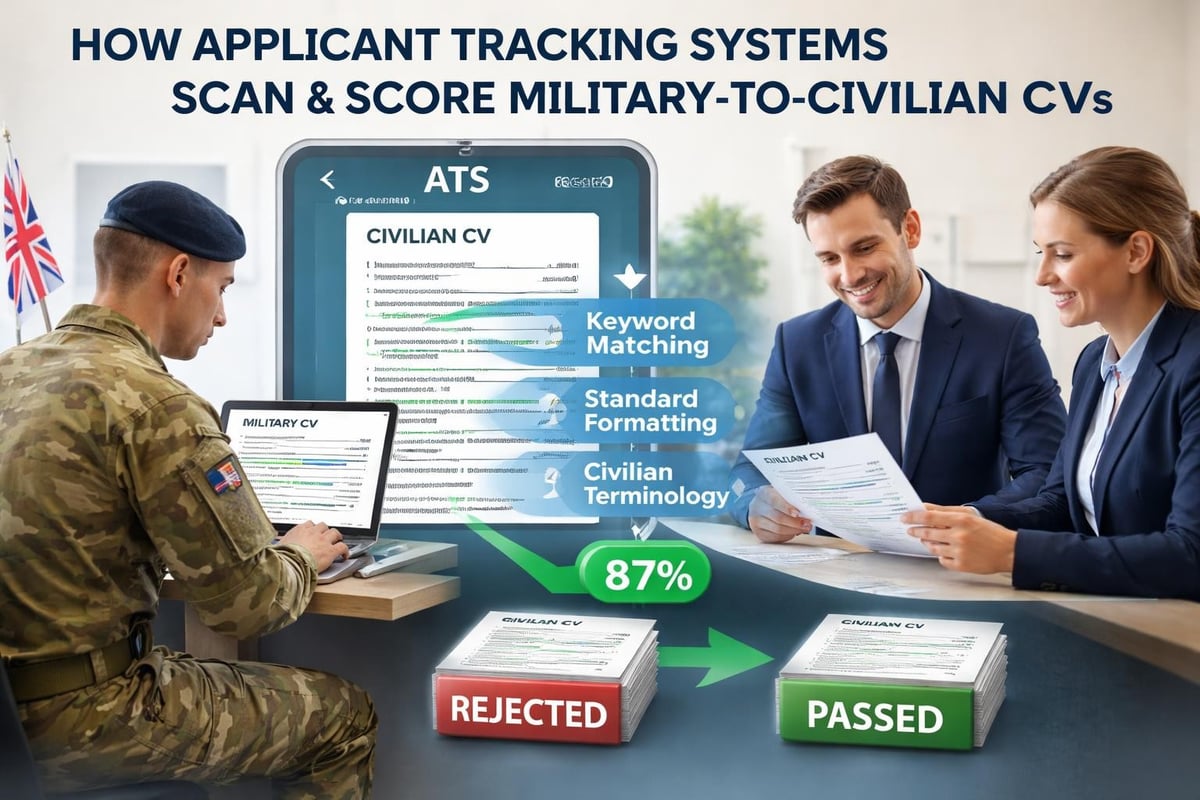
ATS software searches for specific keywords matching the job description, scans for standard section headings, and ranks candidates based on relevance scores. Military terminology often fails to match civilian job requirements, causing qualified veterans to be filtered out before their applications reach hiring managers.
Keyword Integration Strategies
Study the job description carefully and identify the skills, qualifications, and experience they emphasise. Incorporate these exact terms throughout your CV where truthful and relevant. If the job description mentions “project management,” “stakeholder engagement,” and “budget oversight,” ensure these phrases appear in your experience descriptions where applicable.
However, avoid keyword stuffing that makes your CV read unnaturally. The military-to-civilian guide demonstrates how to weave keywords organically into achievement statements whilst maintaining readability for human reviewers.
Formatting Considerations
ATS systems struggle with complex formatting, tables, graphics, and unusual fonts. Keep your military to civilian resume sample clean and simple:
- Use standard section headings (Professional Experience, Education, Skills)
- Stick to common fonts like Arial, Calibri, or Times New Roman
- Avoid headers, footers, text boxes, and columns
- Save as .docx format unless specifically requested otherwise
- Use bullet points rather than paragraphs for experience details
Real Military to Civilian Resume Sample Analysis
Examining actual examples helps clarify the translation process. Let’s analyse how different military roles convert into compelling civilian CVs.
Infantry Leader to Operations Manager
A Colour Sergeant with the British Army who led infantry sections and platoons possesses direct experience in leadership, planning, risk management, and performance under pressure. The Military sample resume demonstrates how combat leadership translates to operational management roles.
Military Description: Colour Sergeant, 2nd Battalion The Parachute Regiment, 2015-2026
Civilian Translation: Operations Team Leader, Ministry of Defence (2015-2026)
| Military Responsibility | Civilian Achievement Statement |
|---|---|
| Led platoon operations | Directed teams of 30+ personnel in complex operational environments, achieving 100% mission success rate across 15 major projects |
| Conducted risk assessments | Developed and implemented comprehensive risk management frameworks, reducing incident rates by 35% year-on-year |
| Managed equipment worth £500K | Oversaw asset management for equipment valued at £500K+, maintaining 99% operational readiness through preventative maintenance programmes |
Communications Specialist to IT Professional
A Royal Signals Communications Systems Engineer brings technical expertise, problem-solving capabilities, and systems management experience that aligns perfectly with civilian IT roles. According to Resumeble’s military transition examples, technical military roles often translate most directly to civilian equivalents.
Key Achievements to Highlight:
- Designed, installed, and maintained complex communications networks
- Provided technical support and troubleshooting to end-users
- Managed cybersecurity protocols and information assurance
- Coordinated with vendors and contractors on system upgrades
- Trained personnel on new technologies and systems
The CV should emphasise certifications, technical competencies, and project delivery whilst removing military-specific references to tactical communications or defence systems unless applying to defence contractors.
Royal Navy Logistics Officer to Supply Chain Manager
Naval logistics officers manage sophisticated supply chains under challenging conditions, coordinating procurement, inventory, distribution, and vendor management. These competencies directly transfer to civilian supply chain and logistics management positions.
A compelling military to civilian resume sample for this transition would emphasise:
- Strategic planning and forecasting based on operational requirements
- Vendor management and procurement expertise handling millions in contracts
- Inventory control systems managing diverse product ranges
- Team leadership directing logistics personnel across multiple locations
- Process improvement implementing efficiencies that reduced costs or improved service
Quantifiable achievements might include percentage improvements in delivery times, cost savings achieved through better vendor negotiations, or inventory accuracy improvements through new systems implementation.
Addressing Common Challenges in Military Transition CVs
Veterans often encounter specific challenges when translating their service into civilian CVs. Understanding these obstacles helps you create a more effective military to civilian resume sample.
Employment Gaps and Short-Term Postings
Military service involves frequent postings, deployments, and training periods that can appear as gaps or job-hopping to civilian recruiters unfamiliar with defence career patterns. Address this by grouping related positions under a single employer (Ministry of Defence or your service branch) and explaining progression through increasingly responsible roles.
Rather than listing each posting separately, consider this approach:
British Army (2014-2026)
Senior Operations Coordinator (2022-2026) Details of most recent role…
Operations Supervisor (2018-2022) Details of previous role…
Team Leader (2014-2018) Details of early career…
This format demonstrates career progression whilst avoiding the appearance of frequent job changes. The military resume resources provides additional strategies for presenting military career timelines effectively.
Balancing Technical Detail With Accessibility
You possess deep technical knowledge in your military specialisation, but civilian employers may not understand the specifics. Strike a balance between demonstrating expertise and maintaining accessibility.
When you managed complex defence systems, focus on the transferable competencies: technical troubleshooting, preventative maintenance scheduling, regulatory compliance, documentation standards, and team training. Mention specific systems only when directly relevant to the civilian role you’re pursuing.
Overcoming the “Overqualified” Perception
Some veterans worry that extensive military experience might make them appear overqualified for entry or mid-level civilian positions. Your CV should be tailored to each application, emphasising the experience most relevant to that specific role whilst de-emphasising aspects that might trigger overqualification concerns.
If you’re a former Warrant Officer applying for a supervisory position rather than senior management, focus your CV on team leadership, operational delivery, and technical skills rather than strategic planning and organisational leadership. This approach, recommended by professional CV writing services, ensures your application matches the role’s requirements without appearing excessive.
Essential Sections Beyond Experience
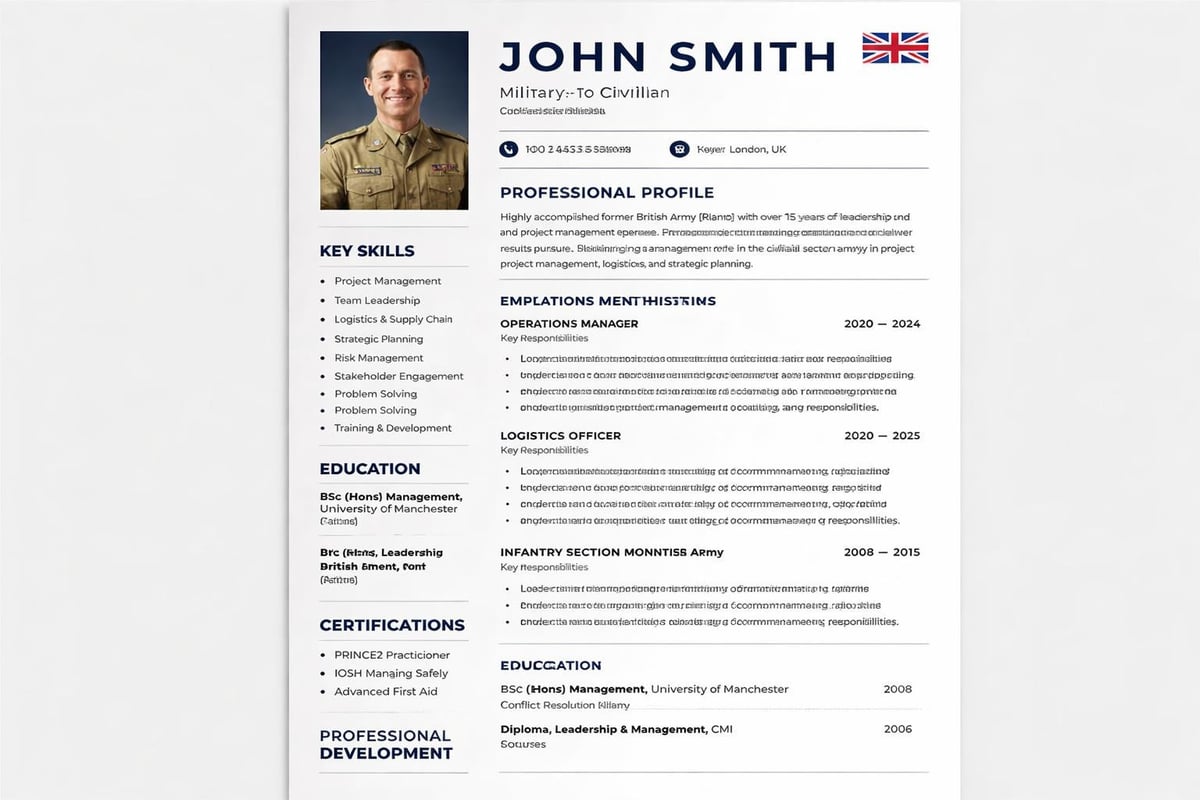
A complete military to civilian resume sample includes several sections beyond your professional experience that strengthen your application and provide context civilian employers need.
Education and Professional Development
List your educational qualifications using civilian terminology. Military training courses should be translated into recognisable certifications or described by their civilian equivalent competencies.
Instead of “Junior Command and Staff Course,” write “Leadership and Management Development Programme (equivalent to Level 5 ILM Leadership qualification).” Rather than listing every military course, select those most relevant to civilian employers:
- Leadership and management training
- Technical certifications (especially if industry-recognised)
- Health and safety qualifications
- Project management training
- Specialist technical courses with civilian applications
Skills Section
Create a skills section that highlights your most marketable competencies using terminology from civilian job descriptions. Review multiple job postings in your target field and note which skills appear repeatedly, then ensure these feature prominently in your skills section where genuinely applicable.
Effective skills sections might include:
Leadership & Management: Team building, performance management, coaching and mentoring, conflict resolution, change management
Operations: Process improvement, project coordination, risk management, quality assurance, compliance monitoring
Technical: Relevant software, systems, or equipment knowledge using civilian-recognised names
Cover Letters for Military Transitions
Whilst your CV does the heavy lifting of presenting your experience, a well-crafted cover letter provides context for your transition and demonstrates your understanding of the civilian role. Each bespoke cover letter should address why you’re leaving military service, why you’re interested in this specific role, and how your background uniquely qualifies you for the position.
Your cover letter offers space to explain the narrative that your CV cannot: your motivation for transitioning, your understanding of the civilian sector, and your commitment to building a long-term civilian career. This personal touch helps hiring managers see beyond the military background to the capable professional you are.
Frequently Asked Questions
How long should my military to civilian CV be?
Your CV should typically be two pages maximum, regardless of your length of service. Civilian employers expect concise, focused CVs that highlight relevant experience rather than comprehensive service records. Prioritise your most recent and relevant roles, and summarise earlier positions more briefly. If you’ve served for 20+ years, you don’t need to detail every posting; focus on the last 10-15 years and positions most relevant to your target civilian role.
Should I include my military rank on my CV?
Generally, no. Your rank means little to civilian employers unfamiliar with military hierarchy. Instead, translate your rank into a civilian-equivalent job title that conveys your level of responsibility. However, if you’re applying to defence contractors, government positions, or organisations that specifically value military experience, you might include your rank alongside the civilian translation. The key is ensuring the hiring manager immediately understands your level of seniority and scope of responsibility.
How do I explain deployments and operational tours?
Frame deployments as project assignments or operational postings rather than combat tours. Focus on what you accomplished, the challenges you overcame, and the skills you demonstrated. For example: “Deployed to challenging operational environment as Logistics Coordinator, managing supply chain for 500+ personnel across multiple locations whilst maintaining 99% equipment availability under resource constraints.” This approach highlights relevant competencies without dwelling on military-specific combat experiences that may not translate directly to civilian contexts.
What if I have no civilian work experience at all?
Military service is work experience, it simply needs proper translation. Your military career provided you with professional experience in leadership, project management, technical skills, administration, or whatever your specialisation involved. The military to civilian resume sample approach treats your service as professional employment, which it absolutely was. Additionally, highlight any volunteer work, part-time employment during service, or civilian certifications you’ve obtained. Many veterans successfully transition with no prior civilian employment by effectively presenting their military achievements in civilian terms.
How important is ATS optimisation for military veterans?
Extremely important. Many qualified veterans are filtered out by ATS systems because their CVs contain military jargon that doesn’t match civilian job descriptions. Optimising your CV with relevant keywords from the job posting, using standard section headings, and avoiding complex formatting significantly improves your chances of passing ATS screening. According to research, up to 75% of CVs never reach human reviewers due to ATS filtering, making optimisation essential rather than optional for military-to-civilian transitions.
Tailoring Your CV for Specific Industries
Different civilian sectors value different aspects of your military experience. A successful military to civilian resume sample recognises these variations and adapts accordingly.
Corporate and Business Roles
When targeting corporate positions in management, operations, or business development, emphasise:
- Leadership and team management experience
- Budget oversight and financial responsibility
- Strategic planning and execution
- Stakeholder management and relationship building
- Process improvement and efficiency gains
- Performance management and staff development
Use business terminology throughout. Your platoon becomes your team. Your commanding officer becomes your senior management. Your operations order becomes your project plan.
Technical and Engineering Positions
For technical roles, highlight:
- Specific technical qualifications and certifications
- Systems management and maintenance experience
- Troubleshooting and problem-solving capabilities
- Technical documentation and reporting
- Compliance with standards and regulations
- Project delivery within specifications and deadlines
Include details of relevant systems, equipment, or technologies you’ve worked with, particularly if they have civilian equivalents or applications.
Public Sector and Emergency Services
When applying to police, fire services, NHS, or civil service positions, your military background may be particularly valued. However, you still need to translate your experience appropriately:
- Emergency response and crisis management
- Multi-agency coordination and cooperation
- Community engagement and public service
- Regulatory compliance and procedure adherence
- Risk assessment and safety management
- Incident investigation and reporting
These sectors often include veterans in their workforce and may have specific veteran hiring programmes, but your application still needs professional presentation using appropriate civilian language.
Logistics and Supply Chain
Your military logistics experience directly transfers to civilian supply chain management. Emphasise:
- End-to-end supply chain oversight
- Inventory management and stock control
- Procurement and vendor management
- Distribution and warehousing operations
- Transport coordination and fleet management
- Systems implementation and process optimisation
Quantify your achievements in terms civilian employers recognise: cost savings percentages, delivery time improvements, inventory accuracy rates, and efficiency gains.
Next Steps After Creating Your CV
Once you’ve developed your military to civilian resume sample, several additional steps maximise your job search effectiveness. Professional CV writing support can make a significant difference, as expert writers understand exactly what civilian employers seek and how to position your military background most effectively.
Review your CV critically, ideally with someone experienced in civilian hiring. Better yet, contact professional services that specialise in military transitions. Send your CV to John@johnloganbmc.co.uk for expert feedback from someone who understands both military experience and civilian employer expectations.
Prepare thoroughly for interviews by practising how you’ll discuss your military experience in civilian terms. Anticipate questions about your transition motivation, your understanding of civilian workplace culture, and how your military skills apply to the specific role. Develop concrete examples that demonstrate your capabilities using the STAR method (Situation, Task, Action, Result).
Network actively within your target industry. Many veterans successfully transition through connections made at networking events, industry associations, or veteran employment programmes. Your military experience demonstrates reliability, discipline, and capability; you simply need opportunities to prove it in civilian contexts.
Continue developing civilian-recognised qualifications and skills. Industry certifications, management qualifications, or technical training relevant to your target sector strengthen your applications and demonstrate commitment to your new career direction.
Professional Support for Military Transitions
Creating an effective military to civilian resume sample requires understanding both military experience and civilian employer expectations. Professional CV writers specialising in military transitions bring this dual perspective, helping you present your background in the most compelling way possible.
The investment in professional CV writing often pays for itself through faster job placement and higher-level positions. Expert writers know which achievements resonate with civilian employers, how to optimise for ATS systems, and how to structure your CV for maximum impact. They translate your military experience into powerful civilian career credentials that open doors.
Successfully transitioning from military service to civilian employment begins with a CV that effectively translates your valuable experience into language civilian employers immediately understand and appreciate. The strategies, examples, and insights in this guide provide the foundation for creating your compelling application materials, but personalised professional support often makes the difference between applications that get overlooked and those that lead to interviews. John Logan Consulting and Mentoring specialises in helping military veterans craft bespoke, ATS-optimised CVs that position your service experience as the competitive advantage it truly is, with no templates or shortcuts, just professional expertise dedicated to your successful transition.
Send me your CV for a free review to John@johnlogan.co.uk. I’ll look through it myself and give you honest, constructive feedback as a professional CV writer.
text][et_pb_button button_url=”https://johnloganbmc.co.uk/cv-packages/” button_text=”Pricing and Packages” _builder_version=”4.27.4″ _module_preset=”default” global_colors_info=”{}” theme_builder_area=”post_content”]button][et_pb_button button_url=”https://johnloganbmc.co.uk/john-logan-cv-reviews/” button_text=”Reviews” _builder_version=”4.27.4″ _module_preset=”default” global_colors_info=”{}” theme_builder_area=”post_content”]button][et_pb_button button_url=”https://johnloganbmc.co.uk/contact-john-logan-cv-writer/” button_text=”Contact” _builder_version=”4.27.4″ _module_preset=”default” global_colors_info=”{}” theme_builder_area=”post_content”]button]column]row]section]